










Laxmi Dental targets hybrid US lab while retaining India work
Key highlights
- Laxmi Dental's international laboratory business grew 32% year on year in Q2 FY27, versus 15% growth in domestic laboratories.
- Laxmi Dental said potential overseas laboratories would retain digital and labour-intensive work in India while completing selected physical work locally.
- Laxmi Dental disclosed no location, capacity, investment amount or opening date for a potential US laboratory.
- Laxmi Dental plans to use Rs 48.1 crore of unutilised initial public offering proceeds across FY27 and FY28 for domestic manufacturing infrastructure and equipment.
powered by IRIS
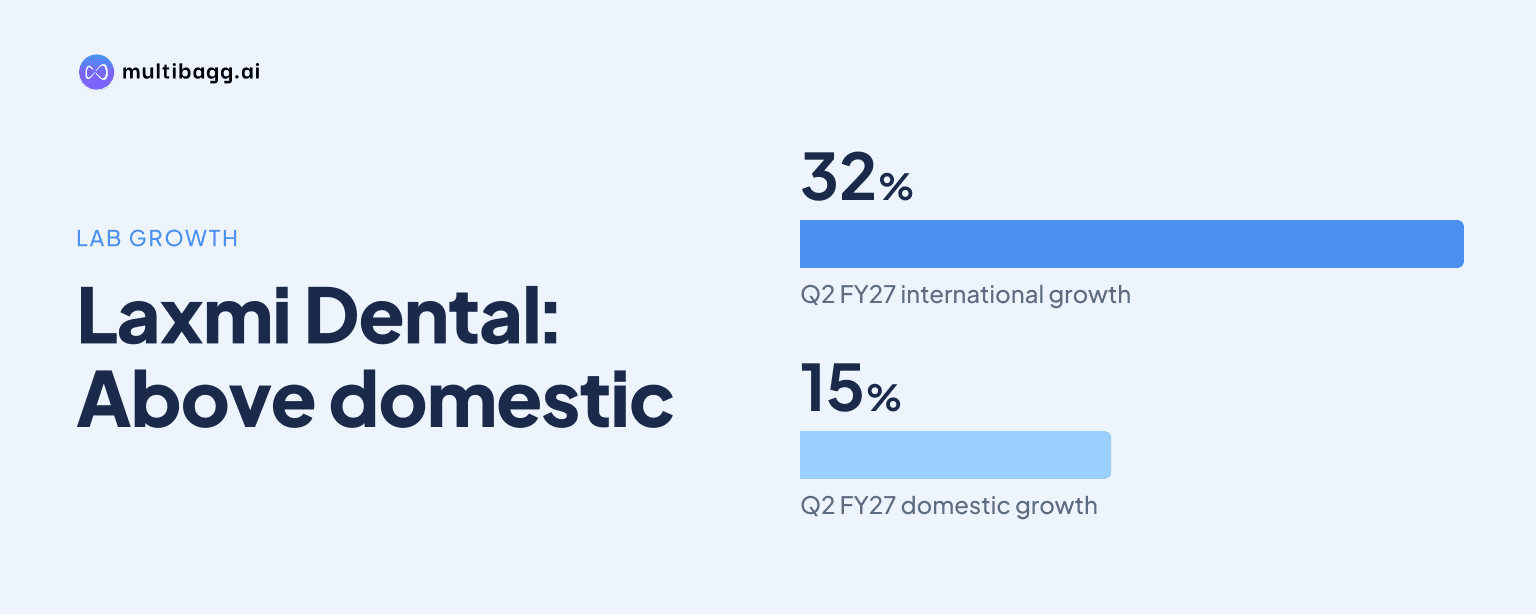
Laxmi Dental is evaluating a potential US laboratory that would retain digital design and labour-intensive production in India while completing urgent physical work and selected finished products locally, after its international laboratory business grew 32% year on year in Q2 FY27. Management has not disclosed a site, investment, capacity or launch date.
Know Laxmi Dental inside out
Results, valuation, peers and who's buying, in one view.
Is Laxmi Dental opening a laboratory in the US?
Laxmi Dental is evaluating a US laboratory but has not made a committed announcement on its location, capital expenditure, capacity or opening date. Management said it had appointed a chief executive officer in the US, was building a team and had the ability to create a semi-automated laboratory there. It said shareholders would be updated as plans develop.
The potential US operation follows faster growth in the international laboratory business than in the domestic laboratory business during Q2 FY27. Total dental laboratory business grew 22.7% year on year, comprising 32% growth in international laboratories and 15% growth in domestic laboratories. Management attributed international momentum to relationships and market presence in the US, the UK and Europe.
Laxmi Dental uses different international routes for standard and custom products. For standard products, including Taglus under Vedia Solutions and Kids-e-Dental products, it uses business-development personnel and distributors that sell to dentists or aligner companies. For custom products, including aligners and zirconia crowns, management said the objective is to work with chains of dental clinics in overseas markets.
Laxmi Dental said it is present in about 90 to 100 countries, depending on the product line, and its international receivable terms are generally 30, 45 or 60 days. The company said most small products are transported by air, with only a small portion moving by sea. These arrangements support existing exports but do not provide a local solution for cases requiring immediate physical intervention.
How would Laxmi Dental's hybrid overseas laboratory work?
Laxmi Dental said a future overseas laboratory would be a hybrid operation, not a full replica of its Mumbai production setup. Job entry, design and much customer communication would remain in India, while local facilities would undertake physical work that requires in-person intervention. Management said local work could use semi-automation, computer numerical control machines and three-dimensional printing equipment.
The overseas facilities would focus on finished products, principally zirconia crowns, aligners and retainers, according to management. Laxmi Dental said it does not currently need multiple overseas sites for standard products such as sheets because it can manufacture them in India and supply global markets. Management cited a 50,000-square-foot Indian facility used for sheet manufacturing.
Laxmi Dental said labour-intensive work would continue in India, while overseas sites would handle the more automated parts of manufacturing and physical requirements. A local laboratory could therefore make crowns as well as aligners and retainers, rather than operate only as a crown facility. Management did not disclose the expected mix between India-based and overseas production stages.
The company also did not provide economics, staffing levels, automation levels or expected margins for the potential US laboratory. Management described overseas laboratories as part of a medium- to long-term strategy and said it would disclose the planned capacity, size, market opportunity and intended build-out when a specific project is ready.
Got a follow-up? Ask IRIS
Why does Laxmi Dental want overseas laboratory capacity?
Laxmi Dental said a local laboratory can support rush cases, urgent interventions and products that need to be repaired quickly and cannot wait to travel from Mumbai. Management said this proximity gives dentists greater confidence and could increase the share of their spending with Laxmi Dental. It used the same reasoning to explain its hub-and-spoke model in India.
Under that domestic model, a dentist sending work to Mumbai could also use a smaller laboratory in a city such as Hyderabad while retaining a single billing relationship and key account contact. Management said its internal dashboards show higher wallet share from the same dentist after a spoke opens, although it did not disclose a numerical increase. Domestic digital penetration was about 78% in Q2 FY27, against a medium-term target above 90%.
Management said an overseas domestic centre could expand its relationship with customers that currently use Laxmi Dental only for outsourced production. The proposed model would allow a local laboratory to supply finished aligners, retainers and zirconia products while India retains digital processing and labour-intensive activity. This was management's stated service rationale, not a revenue or margin forecast.
The strategy addresses a limitation of air-based exports for urgent cases. Laxmi Dental said most products are small enough to be shipped by air, but management did not quantify current delivery times or the turnaround-time benefit of a US facility. The operating benefit therefore remains a stated objective rather than a reported outcome.
What has Laxmi Dental disclosed about investment and capacity?
Laxmi Dental has not allocated a budget for an overseas laboratory, and its separate Indian infrastructure programme should not be treated as funding for a US facility. Shareholders approved the use of Rs 48.1 crore of unutilised initial public offering proceeds across FY27 and FY28. More than Rs 27 crore is intended for land, building construction and infrastructure, while more than Rs 21 crore is for machinery, computer equipment and other movable assets.
That programme relates to a self-owned, horizontally integrated Indian facility intended to replace multiple leased and vertically structured units in Mira Road. Management said the transition would occur gradually to avoid disruption and is expected to be completed by the end of FY28. At the time of the call, land had not been acquired.
Management indicated that the proposed Indian facility could span about 1.25 lakh to 1.5 lakh square feet, compared with its current 35,000 to 40,000 square feet. It said the larger facility could be around three to 3.5 times the present size, although detailed capacity calculations would follow equipment installation. Laxmi Dental said its domestic aligner products would be sold under its own brand rather than white-labelled in India.
Laxmi Dental reported cash, bank balances, fixed deposits and other investments of Rs 97 crore as of September 30, 2026, after capital expenditure of about Rs 16.7 crore in H1 FY27. In Q2 FY27, revenue from operations reached Rs 79.5 crore and earnings before interest, tax, depreciation and amortisation were Rs 15.3 crore. Management did not link either figure to a potential US laboratory investment.
Conclusion
Laxmi Dental's disclosed international expansion approach combines India-based digital and labour-intensive work with overseas facilities for selected finished products and urgent physical requirements. The model follows 32% year-on-year growth in international laboratory business in Q2 FY27, compared with 15% growth in the domestic laboratory business, but it does not yet constitute a committed US project.
The next disclosures to watch are the location, capacity, cost and timing of any US laboratory, which management said it would share when plans are ready. Management's FY27 and FY28 domestic infrastructure programme also remains relevant because land acquisition, construction and the planned Mira Road transition by the end of FY28 would expand the India-based production platform supporting the hybrid model.