










Laxmi Dental links scanner subscriptions to monthly business
Key highlights
- Laxmi Dental requires Rs 25,000 of monthly business for every subscription scanner.
- The scanner subscription requires a Rs 50,000 deposit and a Rs 3,000 monthly fee plus GST.
- Management said 1,000 scanners meeting the threshold would represent Rs 2.5 crore of monthly business.
- Laxmi Dental said 78% of its network is digital, against a 90% to 95% target.
powered by IRIS
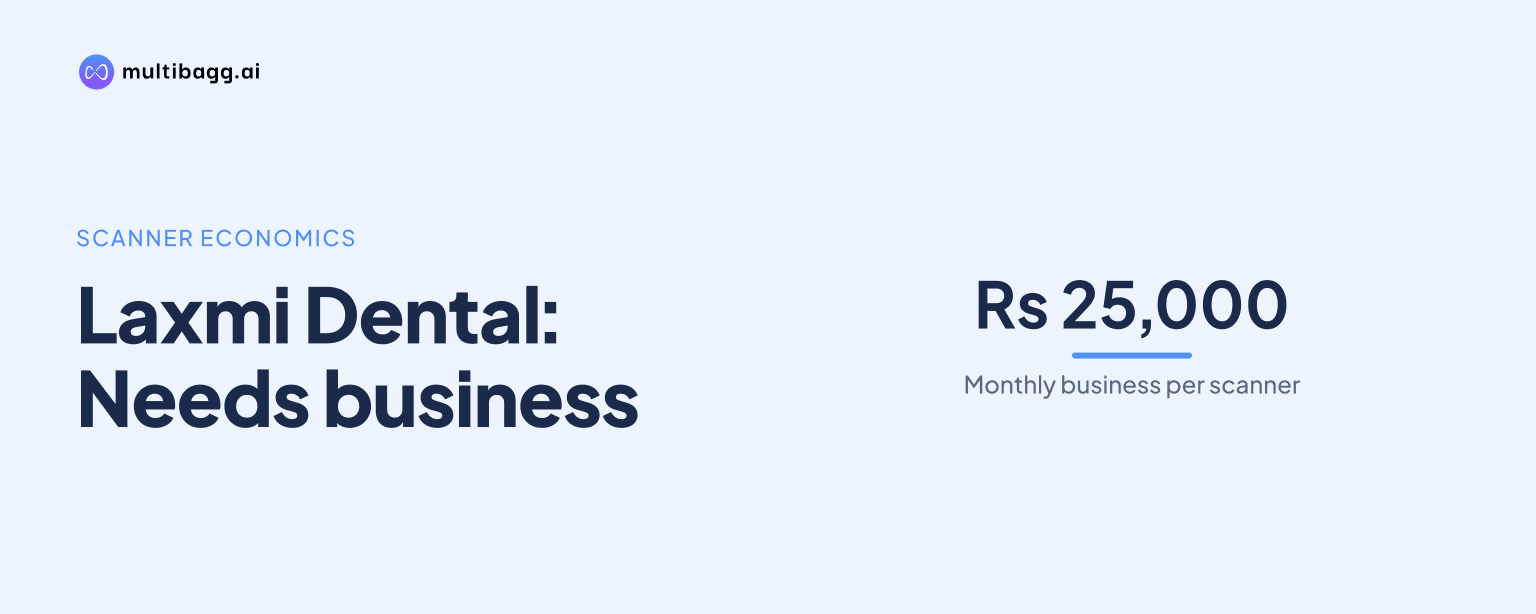
At its November 4, 2026 earnings call, Laxmi Dental Limited said each scanner subscription requires Rs 25,000 of monthly business, alongside a Rs 50,000 deposit and a Rs 3,000 monthly fee plus Goods and Services Tax (GST). The model keeps the scanner under Laxmi Dental’s ownership and allows it to redeploy equipment after continued underperformance.
Know Laxmi Dental inside out
Results, valuation, peers and who's buying, in one view.
How does Laxmi Dental's scanner subscription work?
Laxmi Dental’s subscription gives a dentist use of a scanner after a Rs 50,000 deposit and payment of Rs 3,000 plus GST each month for as long as the scanner is used. The dentist must separately buy and own the laptop needed to operate the scanner. Management said the scanner remains Laxmi Dental’s property, while the dentist commits to route at least Rs 25,000 of business a month to the company.
The programme initially launched as the Pink Revolution campaign for women in dentistry, while management said it hoped to introduce a Blue Revolution for men around Men’s Day. Management said the programme had been live for about two-and-a-half to three weeks by the November 4 call. This means Laxmi Dental had not yet disclosed quarterly subscription revenue, collection performance or a deployment run rate.
The Rs 25,000 monthly commitment is a floor rather than a cap on business from a subscribed dentist. Management said some dentists using scanners already provide Rs 1 lakh, Rs 1.5 lakh or Rs 2 lakh of business each month. The company did not disclose how many of those higher-volume dentists use subscription scanners rather than scanners bought outright.
Why is Laxmi Dental shifting from scanner sales?
Laxmi Dental said the subscription structure is intended to lower the initial cost of adopting digital dentistry, particularly as laptop prices have increased. Management said a dentist’s total initial spending had been about Rs 4.2 lakh to Rs 4.4 lakh last year and had risen to about Rs 5.2 lakh to Rs 5.4 lakh this year. Under the subscription approach, management estimated the initial digital commitment at about Rs 2.5 lakh, including the dentist-funded laptop and the Rs 50,000 scanner deposit.
Management said the laptop required for a scanner had previously cost about Rs 1 lakh and was now close to Rs 2 lakh. The subscription removes the need for the dentist to buy the scanner but leaves the laptop purchase with the dentist. Laxmi Dental said this arrangement can make adoption easier while preserving its ownership of the scanner and tying the placement to recurring business.
The change follows slower scanner sales during the first half of the year. Management said the company had run at about 250 scanner sales a quarter last year, compared with 215 scanners sold in roughly six months this year. It attributed part of the slower adoption to higher laptop costs, while also saying the subscription launch had produced a few thousand leads that were still being evaluated.
How much business could scanner subscriptions generate?
Each scanner meeting the minimum commitment represents Rs 3 lakh of annual business for Laxmi Dental, calculated from Rs 25,000 a month over 12 months. Management described this as additional business generated through scanner deployment and said the threshold was intended to increase customer stickiness. However, the company did not disclose revenue recognition, subscription churn or the proportion of the commitment that has been met since launch.
Management illustrated the potential scale by saying 1,000 deployed scanners meeting the threshold would direct Rs 2.5 crore of business each month to Laxmi Dental. That figure refers to business placed by dentists, rather than the Rs 3,000 monthly subscription charge alone. At the stated minimum, 1,000 scanners would also imply Rs 30 crore of annual business, although management did not provide a target for deploying 1,000 units.
Management said the monthly subscription is designed to cover scanner depreciation and characterised the return on investment from deployment as quick. It did not disclose the scanner acquisition cost, depreciation period, capital budget or payback calculation. The company therefore presented the model as a business-development and retention mechanism, rather than providing quantified profitability guidance for it.
Got a follow-up? Ask IRIS
Can Laxmi Dental repossess underused scanners?
Laxmi Dental can take back and redeploy a subscription scanner if a dentist repeatedly fails to provide the agreed business volume. Management said the sales team would first meet a dentist after a month in which business fell below the appropriate level. If the shortfall continued for two months, the company could repossess the scanner because it remains the owner.
The ownership condition differentiates a subscription placement from an outright equipment sale. Management called the subscription units locked scanners, meaning a dentist accepts a business-routing restriction in exchange for lower upfront scanner expenditure. A dentist that does not want that restriction can still buy a scanner and own it directly.
Laxmi Dental said it had still sold almost 14 scanners outright during the first two-and-a-half weeks after the subscription campaign began. Management also said no existing scanner owner had asked to move to a subscription during that period. The early sales suggest the company expects both ownership and subscription options to remain available, rather than replacing outright sales immediately.
How does the model support Laxmi Dental's digital strategy?
Laxmi Dental said the subscription model supports its priority of digitising its existing domestic network before aggressively adding clinics. Management said 78% of the network was digital and set a target of 90% to 95%. Salespeople are currently measured on helping dentists become digital, and management said future clinic additions would focus on dentists adopting scanner deployment campaigns.
The company also linked scanner deployment to higher wallet share through its hub-and-spoke laboratory model. Management said dentists commonly use two labs, and a local spoke can allow a dentist to use two Laxmi Dental locations while maintaining one billing relationship and one key account manager. Laxmi Dental did not disclose revenue per clinic, but said internal dashboards showed the same dentists increasing wallet share after a spoke opened.
Management said domestic growth moved from single digits in the preceding quarter to 15% in the current quarter, while noting that most spokes were only one to three months old. It did not isolate the contribution of scanner subscriptions, scanner sales or new spokes to that growth. The company’s stated priority remains network digitisation, with broader expansion expected after the digital foundation reaches its target level.
Conclusion
Laxmi Dental has shifted the scanner proposition from a one-time equipment sale toward a company-owned deployment model tied to Rs 25,000 of monthly business. The structure lowers the dentist’s upfront requirement, creates a Rs 3,000 monthly charge plus GST, and gives Laxmi Dental a mechanism to retain or reassign equipment when business commitments are not met.
The next evidence point is Laxmi Dental’s next quarterly call, when management said it should be able to share deployment numbers after the late-October launch and Diwali period. Progress toward the 90% to 95% digital-network target, the mix of subscriptions against outright scanner sales, and adherence to the Rs 25,000 monthly commitment will indicate how the programme develops.