










Lodha targets Rs 8,500 crore PAT by FY31 with debt ceiling
Key highlights
- Lodha targets PAT of more than Rs 8,500 crore by FY31, up from Rs 3,430 crore in FY26, implying about 20% CAGR.
- Lodha’s net-debt-to-equity ratio was 0.21 times in September 2026, below its ceiling of 0.5 times, with net debt at Rs 5,280 crore.
- Lodha reported first-half FY27 PAT of Rs 2,390 crore, up 63% year on year, while pre-sales rose 7% to Rs 9,670 crore.
- Lodha reported unsold GDV of about Rs 2,00,000 crore and targets tenfold growth in annuity income from the FY26 base of Rs 290 crore over six years.
powered by IRIS
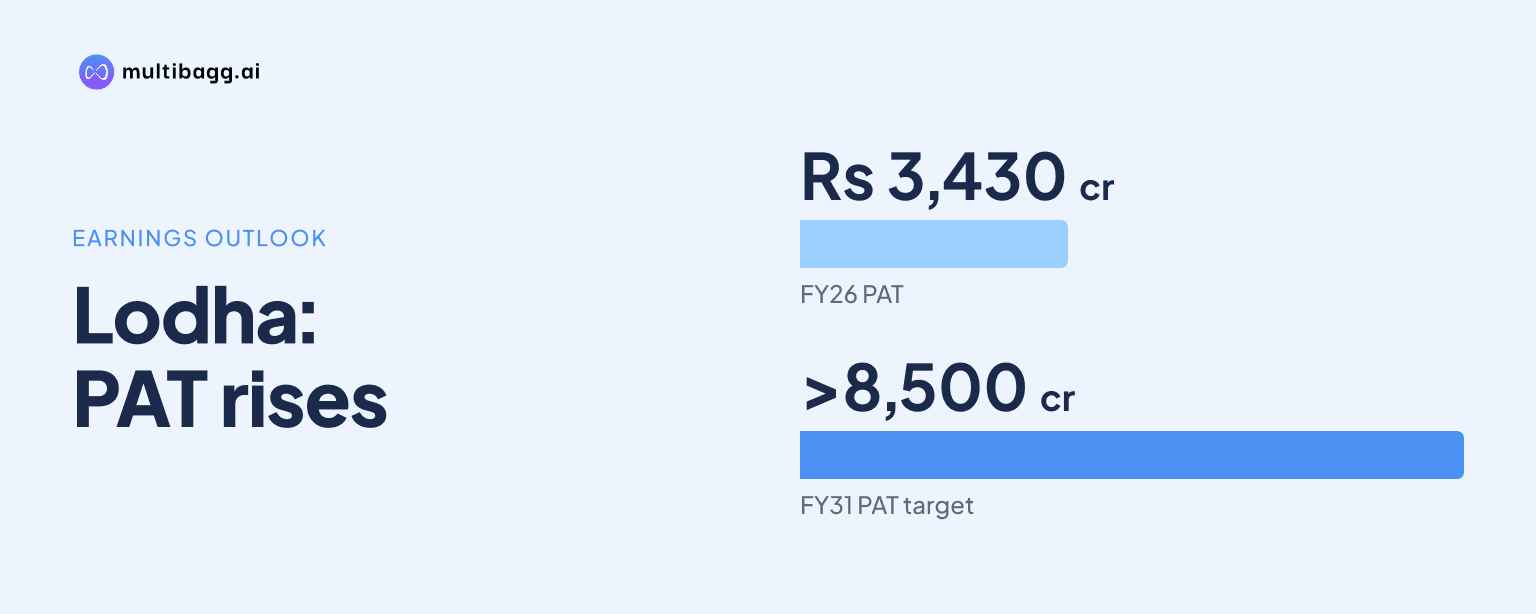
Lodha Developers Limited, referred to here as Lodha, targets profit after tax (PAT) of more than Rs 8,500 crore by FY31, up from Rs 3,430 crore in FY26, implying about 20% compound annual growth. The developer says it will pursue that target while maintaining a net-debt-to-equity ceiling of 0.5 times; the ratio was 0.21 times in September 2026.
Know Lodha Developers inside out
Results, valuation, peers and who's buying, in one view.
What is Lodha's FY31 PAT target?
Lodha's stated FY31 target is PAT of more than Rs 8,500 crore, compared with Rs 3,430 crore in FY26. The investor presentation describes the required medium-term trajectory as about 20% compound annual growth rate, or CAGR, over the five financial years from FY26 to FY31. This is a management target rather than a reported financial outcome.
The FY26 base is more than six times the Rs 500 crore shown for FY21 in the presentation's adjusted PAT series. That series is adjusted for foreign-exchange and exceptional items. Lodha reported a PAT margin of about 20% and an adjusted earnings before interest, tax, depreciation and amortisation, or EBITDA, margin of about 34% in FY26.
Lodha also reported PAT of Rs 2,390 crore in the first half of FY27, up 63% year on year, with a PAT margin of 24.6% against 19.5% in the comparable period. In Q2FY27, PAT was Rs 1,010 crore, up 28% year on year, and the PAT margin was 22.1%; the presentation also lists a 20.4% margin alongside that quarterly comparison.
How has Lodha's profit and sales record changed?
Lodha increased pre-sales to Rs 20,500 crore in FY26 from Rs 6,000 crore in FY21, representing a five-year CAGR of about 28%. Over the same period, adjusted PAT rose from Rs 500 crore to Rs 3,430 crore, although the annual progression was uneven: the presentation shows Rs 1,800 crore in FY23, Rs 1,600 crore in FY24 and Rs 2,800 crore in FY25.
The FY27 figures show continuing sales growth, but at a lower first-half rate than the five-year pre-sales CAGR. Pre-sales were Rs 9,670 crore in the first half of FY27, up 7% year on year, and Rs 5,040 crore in Q2FY27, up 10%. Lodha's FY27 pre-sales guidance is Rs 24,000 crore, above the Rs 20,500 crore achieved in FY26.
Collections grew faster than first-half pre-sales in the September 2026 update. First-half FY27 collections were Rs 7,650 crore, up 19% year on year, while Q2FY27 collections of Rs 3,450 crore were flat year on year. Lodha also reported 4% year-to-date price growth on a like-for-like basis, which compares prices in comparable projects rather than changes in project mix.
What leverage limit is Lodha maintaining?
Lodha is maintaining a net-debt-to-equity ceiling of 0.5 times, and its reported ratio was 0.21 times at the end of September 2026. Net debt stood at Rs 5,280 crore on that date, after increasing by Rs 350 crore quarter on quarter. The company reported an average cost of debt of 7.8%, steady in the September 2026 update.
The September 2026 ratio was below the 3.5 times reported in FY21. The presentation's annual series shows net debt declining from Rs 16,000 crore in FY21 to Rs 9,300 crore in FY22, Rs 7,100 crore in FY23 and Rs 3,000 crore in FY24, before rising to Rs 4,000 crore in FY25 and Rs 5,400 crore in FY26. The difference between FY26 and September 2026 net debt reflects the different reporting dates.
Management's stated objective goes beyond the group-level leverage ceiling: Lodha targets becoming debt-free at its development company, or DevCo, level in the next few years. The presentation does not specify a year, an absolute debt figure or cash-flow milestones for this DevCo objective. Lodha's credit rating was AA with a stable outlook, following seven upgrades since 2021.
Got a follow-up? Ask IRIS
What supports Lodha's growth and deleveraging plan?
Lodha links growth and deleveraging to its development pipeline and operating model as a general contractor. It reported unsold gross development value, or GDV, of about Rs 2,00,000 crore, excluding land held by its land company. Management says this reduces the business-development requirement over the next few years and can substantially increase free cash flow.
The development portfolio spans about 40 operating locations in the Mumbai Metropolitan Region, Pune, Bengaluru and, from FY27, the National Capital Region. It covers luxury, premium and mid-income housing. Lodha's stated market share is below 3.5% by value in primary housing sales across the top six cities, including its current four markets plus Hyderabad and Chennai.
Rental and data-centre activities are also part of the disclosed plan. Lodha reported annuity income of Rs 290 crore in FY26 and targets tenfold growth in annuity income over the following six years. Its Navi Mumbai data-centre park has about 660 acres of shovel-ready land and 5 gigawatts of approved power; in phase one, AWS, STT and Digital Edge are already developing more than 1 gigawatt, while Lodha plans a 1-gigawatt build-to-suit powered shell.
The presentation says the powered-shell project is intended to be largely self-funded from the sale of remaining phase-one capacity. Separately, Lodha has added projects with Rs 1,40,000 crore of GDV since its initial public offering while increasing investment in annuity streams. These disclosed mechanisms explain how management expects development cash flows and recurring-income investment to coexist, but the presentation does not provide a yearly cash-flow bridge to FY31.
Conclusion
Lodha's disclosed FY31 framework combines a PAT target above Rs 8,500 crore with a net-debt-to-equity ceiling of 0.5 times. The starting position includes FY26 PAT of Rs 3,430 crore, September 2026 net debt of Rs 5,280 crore and a 0.21-times leverage ratio, while its Rs 2,00,000 crore of unsold GDV provides management's stated source of project visibility.
The next measures to watch are progress toward FY27 pre-sales guidance of Rs 24,000 crore, collection growth after Rs 7,650 crore in the first half, and whether Lodha delivers its stated aim of becoming debt-free at DevCo level in the next few years. Management has also set a six-year target for annuity income to increase tenfold from the FY26 base of Rs 290 crore.