










Lodha sees 14 million high-income households added by 2030
Key highlights
- Lodha projects high-income households earning more than Rs 28 lakh annually will rise from 9 million in 2021 to 23 million in 2030.
- Lodha estimates 2.75 million high-income housing completions in the Top-7 cities during CY21-30, including 1.75 million units in CY26-30.
- Lodha reports an approximate 3.5% share of primary home sales in the Top 6 cities, based on CY25 market sales of Rs 5.9 lakh crore and FY26 pre-sales of Rs 20,500 crore.
- Lodha says Palava and Upper Thane could deliver more than Rs 10 lakh crore of sales over the next three decades, with approximately 50% EBITDA margins.
powered by IRIS
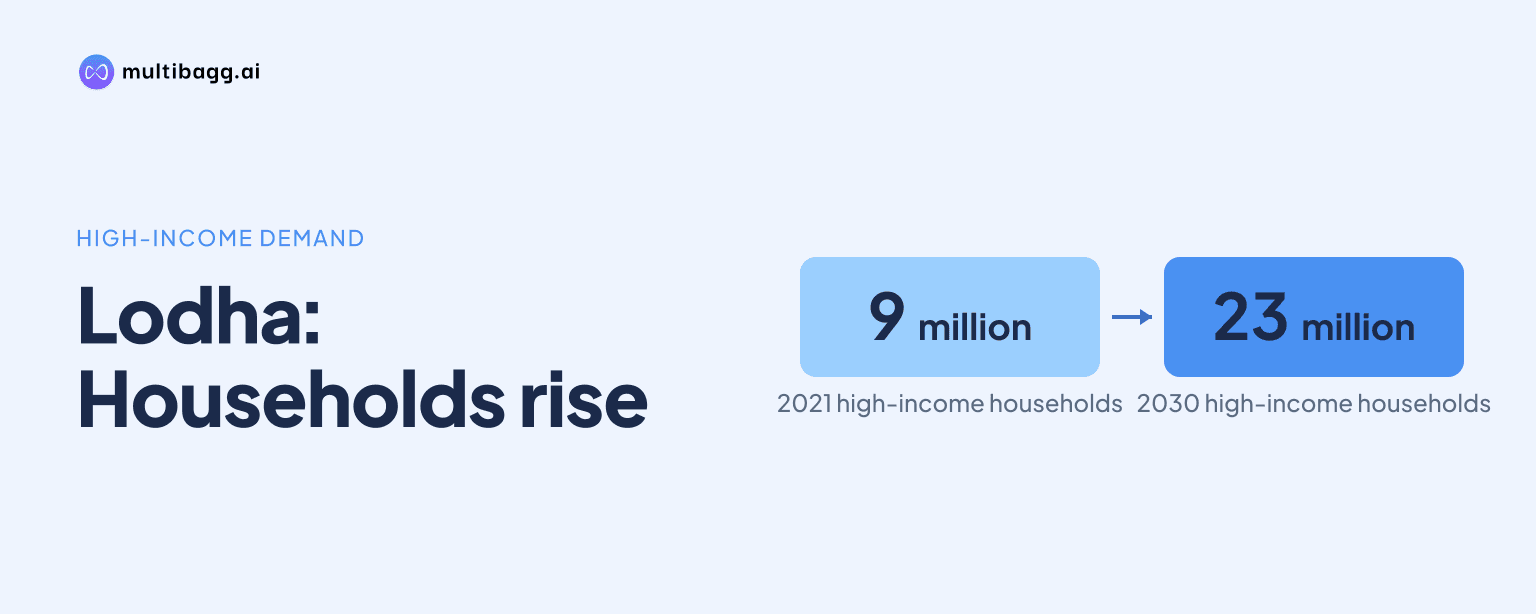
Lodha says 14 million new homes will be required for high-income households this decade, based on its forecast that households earning more than Rs 28 lakh annually will rise from 9 million in 2021 to 23 million in 2030. Lodha estimates 2.75 million relevant completions in the Top-7 cities during CY21-30.
Know Lodha Developers inside out
Results, valuation, peers and who's buying, in one view.
Why does Lodha project 14 million new high-income homes?
Lodha bases the 14 million figure on projected growth in its highest household-income category, rather than on a separately disclosed forecast of home purchases. It defines high-income households as those earning more than Rs 28 lakh in annual household income and projects their number will rise from 9 million, or 3% of India’s 296 million households in 2021, to 23 million, or 6% of 386 million households in 2030.
The difference between the two projected household totals is 14 million, which Lodha presents as the number of new homes required for this group during the decade. The company places the demographic projection alongside an increase in India’s gross domestic product from USD 3 trillion in 2021 to USD 7 trillion to USD 8 trillion in 2030. These are market assumptions supporting Lodha’s demand thesis, not reported residential sales.
Lodha identifies households with annual income of Rs 5 lakh to Rs 28 lakh as upper-middle income and says the formal housing market begins above Rs 5 lakh of annual household income. This group is projected to increase from 68 million households, or 23% of the total, in 2021 to 152 million households, or 39%, in 2030. Together with the high-income group, these two categories would rise from 77 million to 175 million households.
How does Lodha's estimated supply compare with demand?
Lodha estimates cumulative completions of 2.75 million units in the high-income segment it serves across the Top-7 cities in CY21-30. It describes this segment as about 50% of overall housing supply, while separately stating that total industry supply could remain below 10 million units even if industry supply growth is significant.
The company divides the 2.75 million-unit high-income estimate into about 1 million units in CY21-25 and an estimated 1.75 million units in CY26-30. The second-half estimate assumes a 10% compound annual growth rate, or CAGR, in industry supply. This compares with Lodha’s projected 14 million increase in high-income households nationally between 2021 and 2030.
The annual series for overall Top-7-city completions rises from 0.3 million units in CY21 to 0.5 million in both CY24 and CY25, and then reaches 0.8 million units in CY29 and CY30. Lodha associates approximately half of this overall supply with the high-income segment it caters to. The company does not provide a city-by-city demand forecast, homeownership assumption or calculation showing that each additional high-income household will buy a newly completed home.
Got a follow-up? Ask IRIS
Which household-income groups does Lodha target?
Lodha’s stated market framework covers households above Rs 5 lakh in annual income, the level where it says formal housing begins. Within that framework, the high-income category above Rs 28 lakh is projected to rise from 9 million to 23 million households, while the Rs 5 lakh to Rs 28 lakh upper-middle-income category is projected to increase from 68 million to 152 million by 2030.
The two lower-income categories show a different projected mix. Lower-middle-income households, earning Rs 2 lakh to Rs 5 lakh annually, are projected to increase from 85 million in 2021 to 119 million in 2030, while low-income households below Rs 2 lakh are projected to decline from 134 million to 92 million. Their respective shares are shown at 31% and 24% of the projected 386 million households in 2030.
Lodha distinguishes between its formal-market threshold and its supply estimate. The 2.75 million CY21-30 completion figure applies to the high-income segment that it says it serves, rather than the entire Rs 5 lakh-and-above formal housing market. It does not disclose a separate Top-7-city supply forecast for all 175 million projected high- and upper-middle-income households.
How much room for growth does Lodha report in major cities?
Lodha says it has about 3.5% of primary home sales in the Top 6 cities, based on CY25 market sales of Rs 5.9 lakh crore and Lodha FY26 pre-sales of Rs 20,500 crore. The Top 6 cities in this comparison are Mumbai Metropolitan Region, National Capital Region, Bengaluru, Pune, Hyderabad and Chennai.
The market-sales figure is for CY25, while Lodha’s pre-sales figure is for FY26, meaning the two measures cover different reporting periods. Lodha nevertheless presents them together as the basis for its approximate market-share calculation. The company describes this share as providing headroom for growth, but does not disclose a market-share target or a date by which it expects to reach one.
Lodha also says Palava and Upper Thane are set to deliver more than Rs 10 lakh crore of sales over the next three decades, with approximately 50% earnings before interest, tax, depreciation and amortisation margins. This is a management projection, not reported sales. For Palava, Lodha says Parts A and B of the Mulund-Airoli-Palava freeway were opening soon as of October 2026, with travel to Airoli expected to take 15 to 20 minutes after their completion.
Conclusion
Lodha’s long-term housing argument combines a projected gain of 14 million high-income households by 2030 with estimated high-income completions of 2.75 million units in the Top-7 cities during CY21-30. The comparison is directional because the household forecast is national while the supply forecast covers selected cities, and because Lodha does not assume or demonstrate that every incremental household purchases a new home.
The next measures to watch are whether industry supply achieves the 10% CAGR assumed for CY26-30 and whether Lodha’s approximately 3.5% share of Top-6-city primary sales changes. Its Palava development case also depends on disclosed infrastructure milestones, including completion progress on freeway Part C and the expected 2028 or 2029 opening of the bullet-train station at Palava.