










Lodha ties up over Rs 14,130 crore GDV, starts NCR pilot
Key highlights
- Lodha has tied up more than Rs 14,130 crore of GDV across 56 projects and over 74 msf of development potential in MMR, Pune, Bengaluru and NCR.
- MMR accounts for more than Rs 10,000 crore of GDV across 36 projects, including Rs 6,420 crore across 15 south-central Mumbai projects.
- Pune has approximately Rs 1,880 crore of GDV across 11 projects and about 20 msf of potential, while Bengaluru has approximately Rs 1,920 crore across seven projects and about 16 msf.
- Lodha’s NCR pilot comprises two Gurgaon joint-development projects worth Rs 330 crore, with 1.1 msf of potential and operations scheduled to start in FY27.
powered by IRIS
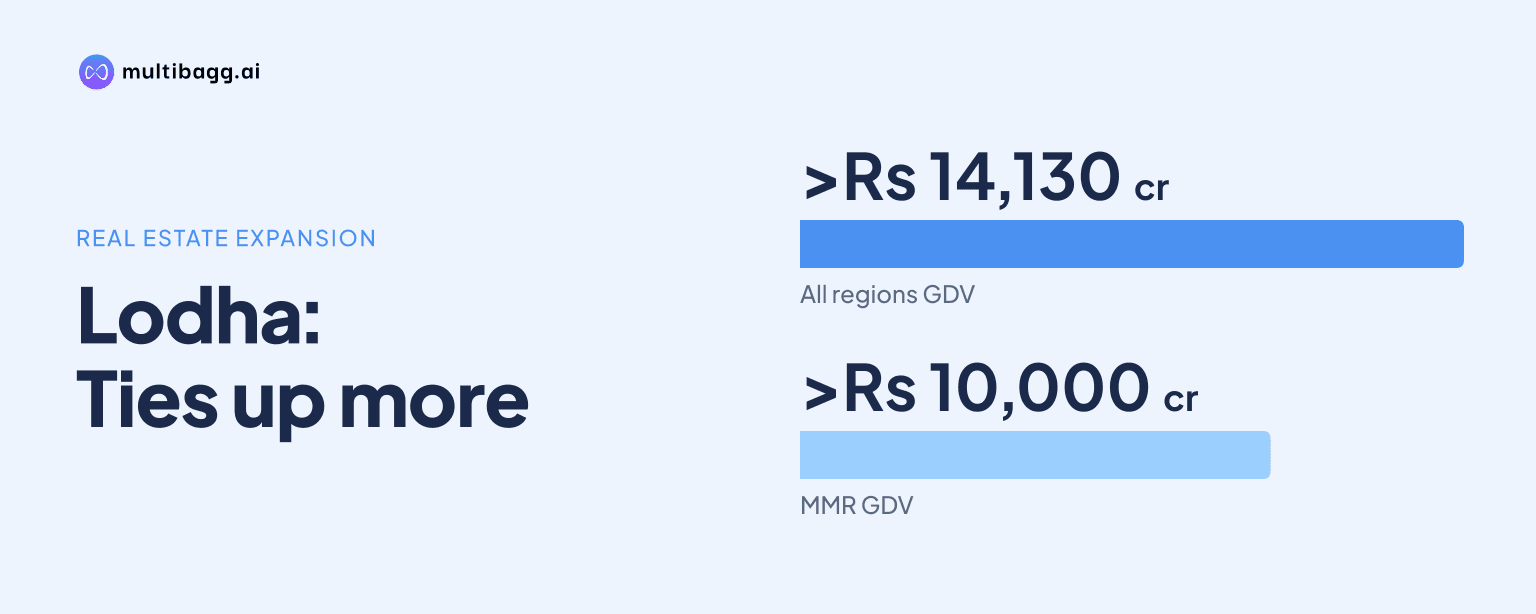
Lodha has tied up more than Rs 14,130 crore of gross development value (GDV) across Mumbai Metropolitan Region (MMR), Pune, Bengaluru and National Capital Region (NCR). MMR accounts for more than Rs 10,000 crore, while Lodha’s NCR pilot comprises two Gurgaon joint-development projects worth Rs 330 crore that are scheduled to start operations in FY27.
Know Lodha Developers inside out
Results, valuation, peers and who's buying, in one view.
How large is Lodha’s tied-up development pipeline?
Lodha’s disclosed pipeline exceeds Rs 14,130 crore of GDV across four markets, with 56 projects and more than 74 million square feet (msf) of stated development potential. The total combines MMR’s more than Rs 10,000 crore, Pune’s approximately Rs 1,880 crore, Bengaluru’s approximately Rs 1,920 crore and NCR’s Rs 330 crore.
MMR is the largest component, accounting for more than 70% of the stated minimum total GDV and 36 of the 56 projects. Pune has 11 projects and about 20 msf of potential, compared with Bengaluru’s seven projects and about 16 msf. The two NCR projects add 1.1 msf, making the initial NCR commitment smaller than the three established markets.
Lodha describes its MMR coverage as a “supermarket” strategy, with projects spread across several micro-markets. Its disclosed additions include western suburbs, south-central Mumbai, eastern suburbs and Thane, while extended western suburbs, extended eastern suburbs and Navi Mumbai are identified as potential growth markets. The presentation distinguishes those potential markets from locations where project GDV has already been disclosed.
Where is Lodha’s MMR development concentrated?
Lodha’s largest disclosed MMR cluster is south-central Mumbai, where it has added 15 projects with GDV of Rs 6,420 crore. Western suburbs follow with nine projects and Rs 2,130 crore of GDV, while eastern suburbs contain 10 projects with approximately Rs 1,630 crore. Together, these three clusters account for 34 of Lodha’s 36 disclosed MMR projects.
FY26 absorption, based on registration data in the presentation, differs from Lodha’s project-value distribution. Western suburbs have the highest cited absorption at Rs 5,300 crore, above south-central Mumbai’s Rs 3,550 crore despite the latter holding three times as much disclosed GDV. Eastern suburbs recorded Rs 2,700 crore of absorption, and Thane recorded Rs 1,550 crore alongside two added projects worth Rs 150 crore.
Lodha identifies three further MMR opportunities without listing tied-up project GDV for them: extended western suburbs, extended eastern suburbs and Navi Mumbai. Their cited FY26 absorption is Rs 1,200 crore, Rs 1,500 crore and Rs 1,650 crore respectively. Extended eastern suburbs also have about 600 msf of development potential, according to the presentation.
Got a follow-up? Ask IRIS
How do Pune and Bengaluru compare in Lodha’s pipeline?
Lodha has tied up approximately Rs 1,880 crore of GDV across 11 Pune projects, slightly below Bengaluru’s approximately Rs 1,920 crore across seven projects. Pune nevertheless has the larger stated development potential, at about 20 msf versus Bengaluru’s about 16 msf, indicating a greater amount of potential area across more projects.
In Pune, north-west is the largest disclosed cluster, with four projects and GDV of approximately Rs 870 crore. North-east has two projects worth approximately Rs 450 crore, and Pimpri-Chinchwad has one added project with approximately Rs 130 crore of GDV. Lodha notes that it had one Pimpri-Chinchwad project before its initial public offering, with annual sales potential of approximately Rs 20 crore.
Pune’s FY26 absorption ranges from Rs 240 crore in central Pune to Rs 2,000 crore in Pimpri-Chinchwad. North-west absorption is Rs 1,750 crore and north-east absorption is Rs 1,320 crore, so the largest disclosed project allocation is in north-west rather than Pimpri-Chinchwad, the highest-absorption area. South-east, south-west and central Pune have GDV of approximately Rs 120 crore, Rs 40 crore and Rs 40 crore respectively.
Bengaluru’s disclosed portfolio is concentrated entirely in two areas. North-east Bengaluru has four projects with Rs 1,420 crore of GDV and FY26 absorption of Rs 4,620 crore, while south-east has three projects with Rs 500 crore of GDV and Rs 3,720 crore of absorption. North-west, central and south-west Bengaluru are identified as potential growth markets, with cited FY26 absorption of Rs 960 crore, Rs 80 crore and Rs 840 crore respectively.
Why is Lodha starting NCR with two Gurgaon projects?
Lodha is initiating an NCR pilot through two Gurgaon projects signed under joint development agreements (JDAs), with GDV of Rs 330 crore and development potential of 1.1 msf. The company says operations are to start in FY27, and it is creating a dedicated NCR-based team to support the market entry.
Lodha cites NCR’s Rs 13,550 crore of absorption as its rationale for entering the region, calling it India’s second-largest real-estate market. The company also says there is a dearth of trusted developers offering premium-quality products. These are management’s stated market-entry reasons rather than a forecast of sales from the two projects.
Within the presentation’s FY26 housing-sales map, Gurugram has the largest value at Rs 9,720 crore, ahead of Noida at Rs 4,680 crore and Ghaziabad at Rs 2,050 crore. Faridabad is shown at Rs 360 crore and Delhi at Rs 300 crore. The projects are described as being in Gurgaon, while the city-level sales map uses the Gurugram spelling.
Lodha has appointed Amandeep Singh, formerly of DLF and Godrej Properties, as chief executive officer for the NCR market. The company says team building is in progress, alongside the FY27 operating start for the two JDAs. This local staffing plan is the principal disclosed execution measure beyond the signed projects themselves.
Conclusion
Lodha’s expansion is led by an MMR pipeline of more than Rs 10,000 crore, with Pune and Bengaluru together adding approximately Rs 3,800 crore across 18 projects. The comparison shows different geographic roles: MMR holds the largest project base, Pune has more stated development potential than Bengaluru, and NCR begins with a limited two-project pilot.
The next disclosed milestone is the FY27 start of NCR operations. Lodha’s progress will depend on building its local NCR team and advancing the two Gurgaon JDAs with 1.1 msf of potential, while potential growth areas in MMR and Bengaluru have not yet been assigned disclosed project GDV.