










Lupin reports 41% Scope 1 and 2 emissions cut near 2030 target
Key highlights
- Lupin reported approximately 41% Scope 1 and Scope 2 GHG emission reduction from FY23 in FY2026, against a 42% target for 2030.
- Lupin reported about 45% water recycling in FY2026, compared with its 50% target for 2030.
- Lupin completed biodiversity assessments at 66% of global sites in FY2026, against a 100% target for 2030.
- Lupin reported a 91 out of 100 S&P Global ESG Rating for 2025, compared with 17 out of 100 in 2021.
powered by IRIS
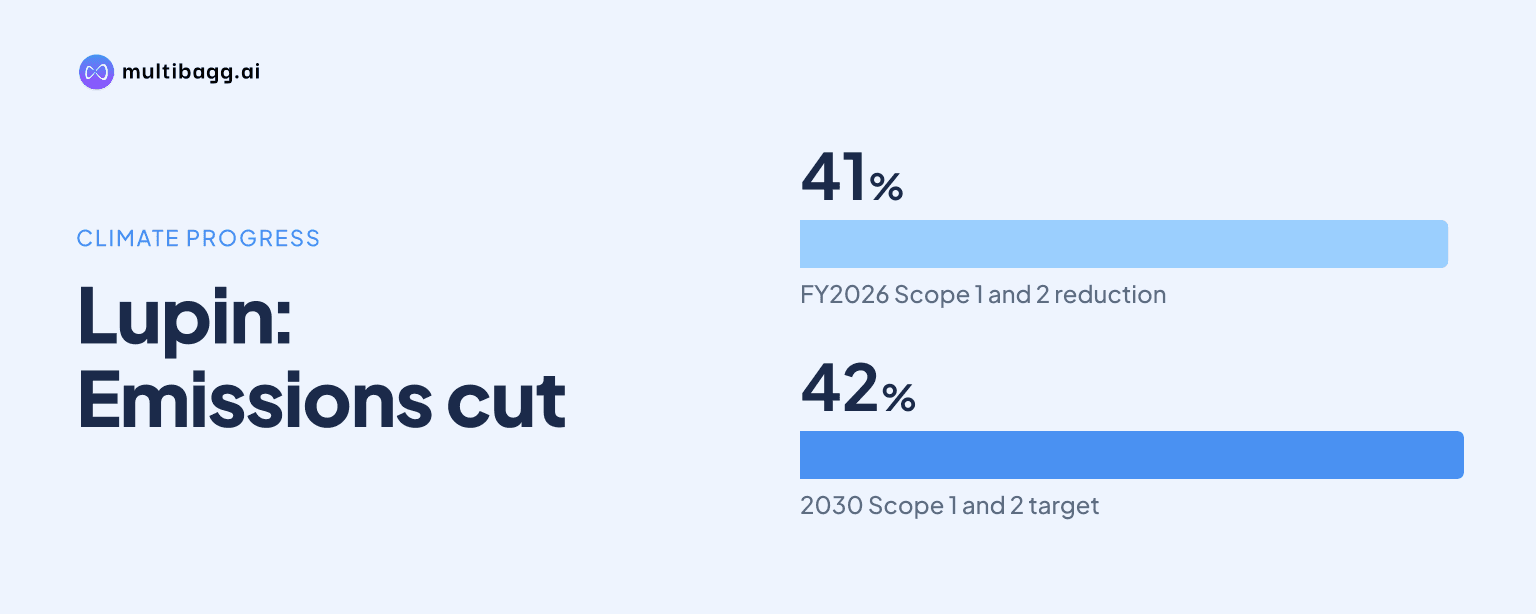
Lupin reported an approximately 41% reduction in Scope 1 and Scope 2 greenhouse-gas emissions from its FY23 baseline in FY2026, placing it one percentage point below its stated 42% reduction target for 2030. The update also shows progress in water recycling, biodiversity reviews, workforce diversity, supplier engagement and community-health activities.
Know Lupin inside out
Results, valuation, peers and who's buying, in one view.
How close is Lupin to its 2030 emissions target?
Lupin is about one percentage point below its 2030 climate goal, reporting roughly 41% Scope 1 and Scope 2 greenhouse-gas, or GHG, emission reduction in FY2026 against a 42% reduction target from FY23. The presentation identifies the FY23 baseline and labels the target as a 2030 goal, rather than providing annual emissions tonnage or a separate result for each emissions scope.
The FY2026 status indicates that Lupin had achieved most of the stated percentage reduction by the reported period, while the remaining gap to the target was approximately one percentage point. Lupin also reported that renewable energy represented 48% of its energy mix in its corporate overview, a separate metric from the Scope 1 and Scope 2 reduction measure. The presentation does not specify the contribution of renewable energy, energy efficiency, fuel switching or other mechanisms to the reported emissions change.
Lupin’s environmental agenda also includes water, waste and biodiversity under its Planet pillar. In Q2 FY27, it said eight manufacturing sites received external Zero Waste to Landfill certification, comprising Platinum ratings for seven sites and a Gold rating for one. That certification result is reported separately from the FY2026 emissions status and does not quantify waste volumes diverted from landfill.
Which environmental targets has Lupin met or still needs to complete?
Lupin reported FY2026 progress below its stated 2030 targets for water recycling and biodiversity assessments, alongside the near-complete GHG reduction result. Water recycling reached about 45% against a 50% 2030 goal, leaving an indicated gap of about five percentage points. Biodiversity assessments had been completed at 66% of global sites, against a target to cover 100% of global sites by 2030.
Lupin described itself as water positive for five consecutive years in its corporate overview, while its sustainability scorecard measured recycling at about 45% in FY2026. These are different disclosures: the presentation does not define water positivity in this update or reconcile it with the 50% recycling target. Readers therefore can compare the stated five-year water-positivity record with the recycling progress, but cannot derive a common water-volume measure from the supplied information.
For waste, Lupin’s Q2 FY27 update focused on certification outcomes rather than a numerical target in the FY2026 goal table. The seven Platinum-rated and one Gold-rated sites represent eight certified manufacturing locations. The presentation does not state how many manufacturing sites are in Lupin’s global footprint, so the share of all sites covered by those eight certifications cannot be calculated from this disclosure.
Got a follow-up? Ask IRIS
How far has Lupin progressed on people and supplier goals?
Lupin reported 12% women in top management in FY2026, compared with its 15% target for 2030, while employee volunteering had exceeded 35,400 hours against a 50,000-hour goal. The gender metric leaves a gap of about three percentage points to the stated target. The volunteering result represents more than 35,400 hours, but the presentation does not state how those hours were allocated by programme or geography.
Lupin said its Q2 FY27 diversity and inclusion activity included We-Sync for persons with disabilities, or PwD, inclusion and iMPACT 3.0 for women’s mentoring and leadership development. These programmes give operational context to the 12% top-management representation figure, although the presentation does not attribute a measured change in representation to either programme.
Supplier assessment was at a substantially earlier stage than the emissions and water indicators in the FY2026 scorecard. Lupin reported 17% ongoing engagement with suppliers under a goal to cover 100% of Tier 1 direct-material suppliers on a three-year cycle. In Q2 FY27, it also said environmental, social and governance, or ESG, assessments covered more than 130 suppliers and that it conducted seven supplier capability-building programmes.
On patient and community measures, Lupin reported education and awareness outreach to 980,000 patients and 73,500 doctors, versus 2030 goals of 3 million patients and 50,000 doctors. Doctor outreach was therefore above the stated numerical goal, while patient outreach remained below the 3 million objective. Its Lives and Livelihood programme had affected more than 2.5 million beneficiaries, compared with a 3 million-beneficiary goal, and Q2 FY27 community healthcare activity included 105,850 screenings for non-communicable diseases and 756 health camps.
How do Lupin’s ESG ratings compare with earlier years?
Lupin reported a 91 out of 100 score in the 2025 S&P Global ESG Rating, up from 17 out of 100 in 2021, and said S&P Global ranked it No. 1 globally in the pharmaceutical sector. Lupin also said it was included in the S&P Global Yearbook for a third consecutive year. These ratings are external assessments reported by Lupin and are distinct from the company’s operational target scorecard.
Other ratings in the presentation also show changes across years. Sustainalytics assigned Lupin a 22.11 Medium Risk rating in 2026, compared with 42.69 Severe Risk in 2019, while CDP gave it an A leadership rating in climate and water in 2025 compared with F in 2021. MSCI upgraded Lupin to BBB in 2025 from BB in 2024, according to Lupin’s ESG ratings update.
Lupin also listed a 71 out of 100 ESG score from NSE Sustainability Ratings & Analytics for FY2025 and scores of 69 for Crisil ESG and 65 for Crisil Core ESG in 2026. The presentation names frameworks and standards including the Science Based Targets initiative, CDP, the Task Force on Climate-related Financial Disclosures and the Taskforce on Nature-related Financial Disclosures. It does not provide the methodology, weighting or detailed evidence behind each third-party score.
Conclusion
Lupin’s FY2026 sustainability update shows its reported Scope 1 and Scope 2 GHG reduction at about 41% from FY23, close to its 42% 2030 target. The same scorecard shows less complete progress in water recycling at about 45%, biodiversity assessments at 66% of global sites, women in top management at about 12%, and supplier engagement at 17%, while doctor outreach had surpassed its 50,000 target.
The next disclosed milestones to watch are Lupin’s 2030 goals: 50% water recycling, biodiversity assessments at all global sites, 15% women in top management, 50,000 volunteering hours, supplier coverage across Tier 1 direct-material suppliers over a three-year cycle, and outreach to 3 million patients. Lupin’s future updates will determine whether the final percentage point on its climate target is achieved and whether the lower-coverage programmes advance at a comparable pace.