










Lupin Limited Q2 FY27 sales rise 14% as EBITDA margin falls
Key highlights
- Lupin Q2 FY27 sales rose 14% year on year to Rs 7,785.5 crore.
- Lupin EBITDA fell 8% year on year to Rs 1,957.4 crore and margin declined to 25.1% from 31.3%.
- Lupin net income declined 22% year on year to Rs 1,155.3 crore in Q2 FY27.
- APAC sales rose 43% to Rs 427.3 crore, while LATAM sales declined 30% to Rs 242.7 crore.
powered by IRIS
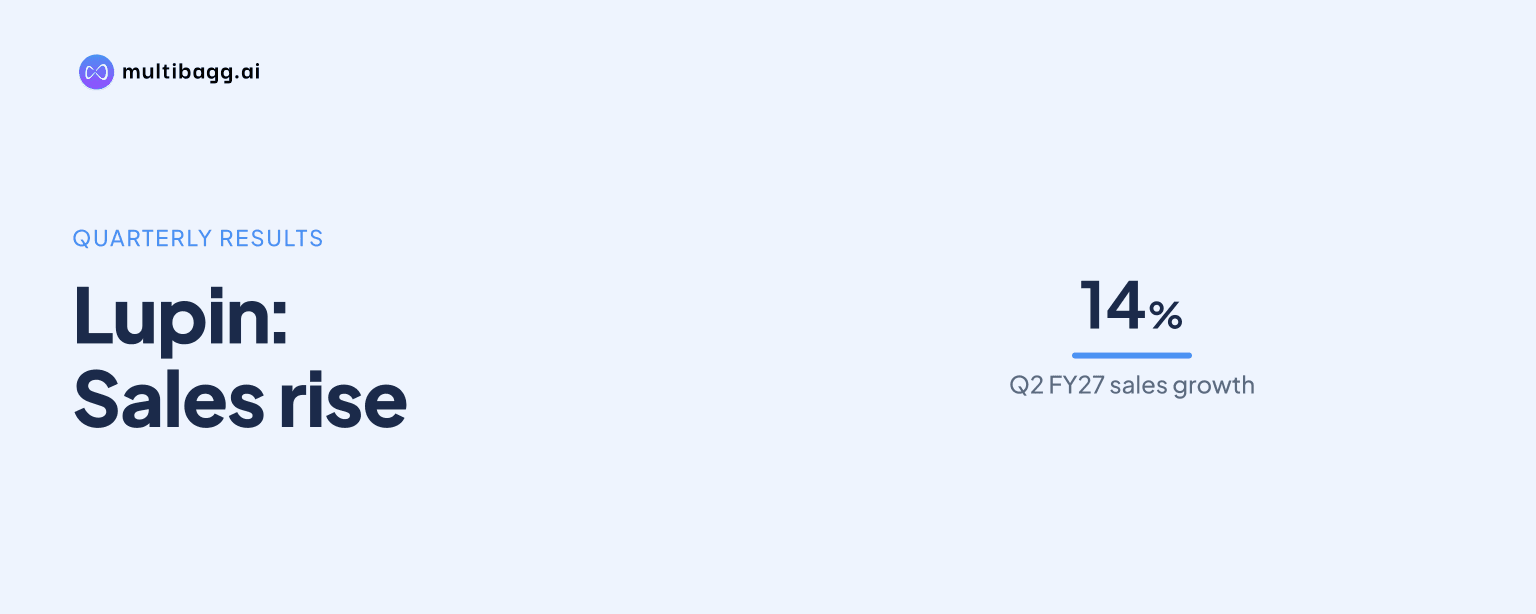
Lupin’s Q2 FY27 sales rose 14% year on year to Rs 7,785.5 crore, but EBITDA declined 8% to Rs 1,957.4 crore and EBITDA margin fell to 25.1% from 31.3% in Q2 FY26. Net income, after adjusting the NCI stake from profit after tax, declined 22% to Rs 1,155.3 crore.
Know Lupin inside out
Results, valuation, peers and who's buying, in one view.
What did Lupin report for Q2 FY27?
Lupin reported higher sales but lower EBITDA and net income in Q2 FY27. Sales increased from Rs 6,831.4 crore in Q2 FY26 to Rs 7,785.5 crore, while EBITDA declined from Rs 2,137.6 crore to Rs 1,957.4 crore and net income fell from Rs 1,477.9 crore to Rs 1,155.3 crore.
Q2 FY27 sales were also below Rs 8,217.2 crore in Q1 FY27, while EBITDA fell from Rs 2,463.5 crore in the preceding quarter. Lupin calculates EBITDA excluding foreign-exchange effects and other income, and calculates EBITDA margin on net sales excluding those items; its Q2 FY27 net-income margin was 14.8%.
Why did Lupin’s EBITDA margin decline in Q2 FY27?
Lupin’s EBITDA margin declined by 6.2 percentage points year on year to 25.1% in Q2 FY27, from 31.3% in Q2 FY26, even as sales rose by Rs 954.1 crore. The supplied presentation does not provide a cost bridge, pricing analysis or identified one-off item explaining the margin movement.
The latest margin was also below 30.0% in Q1 FY27 and was the lowest in the five-quarter series shown. EBITDA margin moved from 31.3% in Q2 FY26 to 31.1% in Q3 FY26, 29.4% in Q4 FY26, 30.0% in Q1 FY27 and 25.1% in Q2 FY27.
The differing revenue and earnings movements are visible in the absolute figures. Q2 FY27 EBITDA was Rs 180.2 crore below the prior-year quarter, while net income was Rs 322.6 crore lower, despite the 14% increase in sales. Management described the operating performance as steady and referred to healthy EBITDA margins, while the presentation’s financial data show lower reported profit measures.
Which markets drove Lupin’s Q2 FY27 sales growth?
Lupin’s largest sales-mix markets were the United States at Rs 3,020.2 crore, or 39% of Q2 FY27 sales, and India at Rs 2,383.6 crore, or 31%. The United States figure includes intellectual-property income, and the two markets together represented 70% of the Rs 7,785.5 crore sales total.
India sales increased 15% year on year to Rs 2,383.6 crore, while North America sales increased 10% to Rs 3,169.6 crore. Asia-Pacific, or APAC, sales grew 43% to Rs 427.3 crore and Europe, Middle East and Africa, or EMEA, sales grew 40% to Rs 991.3 crore; active pharmaceutical ingredient, or API, sales increased 20% to Rs 308.6 crore.
Not all reported businesses expanded in Q2 FY27. Latin America, or LATAM, sales declined 30% year on year to Rs 242.7 crore, while rest-of-world sales declined 4% to Rs 262.4 crore. The presentation therefore records growth in India, North America, APAC, EMEA and API alongside declines in LATAM and rest of world.
Got a follow-up? Ask IRIS
How was Lupin’s Q2 FY27 revenue mix divided?
Lupin generated 39% of Q2 FY27 sales from the United States, 31% from India, 15% from other developed markets, 11% from emerging markets and 4% from API. The five categories total Rs 7,785.5 crore, matching the company’s stated Q2 FY27 sales.
Other developed markets generated Rs 1,182.3 crore and include Canada, Australia, Europe and other markets. Emerging markets generated Rs 890.8 crore and include LATAM, South Africa, the Philippines and rest of world, which differs from the separate operating-performance presentation of APAC, LATAM, EMEA and rest of world.
Combining the disclosed categories, the United States and other developed markets accounted for 54% of Q2 FY27 sales, while India and emerging markets accounted for 42%. These are calculations from Lupin’s reported mix percentages, with API representing the remaining 4%.
What product and compliance updates did Lupin disclose?
Lupin received tentative approval from the U.S. Food and Drug Administration for Apixaban Oral Suspension through the 505(b)(2) pathway and launched Sugammadex Injection in the United States. The presentation does not give a launch date for Apixaban Oral Suspension, and tentative approval is the status disclosed for that product.
In business development, Lupin entered a strategic partnership with Tenpoint Therapeutics to commercialize YUVEZZI across the European Union, United Kingdom, Switzerland, Norway and Iceland. It also received a marketing authorization application for Ranibizumab in the United Kingdom and Australia, launched Formoterol-Glycopyrrolate metered-dose inhaler in India, and initiated developmental-batch supply related to a contract development and manufacturing organisation technology-transfer deal.
For compliance, Ankleshwar and Somerset received establishment inspection reports with voluntary action indicated status from the U.S. Food and Drug Administration. Pithampur Unit II remained under official action indicated status, with Lupin stating that it had submitted its response and remediation was in progress; Mandideep Unit I received approval from Brazil’s ANVISA and Tarapur received World Health Organization approval.
Conclusion
Lupin’s Q2 FY27 results show that 14% sales growth to Rs 7,785.5 crore did not translate into higher reported EBITDA or net income. Growth in India, North America, APAC, EMEA and API was accompanied by a 25.1% EBITDA margin, down from 31.3% a year earlier, while LATAM and rest-of-world sales declined.
The next disclosed milestones include Lupin’s plan to launch more than 20 products in India in FY27 and about 15 products in the United States, including one 505(b)(2) product, one biosimilar and three injectables. Management also plans to file more than 15 abbreviated new drug applications in FY27, while remediation at Pithampur Unit II remains in progress.