










Lupin standalone loss follows ₹76.93 crore investment impairment
Key highlights
- Lupin booked a ₹76.93 crore standalone impairment on an investment in a subsidiary in the September 2026 quarter.
- Lupin reported a ₹5.91 crore standalone net loss, compared with ₹1,357.35 crore profit a year earlier.
- Lupin’s consolidated September-quarter net profit was ₹1,155.30 crore despite the parent-company standalone loss.
- Lupin’s investment in subsidiaries stood at ₹14,907.45 crore at September 30, 2026, versus ₹12,137.09 crore at March 31, 2026.
powered by IRIS
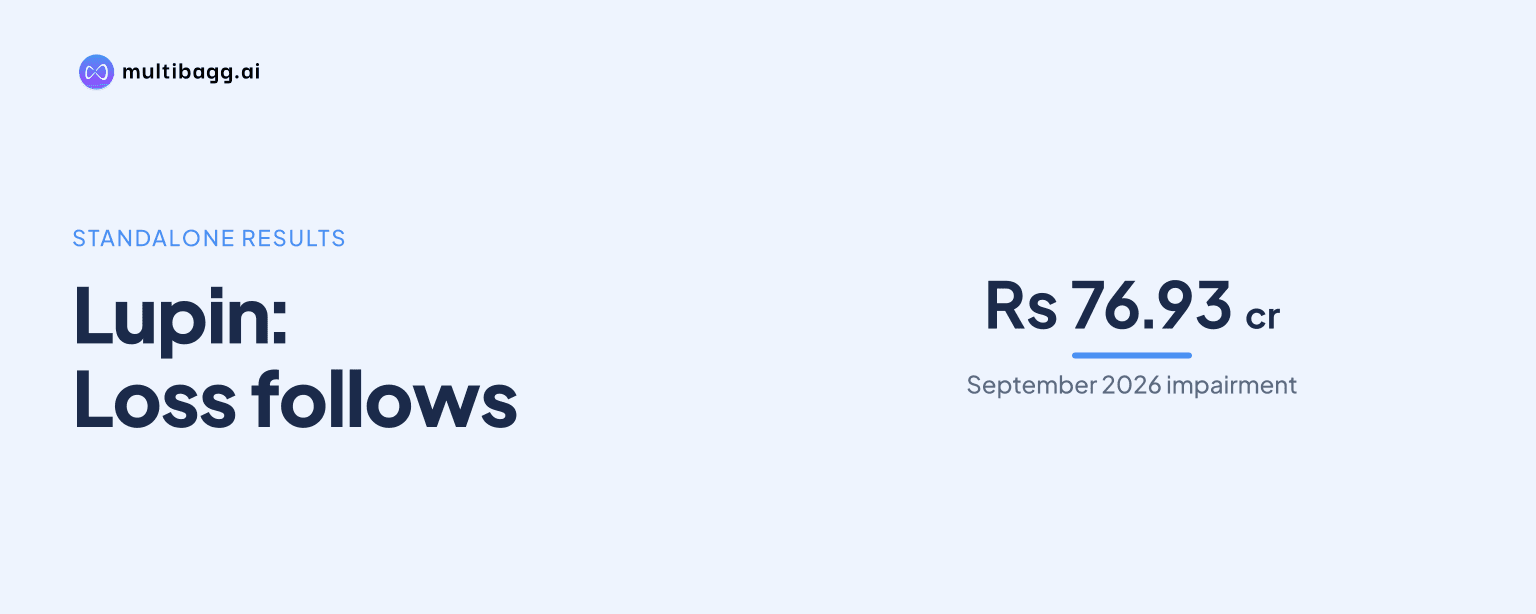
Lupin Limited reported a standalone net loss of ₹5.91 crore for the quarter ended September 30, 2026, after recognising a ₹76.93 crore impairment on an investment in a subsidiary. Lupin recorded standalone profit before exceptional items and tax of ₹81.12 crore, but the impairment and ₹10.10 crore tax expense moved the quarter into loss.
Know Lupin inside out
Results, valuation, peers and who's buying, in one view.
What caused Lupin’s standalone loss in the September quarter?
Lupin’s standalone loss resulted from a ₹76.93 crore exceptional impairment charge on an investment in a subsidiary. The company said the investment’s carrying value exceeded its recoverable amount during the quarter and six months ended September 30, 2026, leading it to provide for diminution in value.
Before the exceptional charge, Lupin generated standalone profit before exceptional items and tax of ₹81.12 crore in the September 2026 quarter. The impairment reduced pre-tax profit to ₹4.19 crore; total tax expense of ₹10.10 crore then resulted in a ₹5.91 crore net loss. Basic and diluted earnings per share after exceptional items were each negative Rs 0.13, compared with Rs 1.55 before exceptional items.
Lupin had also recognised a ₹70 crore diminution provision on an investment in a wholly owned subsidiary in prior periods ended September 30, 2025 and March 31, 2026. The September 2026 filing does not identify the subsidiary affected by the new impairment or disclose the recoverable amount used in that assessment.
How did Lupin’s standalone earnings change from a year earlier?
Lupin moved from standalone net profit of ₹1,357.35 crore in the quarter ended September 30, 2025 to a ₹5.91 crore loss in the latest quarter. Total income declined by ₹475.42 crore year on year, while total expenses increased by ₹486.59 crore, reducing pre-exceptional profit before tax from ₹1,043.13 crore to ₹81.12 crore.
Exceptional items also changed sharply between the two periods. The September 2025 quarter included ₹592.68 crore of exceptional income, whereas September 2026 included the ₹76.93 crore investment impairment expense. The earlier gain reflected, among other transactions, the transfer of Lupin’s Indian over-the-counter business to Lupinlife Consumer Healthcare Limited for ₹820 crore, which generated a disclosed divestment gain of ₹658.96 crore.
For the six months ended September 30, 2026, Lupin’s total income increased to ₹10,937.24 crore from ₹9,901.01 crore in the year-earlier period. Net profit after tax nevertheless declined to ₹2,708.69 crore from ₹3,485.42 crore, as the earlier half-year included ₹592.68 crore of exceptional income while the latest half-year contained the impairment expense.
Why was Lupin’s consolidated business still profitable?
Lupin remained profitable on a consolidated basis because the subsidiary-investment impairment was recorded in the parent’s standalone accounts, while the consolidated September 2026 statement reported no exceptional item. Consolidated net profit after tax was ₹1,155.30 crore for the quarter, compared with ₹1,484.83 crore a year earlier.
Consolidated total income rose to ₹7,954.05 crore in the September 2026 quarter from ₹7,137.51 crore in September 2025. Total expenses increased to ₹6,374.46 crore from ₹5,130.54 crore, resulting in consolidated profit before tax and exceptional items of ₹1,579.60 crore, down from ₹2,006.97 crore in the prior-year quarter.
The differing outcomes reflect the scope of the two statements. Standalone results include Lupin’s carrying value of its subsidiary investments, while consolidated results combine the parent and subsidiaries; consolidated basic earnings per share were Rs 25.27 in the latest quarter, compared with Rs 32.36 a year earlier.
Got a follow-up? Ask IRIS
What changed in Lupin’s subsidiary investments and cash flows?
Lupin’s standalone investment in subsidiaries rose to ₹14,907.45 crore at September 30, 2026 from ₹12,137.09 crore at March 31, 2026, despite the ₹76.93 crore impairment. Total standalone assets increased to ₹38,213.47 crore from ₹36,102.89 crore, while total equity rose to ₹32,118.88 crore from ₹30,133.77 crore.
The six-month cash-flow statement recorded ₹710.12 crore of investments in subsidiaries, compared with ₹70 crore in the six months ended September 30, 2025. Lupin also provided ₹51.50 crore of loans to subsidiaries and received ₹111.50 crore of subsidiary loan repayments in the latest half-year period.
Net cash generated from operating activities increased to ₹2,607.19 crore in the six months ended September 30, 2026 from ₹2,274.54 crore a year earlier. Investing activities used ₹1,503.18 crore, against an outflow of ₹2,560.74 crore in the previous period, while financing activities used ₹1,050.21 crore, including ₹823.02 crore of dividend payments.
What other disclosures accompanied Lupin’s results?
Lupin said its wholly owned subsidiary settled one ongoing antitrust matter during the period ended September 30, 2026 for ₹316.28 crore, or US$35.8 million, without admission of liability or wrongdoing. The company had recorded a ₹449.39 crore provision, equivalent to US$50 million, for generic pharmaceuticals antitrust litigation in the year ended March 31, 2026.
Lupin and its subsidiary also entered a February 9, 2026 settlement agreement with Astellas concerning Mirabegron ER Tablets, a generic version of Myrbetriq ER Tablets in US markets, for US$90 million. Lupin compensated Lupin Pharmaceuticals, Inc., U.S.A. ₹136.47 crore for the US$15 million payment during the year ended March 31, 2026, while the subsidiary paid and capitalised the remaining US$75 million as a prepaid option.
Lupin’s board approved the unaudited standalone and consolidated results on November 3, 2026. Deloitte Haskins & Sells Chartered Accountants LLP issued a limited-review conclusion stating that nothing had come to its attention to indicate a material misstatement or required disclosure failure in the standalone results.
Conclusion
Lupin’s September 2026 standalone loss principally reflected the ₹76.93 crore write-down of a subsidiary investment, which reduced ₹81.12 crore of pre-exceptional profit to a ₹5.91 crore loss after tax. The consolidated group remained profitable at ₹1,155.30 crore, although its quarterly profit declined from ₹1,484.83 crore a year earlier as expenses rose faster than income.
The next issue to watch is whether Lupin provides further information about the subsidiary investment impairment, including the assumptions behind recoverable value. The filing also leaves legal matters in view, including the ₹316.28 crore antitrust settlement and the US$90 million Astellas agreement, while investments in subsidiaries stood at ₹14,907.45 crore at September 30, 2026.