










Mahanagar Gas Limited expects HPHT allocation to triple
Key highlights
- MGL expects HPHT gas allocation of 16,000-18,000 MMBtu a day from July 2027, versus 5,000-6,000 previously.
- The HPHT allocation formula becomes 100% linked to CNG and domestic-PNG consumption from July 2027.
- Pure spot RLNG represented about 2.5% of MGL's total volume in Q2 FY27.
- MGL's Q2 FY27 CNG and domestic-PNG volumes rose 9.14% and 9.84% year on year, respectively.
powered by IRIS
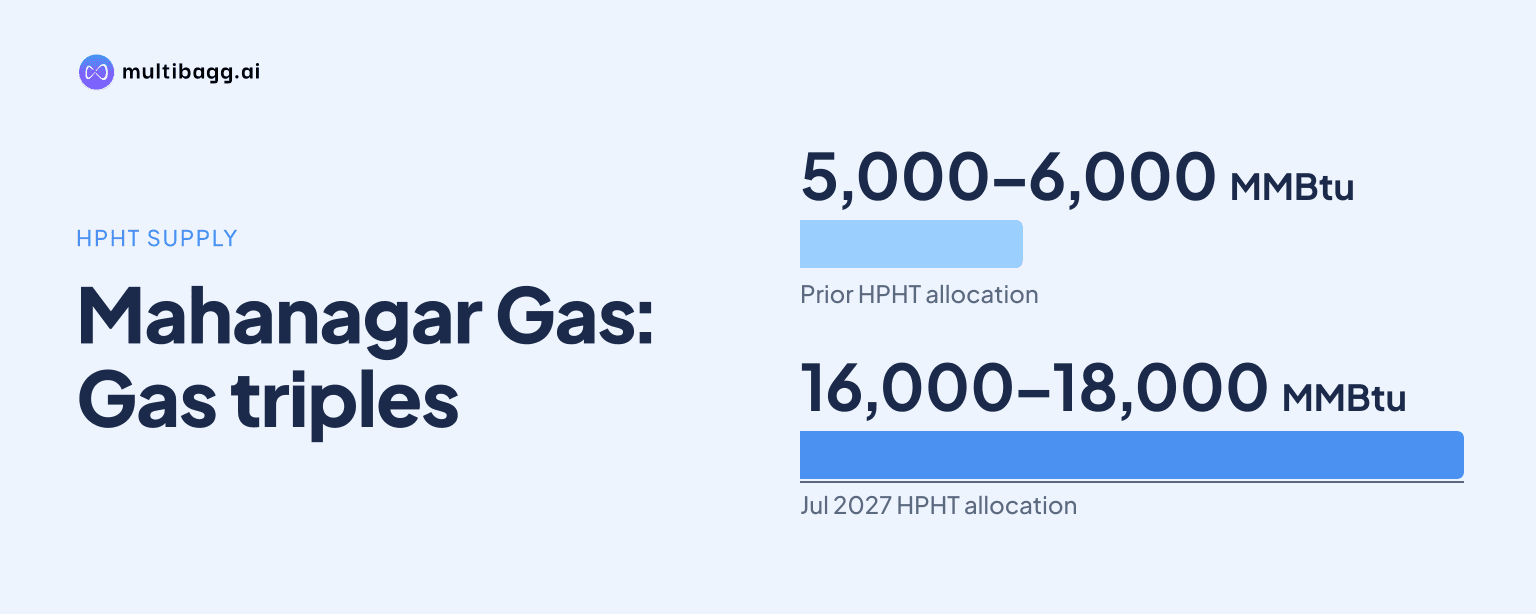
Mahanagar Gas Limited expects its HPHT gas allocation to reach about 16,000-18,000 million British thermal units (MMBtu) a day from July 2027, around 3.5 times its earlier 5,000-6,000 MMBtu-a-day range, under a phased formula tied to compressed natural gas and domestic piped natural gas consumption.
Know Mahanagar Gas inside out
Results, valuation, peers and who's buying, in one view.
How will MGL's HPHT allocation change?
MGL's HPHT allocation will progressively shift from an equal allocation among bidding legal entities to an allocation weighted by each bidder's previous compressed natural gas (CNG) and domestic piped natural gas (PNG) consumption. Management said this approach allocates gas according to priority-segment volumes rather than treating all bidding entities equally regardless of those sales.
The revised formula is being introduced in stages because an immediate change could leave entities receiving less HPHT gas with insufficient time to arrange alternative supply. For November and December, 25% of the available quantity will use consumption proportions and 75% the number of bidding legal entities. The consumption-based component then rises to 50% in January-March and 75% in April-June, before reaching 100% from July 2027.
Management's example used MGL's approximately 3.5 million standard cubic metres a day (MMSCMD) of CNG sales and 0.7 MMSCMD of domestic PNG sales, together about 4.2 MMSCMD. A company selling 2 MMSCMD across those priority segments would receive about half the quantity in that example under the consumption-linked formula.
How much HPHT gas does MGL expect to receive?
MGL expects full implementation of the formula to lift its allocation to around 16,000-18,000 MMBtu a day, or about 3.5 times the historical 5,000-6,000 MMBtu-a-day range. Management made that estimate conditional on monthly HPHT volumes offered for spot sale through the Indian Gas Exchange (IGX) remaining at similar levels.
The transition is expected to start with 7,000-8,000 MMBtu a day, versus the previous 5,000-6,000 MMBtu a day. Management said another 2,500 MMBtu a day should be added at each subsequent step-up, subject to the HPHT quantity available on IGX. The expected improvement is therefore phased rather than an immediate rise to the July 2027 range.
Under the earlier entity-count method, MGL typically received 4.5%-5% of the volume available when most of the 17 or 18 possible entities bid. The new calculation instead reflects MGL's priority-segment consumption, where second-quarter CNG volume was 3.55 MMSCMD and domestic PNG volume was 0.64 MMSCMD. Those volumes grew 9.14% and 9.84%, respectively, from the corresponding quarter a year earlier.
Why does the allocation matter for MGL's gas sourcing?
The higher HPHT allocation could reduce MGL's need to use spot liquefied natural gas (LNG), although management did not quantify a cost saving. In Q2 FY27, pure spot regasified LNG (RLNG) accounted for about 2.5% of company-wide volume and 4% of CNG volume; including HPHT spot purchases through IGX, spot represented around 11% of CNG volume.
Management said it would have completely avoided spot purchases in Q2 FY27 but for the sudden change in the HPHT allocation arrangement, which created a temporary supply gap. LNG prices were hovering at $22-$23 during the quarter. MGL has also arranged new term gas with a modified formula for the current disruption, alongside long-term contracts of around 40,000 MMBtu.
MGL's sourcing mix differs by customer segment. Domestic PNG is supplied entirely by administered price mechanism (APM) gas, while industrial and commercial volumes are mostly served through RLNG term contracts, primarily Henry Hub-linked with a smaller Brent-linked quantity. For CNG, management described roughly 60% as domestically produced gas and 40% as term gas, with spot gas at about 4%.
Got a follow-up? Ask IRIS
What could limit MGL's benefit from the new formula?
The allocation estimate depends on HPHT volumes continuing to be offered through IGX at comparable monthly levels, so the formula itself does not guarantee the 16,000-18,000 MMBtu-a-day outcome. Management also said actual imported LNG deliveries have varied despite term contracts, and this could require an interim return to spot purchases if supply falls short.
MGL said imported LNG availability in India remains a key determinant of its gas cost. Management is seeking to minimise spot exposure through term contracts and has partly changed some indexed contracts to fixed contracts. It said it evaluates supply and pricing conditions every fortnight and every month rather than providing a firm FY27 or FY28 earnings before interest, tax, depreciation and amortisation (EBITDA) margin forecast.
A further uncertainty is the structure of producers' contracts during the transition. Management said term contracts may not be offered in this period, or could be split into a portion ending in June 2027 and a separate portion from July onward, when the 100% consumption-based formula applies. MGL also said it has advocated for an allocation policy for new well gas (NWG), but disclosed no indication that such a policy will be introduced.
How do MGL's priority-segment volumes compare with other sales?
MGL's priority-segment growth provides the consumption base that management says will drive the HPHT allocation. Overall sales volume rose 6.49% year on year to 4.89 MMSCMD in Q2 FY27 from 4.59 MMSCMD, led by CNG at 3.55 MMSCMD and domestic PNG at 0.64 MMSCMD. MGL had more than 1.34 million registered CNG vehicles in its geographies as of September 30, 2026.
Industrial and commercial volume moved in the opposite direction year on year, falling 7.48% to 0.70 MMSCMD from 0.76 MMSCMD because of supply restrictions and higher Brent prices. Management said smaller commercial customers grew nearly 12% in the first half and CNG and domestic sales each grew almost 9.5%, while industrial curtailments caused the overall growth rate to be lower than it otherwise could have been.
Quarter on quarter, total volume increased 2.63% from 4.766 MMSCMD to 4.892 MMSCMD, while industrial and commercial sales rose 8.07% from 0.648 MMSCMD to 0.70 MMSCMD. However, Q2 FY27 operating EBITDA was Rs 287 crore, down from Rs 343 crore in the preceding quarter, and net profit after tax was Rs 137 crore versus Rs 194 crore. Management cited volume-linked operating expenses and a one-time actuarial impact of about Rs 10 crore to Rs 12 crore in the quarter.
Conclusion
MGL's expected HPHT allocation increase is tied to its relatively large CNG and domestic-PNG sales base: the new formula moves the company from an estimated 5,000-6,000 MMBtu a day to a potential 16,000-18,000 MMBtu a day. The significance is primarily sourcing flexibility, as management seeks to limit spot exposure through higher HPHT availability and term-contract supply.
The next point to watch is the formula's scheduled move to 50% consumption weighting in January-March, 75% in April-June and 100% from July 2027. Management's allocation estimate also depends on unchanged HPHT volumes on IGX and on whether LNG suppliers meet contracted deliveries during the transition.