










Mahanagar Gas retains Rs 1,500-1,800 crore capex plan
Key highlights
- Mahanagar Gas spent about Rs 643 crore on capex in the first half of FY27 while retaining its Rs 1,500 crore to Rs 1,800 crore annual plan.
- Management cited nearly Rs 1,000 crore of surplus cash and operating inflows of more than Rs 1,000 crore to Rs 1,200 crore as funding sources.
- Management agreed that free cash flow could be negative by Rs 200 crore to Rs 300 crore under the capex programme.
- Pipeline permissions are generally limited from mid-May through October, and management expects work to accelerate after October.
powered by IRIS
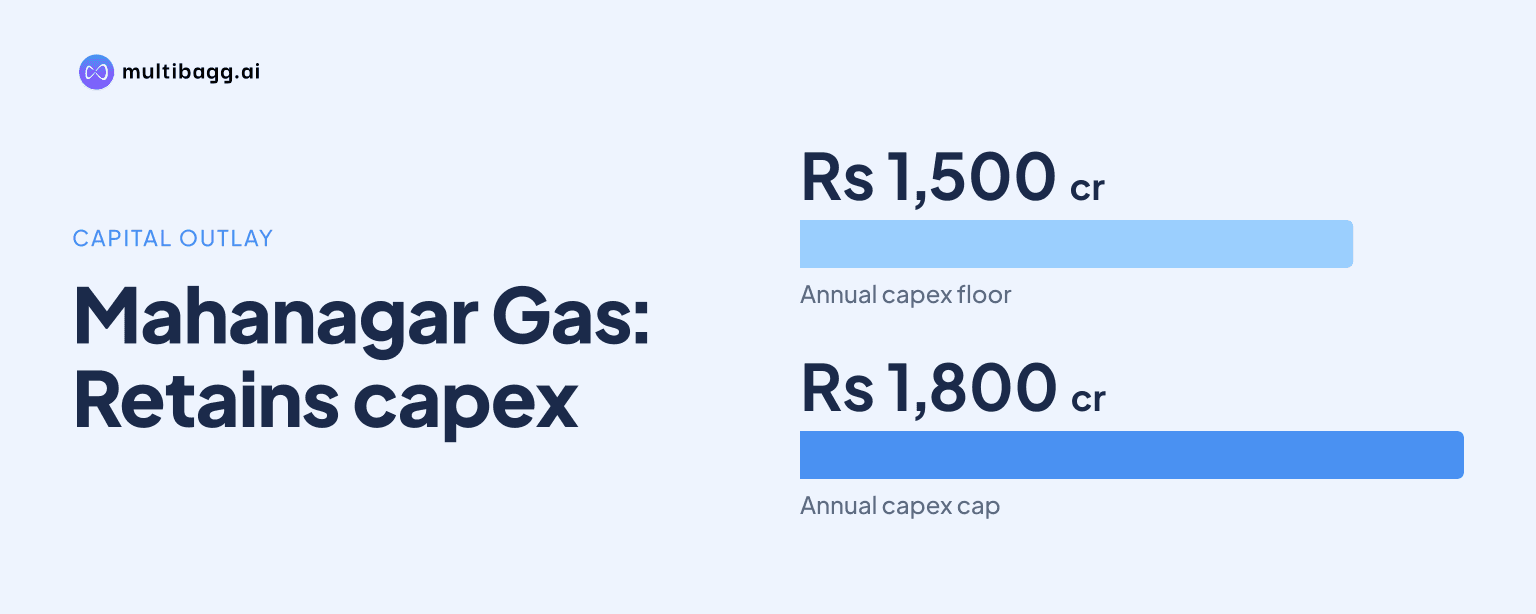
Mahanagar Gas Limited retained its Rs 1,500 crore to Rs 1,800 crore annual capex plan after spending about Rs 643 crore in the first half of FY27, saying pipeline work normally accelerates after October and that nearly Rs 1,000 crore of surplus cash, operating inflows and customer deposits mean debt may not be warranted.
Know Mahanagar Gas inside out
Results, valuation, peers and who's buying, in one view.
Why is Mahanagar Gas retaining its annual capex plan?
Mahanagar Gas is retaining its Rs 1,500 crore to Rs 1,800 crore annual capex plan because management expects pipeline-laying activity to pick up after the monsoon period ends in October. Management said first-half capex of about Rs 643 crore was seasonally lower because permissions for pipeline work are generally not available from mid-May through October. It maintained the existing range while saying its ambition is to invest more and capture the market.
The first-half figure represents 36% to 43% of the stated full-year range, leaving Rs 857 crore to Rs 1,157 crore to be spent in the second half. That implied second-half deployment is higher than first-half spending, reflecting management's expectation that execution starts to accelerate from October. The call did not disclose quarterly capex milestones, individual project costs, pipeline lengths or geographic allocations.
Management distinguished the formal annual range from its broader intention to spend more than Rs 1,500 crore where feasible. It said city gas distribution, or CGD, companies are competing for similar materials, manpower and labour skills, and operations cannot be scaled up immediately. Those execution constraints could affect the pace at which Mahanagar Gas converts its post-October construction plan into capex.
How will Mahanagar Gas fund negative free cash flow?
Mahanagar Gas said debt may not be warranted if free cash flow turns negative by Rs 200 crore to Rs 300 crore because it has nearly Rs 1,000 crore of surplus cash, expects operating cash inflow of more than Rs 1,000 crore to Rs 1,200 crore, and receives customer deposits. In this discussion, free cash flow means operating cash generation less capital expenditure. Management agreed with the Rs 200 crore to Rs 300 crore estimate raised by an analyst.
The analyst framed the potential cash-flow deficit around FY27 and FY28, but Mahanagar Gas did not provide separate free-cash-flow forecasts for either year. Management instead identified its existing cash surplus, future operating inflows and customer deposits as the funding mechanisms. It did not announce a borrowing programme, debt target or mutual-fund liquidation plan during the call.
Customer deposits could partly support network expansion, but the transcript did not quantify either the deposits held or annual additions to them. Similarly, management's more than Rs 1,000 crore to Rs 1,200 crore operating-inflow expectation was not split by customer segment or period. The funding outcome will therefore depend on the timing of capex after October and the delivery of the expected operating cash generation.
What caused Mahanagar Gas's first-half capex slowdown?
Mahanagar Gas said monsoon-related restrictions on pipeline-laying permissions caused the first-half slowdown, with work generally constrained from mid-May until October. The company said actual construction starts picking up from October, making a lower first-half run rate normal rather than a change to its Rs 1,500 crore to Rs 1,800 crore capex plan. This seasonal pattern is central to management's explanation for the Rs 643 crore first-half outlay.
The company also said material availability and labour capacity can limit construction even after the monsoon. Its comments indicate that competition among CGD operators for the same resources may affect the upper end of spending, despite management's stated effort to expand faster. Mahanagar Gas did not identify a specific supplier, labour category or construction package that has delayed its FY27 programme.
Its commercial-vehicle incentive programme shows a separate demand-building expenditure linked to gas consumption. Management said registrations and commitments exceeded 800 larger commercial vehicles, around 110 had been delivered, and quarterly expense was about Rs 3.5 crore to Rs 4 crore. Incentives of roughly Rs 3.5 lakh per vehicle are paid only after delivery and the vehicle begins consuming gas at Mahanagar Gas stations.
Got a follow-up? Ask IRIS
Which operating factors could affect Mahanagar Gas cash generation?
Mahanagar Gas said gas availability, gas costs and sales volumes will affect operating cash generation, even as it expects more than Rs 1,000 crore to Rs 1,200 crore of operating inflows. Management said industrial volumes were affected by restrictions on regasified liquefied natural gas, or RLNG, supply, which it described as being in the range of 70% and sometimes 80%. It also said higher Brent-linked prices made some industrial customers more cautious about consumption.
The company drew a contrast between commercial and industrial demand. Commercial volumes from smaller restaurants that otherwise use 19-kilogram liquefied petroleum gas cylinders rose around 9% to 10%, while industrial volumes declined amid supply restrictions and pricing pressure. Management said customers' daily contracted quantity commitments had increased, and it expects industrial volumes to rebound by more than double digits when conditions normalise, although it gave no date for that normalisation.
Pricing is formula-linked across 100% of industrial and commercial customers and resets monthly against liquefied petroleum gas bottle prices, fuel oil and low-density oil combinations. In the second quarter versus the first quarter, 19-kilogram liquefied petroleum gas cylinder prices rose by more than 25%, while fuel oil and low-density oil declined by about 6% to 15%. Management said these movements lifted commercial realisations but reduced realisations for some larger industrial customers.
For compressed natural gas, or CNG, management cited current unit earnings before interest, tax, depreciation and amortisation, or EBITDA, of around Rs 6.77 per standard cubic metre. It said a Rs 1 to Rs 1.5 change could take unit EBITDA to Rs 7 per standard cubic metre if other conditions remain unchanged. Management said it reviews gas supply, term-contract availability and price conditions every fortnight or month, rather than offering a FY27 or FY28 margin forecast.
Conclusion
Mahanagar Gas has kept its Rs 1,500 crore to Rs 1,800 crore capex range intact despite Rs 643 crore of first-half FY27 spending because it views monsoon-related permission limits as seasonal. Management accepted the possibility of Rs 200 crore to Rs 300 crore negative free cash flow, but said nearly Rs 1,000 crore of surplus cash, operating inflows of more than Rs 1,000 crore to Rs 1,200 crore and customer deposits could meet funding needs without debt.
The next measures to watch are the pace of pipeline work after October and whether manpower and material constraints curb second-half capex. Gas supply remains an unresolved operating factor: management cited RLNG restrictions in the range of 70% to 80%, while saying 40,000 MMBTU of newly signed term gas is already flowing and that it will continue to assess supply and pricing conditions every fortnight or month.