










Mahanagar Gas Limited Q2 profit falls 28.4% to ₹137 crore
Key highlights
- MGL reported Q2 FY27 net profit of ₹137.03 crore, down 28.4% year on year.
- Overall gas sales volume rose 6.49% to 4.89 MMSCMD in Q2 FY27.
- CNG sales grew 9.14% to 3.55 MMSCMD, while domestic DPNG sales rose 9.84% to 0.64 MMSCMD.
- MGL added 65 km of pipeline and completed 70,501 DPNG conversions during the quarter.
powered by IRIS
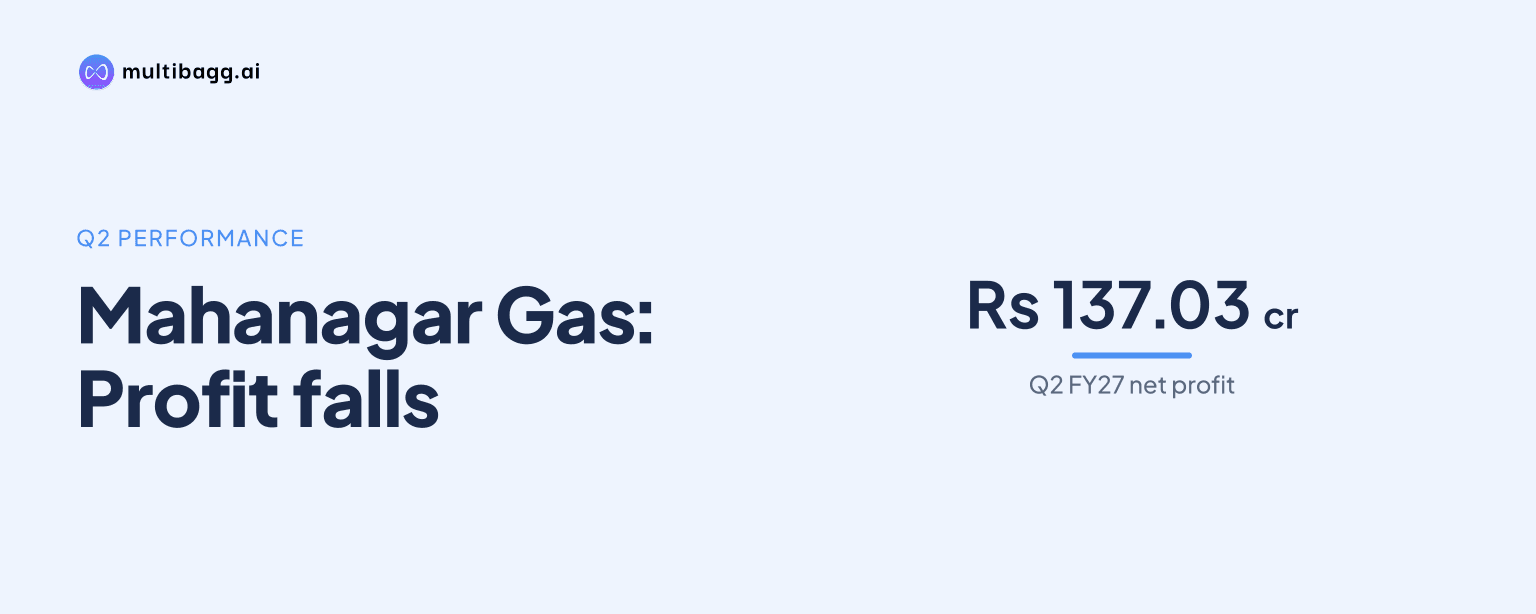
Mahanagar Gas Limited reported Q2 FY27 net profit of ₹137 crore, down 28.4% year on year, even as overall gas sales volume rose 6.49% to 4.89 MMSCMD for the quarter ended September 30, 2026. The company discussed the result, supply conditions, pricing and expansion plans in its November 4 earnings call.
Know Mahanagar Gas inside out
Results, valuation, peers and who's buying, in one view.
What did Mahanagar Gas report for Q2 FY27?
Mahanagar Gas Limited, referred to as MGL, reported standalone revenue from operations of ₹2,776.74 crore in Q2 FY27, an increase of 23.06% from ₹2,256.36 crore a year earlier. Net profit was ₹137.03 crore, compared with ₹191.37 crore in Q2 FY26. The company’s Q2 results were declared on November 3, 2026, followed by the earnings conference call on November 4.
MGL said EBITDA from operations was ₹287 crore in the September quarter, compared with ₹343 crore in the preceding quarter. EBITDA for the first half of FY27 stood at ₹630 crore, versus ₹839 crore in the corresponding prior-year half. First-half profit after tax was ₹331 crore, while the reported standalone H1 revenue from operations was ₹5,374.63 crore.
The reported result also included a ₹17.33 crore exceptional impairment loss on MGL’s investment in 3EV Industries. The auditor’s limited review conclusion was unmodified, according to the company’s disclosure.
How did MGL’s gas volumes change during the quarter?
MGL’s overall sales volume increased 6.49% year on year to 4.89 million standard cubic metres per day, or MMSCMD, from 4.59 MMSCMD. Sequentially, total volume increased 2.63% from 4.766 MMSCMD in the prior quarter, based on the operational update discussed during the call.
CNG volume grew 9.14% year on year to 3.55 MMSCMD from 3.26 MMSCMD. Domestic DPNG volume increased 9.84% to 0.64 MMSCMD from 0.58 MMSCMD. These two segments supported the increase in total sales volumes during the quarter.
Industrial and commercial sales volume, however, declined 7.48% year on year to 0.70 MMSCMD from 0.76 MMSCMD. Management attributed the fall mainly to supply restrictions and higher Brent crude prices. This segment-level movement is relevant because MGL discussed customer pricing and gas sourcing amid a more difficult supply environment.
Why did MGL discuss gas supply and pricing conditions?
MGL said the ongoing West Asia conflict and uncertainty around the Strait of Hormuz were affecting global LNG availability and prices. Management also said India’s natural gas supply situation was gradually improving, with LNG imports showing signs of recovery.
The company’s call covered pricing strategy for industrial and commercial customers, supply sourcing and operating costs. MGL did not provide a specific pricing outcome in the disclosed material, but the discussion shows that imported gas availability and international energy prices remained important operating variables during the period.
For investors, the combination of revenue growth and lower quarterly profit underlines the distinction between sales expansion and profitability. Revenue grew year on year, while the reported operating margin was 12.01%, compared with 16.49% a year earlier in the investor presentation summary. The figures indicate pressure on earnings conversion during the quarter.
Got a follow-up? Ask IRIS
What network and customer additions did MGL make?
MGL completed 70,501 DPNG conversions during the quarter, taking cumulative conversions to 2.24 million. DPNG, or domestic piped natural gas, is a core part of the company’s city gas distribution network and complements CNG sales in its operating areas.
The company laid 65 km of steel and polyethylene pipeline in the quarter, taking its total pipeline network beyond 8,500 km. The expansion was disclosed alongside management’s discussion of capital expenditure plans and capital funding on the earnings call.
Network expansion and new household connections can broaden the distribution base over time, but the call did not disclose a revised capital expenditure target or funding amount. Investors therefore have clarity on the quarter’s physical additions but not on a new quantified spending programme from the available transcript details.
How do the Q2 figures matter for MGL investors?
MGL’s Q2 FY27 update showed that CNG and domestic DPNG demand grew faster than overall volumes, while industrial and commercial demand contracted. The total sales increase to 4.89 MMSCMD provides an operational counterpoint to the decline in quarterly profit and EBITDA from the preceding quarter.
The result also draws attention to external input conditions. Management linked lower industrial and commercial volumes to supply restrictions and higher Brent prices, while identifying LNG availability as a continuing consideration. These factors can affect sourcing, customer pricing decisions and segment mix, although the call did not provide a financial forecast.
MGL’s transcript submission gives shareholders access to management’s explanation of the unaudited results for the quarter and half year ended September 30, 2026. The key disclosed data points remain volume growth in CNG and domestic DPNG, a lower quarterly profit base, and continued work on pipeline and connection expansion.
Conclusion
MGL recorded higher revenue and gas sales volumes in Q2 FY27, but net profit fell 28.4% year on year to ₹137 crore and EBITDA from operations was lower than the preceding quarter. CNG and domestic DPNG growth supported overall volumes, while industrial and commercial sales declined amid supply restrictions and higher Brent prices.
The next areas to watch are MGL’s handling of pricing and gas sourcing conditions, the pace of DPNG conversions and pipeline additions, and the company’s capital expenditure and funding approach. Management discussed these subjects during the November 4 call but did not disclose new quantified targets in the provided transcript details.