










Maharashtra Seamless Says Ind AS Masked Q2 Pipe Margins
Key highlights
- Maharashtra Seamless reported Q2 FY27 seamless EBITDA of Rs 9,220 per tonne, compared with Rs 15,660 per tonne in Q1 FY27.
- Maharashtra Seamless said its order book rose by Rs 500 crore to Rs 2,200 crore in Q2 FY27.
- Management expects the inventory-valuation effect to reverse in the December quarter as pipes are dispatched.
- Maharashtra Seamless said it is on track for 430,000 tonnes of FY27 dispatches after about 200,000 tonnes in the first half.
powered by IRIS
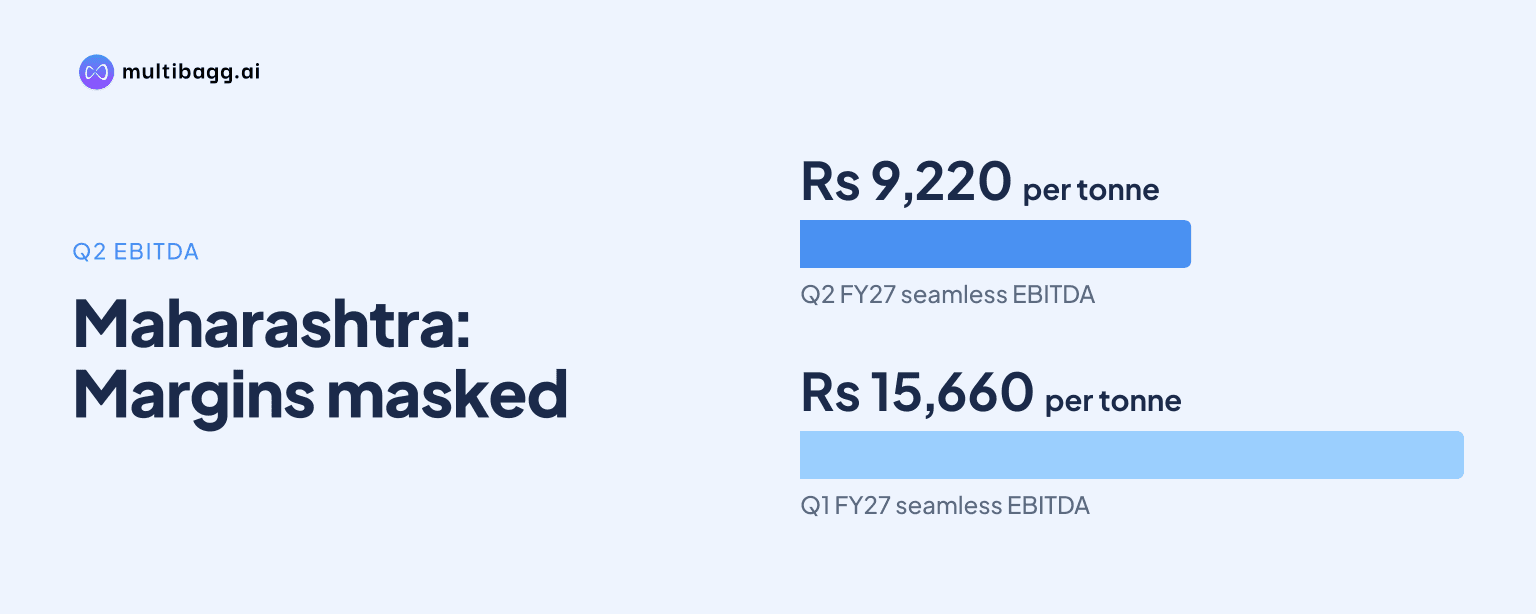
Maharashtra Seamless Limited said Q2 FY27 seamless-pipe EBITDA of Rs 9,220 per tonne was depressed by an Ind AS inventory-valuation adjustment, rather than order profitability, versus Rs 15,660 per tonne in Q1 FY27. Management expects the effect to reverse in the December quarter as higher-cost inventory is made into pipes and dispatched.
Know Maharashtra Seamless inside out
Results, valuation, peers and who's buying, in one view.
Why did Maharashtra Seamless report lower Q2 EBITDA per tonne?
Maharashtra Seamless said the Q2 FY27 decline in EBITDA per tonne resulted from inventory valuation rather than deterioration in sales realisation, costs or order-level profitability. The company reported seamless-pipe EBITDA of Rs 9,220 per tonne in Q2, compared with Rs 15,660 per tonne in Q1. Management said total revenue, sales realisation, and both seamless and ERW pipe dispatches increased during the quarter.
Management also said none of its cost parameters increased despite higher revenue. It described the inventory adjustment as notional and said it did not affect actual profitability on individual orders or the profitability of new orders being received. The reported difference of Rs 6,440 per tonne between Q1 and Q2 was therefore attributed by management to the accounting treatment.
Why did Ind AS inventory valuation affect Maharashtra Seamless's Q2 results?
Maharashtra Seamless said the Ind AS adjustment arose because relevant inventory at the September 30, 2026 quarter end was valued below its procurement price. Management confirmed an analyst's understanding that this difference caused the notional knockdown in reported profitability. It said the effect did not change the economics of the orders already in the book.
The company linked the size of the Q2 effect to a larger inventory base. Steel-billet prices increased rapidly in Q1 FY27 and rose less in Q2, management said, while orders secured in Q2 exceeded those secured in Q1. Maharashtra Seamless said it had to purchase more than Rs 500 crore of inventory, resulting in higher quarter-on-quarter inventory and an adjustment applied to a larger stock of material.
Will Maharashtra Seamless's inventory adjustment reverse in December?
Maharashtra Seamless expects the inventory-valuation impact to reverse in the December quarter when existing inventory is converted into pipes and dispatched. Management said profit is realised when dispatch occurs, and that the currently disproportionate Q2 impact should consequently be reflected differently in the following quarter's reported numbers.
Management did not quantify the expected reversal or provide adjusted Q2 EBITDA per tonne. Its expectation is conditional on the conversion and dispatch of the inventory that produced the September 30, 2026 valuation effect. The company said better margins should be visible once that inventory has been made into pipes and sold through dispatches.
Got a follow-up? Ask IRIS
Are Maharashtra Seamless's current pipe orders profitable?
Maharashtra Seamless said margins on its current order book are good and that underlying EBITDA per tonne was better than the Rs 15,660 per tonne reported for seamless pipes in Q1 FY27. Management made the comparison when asked whether profitability after excluding the inventory effect was similar to, or higher than, the first-quarter reported level.
The company did not disclose an adjusted EBITDA-per-tonne number for Q2 FY27, nor did it provide a margin split between seamless and ERW orders on the call. Its order book increased from Rs 1,700 crore in the prior quarter to Rs 2,200 crore in Q2, and management said the Rs 500 crore increase required further raw-material procurement that contributed to the inventory accounting outcome.
Can Maharashtra Seamless meet its FY27 pipe-dispatch plan?
Maharashtra Seamless said it remains on track for its FY27 dispatch guidance of 430,000 tonnes after completing about 200,000 tonnes in the first half. Management said it expects to dispatch an additional 230,000 tonnes in the remaining half, making the second-half delivery plan relevant to the expected inventory-effect reversal.
The Telangana finishing line is under implementation and will be activated during the current financial year, according to management. Maharashtra Seamless has not started taking orders for the increased capacity because it does not want to buy raw material until the line is fully commissioned. The stated 430,000-tonne plan therefore precedes order booking for the additional Telangana capacity.
How is Maharashtra Seamless separating its pipe businesses?
Maharashtra Seamless said its proposed demerger would create three seamless-pipe companies differentiated by size range, product mix and location. The Nagothane unit, which would remain with Maharashtra Seamless, is planned to cover pipes from 0.5 inch to 20 inches and focus more on oil-and-gas products.
The Mangaon unit is planned to cover pipes from 0.5 inch to 6 inches, with a focus on smaller sizes, cold-drawn pipes and drill pipes. The Telangana unit is planned to cover pipes up to 14 inches and focus more on cylinder pipes, which management said were initially developed at that unit. Premium threaded connections would be part of the Nagothane division because they are physically located beside that manufacturing operation.
Conclusion
Maharashtra Seamless attributed the decline in reported seamless EBITDA per tonne from Rs 15,660 in Q1 FY27 to Rs 9,220 in Q2 FY27 to an Ind AS valuation adjustment on a higher inventory base. Management's explanation rests on higher revenue, sales realisation and pipe dispatches, alongside an order book that expanded by Rs 500 crore to Rs 2,200 crore.
The December-quarter result is the next measure of management's expectation that inventory conversion and dispatches will reverse the Q2 effect. Investors can also watch progress toward 430,000 tonnes of FY27 dispatches and the planned activation of the Telangana finishing line during the current financial year.