










Manaksia says operating factors lifted Q2 EBITDA per tonne
Key highlights
- Manaksia said it has largely passed through 90%-100% of raw-material, energy and freight cost fluctuations.
- Management said Q2 EBITDA per tonne improved through bulk shipping, higher utilisation and premium products, not inventory gains.
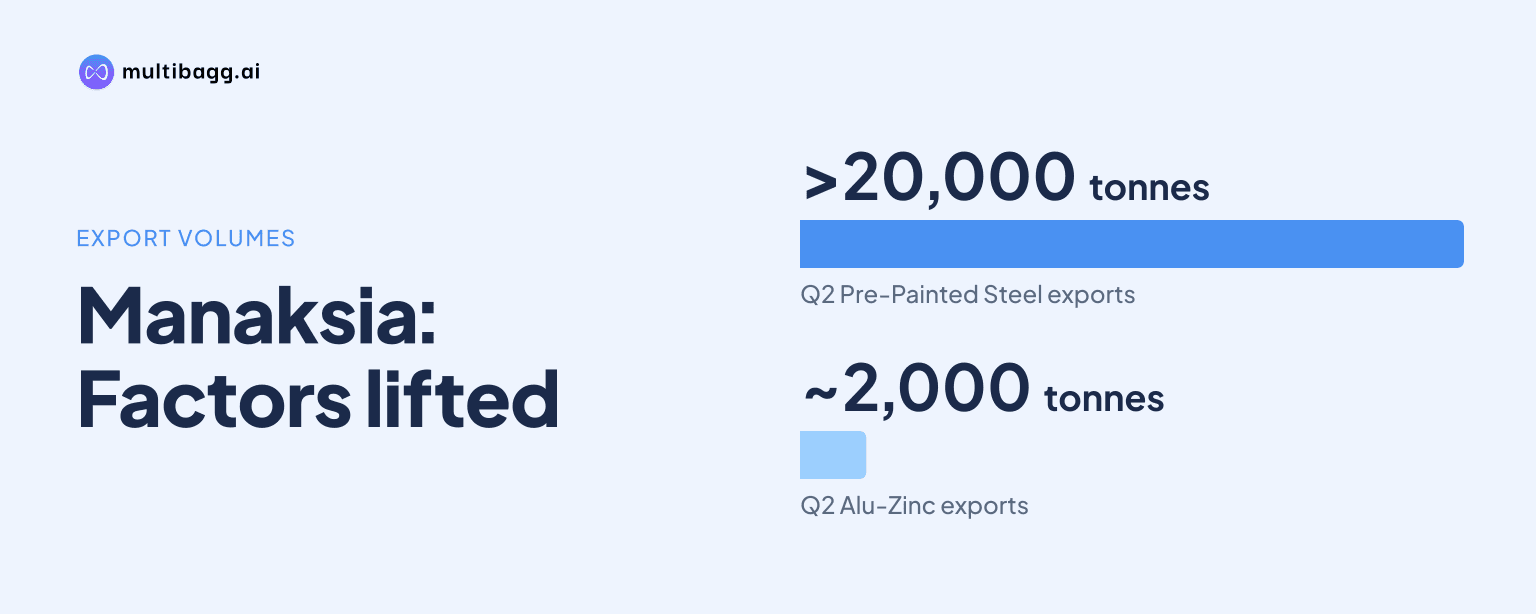
- Pre-Painted Steel exports were just over 20,000 tonnes in the quarter, versus close to 2,000 tonnes of Alu-Zinc exports.
- The new Colour Coated Line's utilisation is expected to ramp over 60-90 days after go-live.
powered by IRIS
Manaksia Coated Metals & Industries Limited said in Q2 that higher earnings before interest, tax, depreciation and amortisation (EBITDA) per tonne came from bulk shipping, higher capacity utilisation and premium products, rather than inventory gains, while it said it had largely passed through 90%-100% of raw-material, energy and freight-cost fluctuations.
Know Manaksia Coated Metals & Industries inside out
Results, valuation, peers and who's buying, in one view.
Why did Manaksia's EBITDA per tonne increase?
Manaksia said its higher EBITDA per tonne reflected three combined operating factors: shifting a good portion of exports from container shipments to bulk shipping, improving production efficiency through higher monthly output, and premiumisation through value-added products for niche original equipment manufacturer (OEM) customers. Management did not assign a separate contribution or rupee-per-tonne value to any of the three drivers during the November 2, 2026 call.
The logistics change was one “big reason” for the increase, according to management. The utilisation effect came from spreading fixed costs over higher production tonnage each month. The product effect came from serving customers requiring thinner gauges, customised colours and specifications for grade, hardness, elongation and product performance. Manaksia said this production capability had supported repeat business from long-term export customers.
Was Manaksia's Q2 margin gain caused by higher steel prices?
No. Manaksia said Q2 EBITDA margins had not increased because of an inventory-price gain, because most inventory on the factory floor or in transit was already locked into back-to-back customer orders. Management said quarterly steel-price movements therefore had an extremely marginal, rather than material, effect on EBITDA margins.
The point was raised in relation to higher hot-rolled coil and cold-rolled coil prices over the previous three quarters. Manaksia said the margin improvement instead resulted from higher capacity utilisation, sales of higher-value products and a more niche customer base. It did not disclose Q2 EBITDA per tonne, the value of any inventory gains, or a quantified division between inventory effects and operating improvements.
The company’s commercial structure also separates a change in input prices from its underlying conversion economics. Its inventory is substantially connected to customer orders, according to management, so a rise or fall in steel prices does not automatically create a comparable gain or loss in EBITDA. That position remains management’s explanation rather than a reported calculation of inventory exposure.
How does Manaksia pass through raw-material cost changes?
Manaksia said it generally captures changes in raw materials, energy and freight when it reprices upcoming quarterly shipments for long-term customers in both export and domestic markets. Management said it seeks a 100% pass-through and has largely achieved between 90% and 100%, although the result can be 85% depending on market conditions and commercial priorities.
The pricing system means quoted terms are reset every quarter for long-term customers. Manaksia said its firm order book normally covers three to five months because price fixation generally does not extend beyond that period. The company said the framework applies across its domestic and export sales, where its orders are periodically repriced to reflect movements in production and delivery costs.
Management did not say that all input inflation is passed through in every quarter. Instead, it described a range of 85% to 100%, with the outcome affected by market conditions and the company’s commercial appetite. The 90%-100% range represents what Manaksia said it has largely achieved, and not a fixed contractual outcome for every customer or shipment.
Got a follow-up? Ask IRIS
Which product and volume changes supported Manaksia's EBITDA per tonne?
Manaksia said a sharp increase in bare Alu-Zinc exports followed the start-up of its Alu-Zinc line in December-January and the subsequent addition of overseas customers that placed repeat orders. In preceding quarters, Alu-Zinc export volumes had been too small to be meaningful, but management said exports from the line had gained momentum from the prior quarter.
Product mix was also shaped by available capacity. Management said Pre-Painted Steel capacity was constrained while Alu-Zinc capacity was higher in the last quarter, so it pursued sales opportunities that offered a suitable EBITDA per tonne. For the quarter cited earlier in the call, Pre-Painted Steel exports were just over 20,000 tonnes, compared with close to 2,000 tonnes of Alu-Zinc exports, making Pre-Painted Steel roughly 90% of export tonnage.
Manaksia did not provide a separate EBITDA-per-tonne figure for either Alu-Zinc or Pre-Painted Steel. Management said such comparisons fluctuate quarter to quarter because domestic and export pricing conditions can differ. It said the more relevant measure was blended EBITDA margin, which it described as stable and increasing, without disclosing the underlying per-product calculation.
Will a larger domestic mix reduce Manaksia's EBITDA per tonne?
Management said domestic sales as a percentage of overall sales would increase after new capacity becomes available, but it rejected the assumption that this would necessarily lower EBITDA per tonne. Its stated reason was that the future product mix should contain more value-added Pre-Painted Steel and a lower proportion of Alu-Zinc than the current mix, which management expects to improve overall EBITDA per tonne.
The second Colour Coated Line was scheduled to start in the quarter of the November 2, 2026 call. Manaksia said the entire capacity of the single line becomes operational at go-live, although utilisation will ramp gradually over 60-90 days. Management said quarterly output of about 50,000 tonnes, plus or minus 10%, could be achievable in a stable state, while characterising that estimate as speculative rather than formal guidance.
The capacity ramp is relevant to the utilisation driver cited for Q2 EBITDA per tonne. Higher output could spread fixed costs across more tonnes, but management did not provide a quarterly utilisation target for the new line. It also declined to disclose whether its incremental sales strategy would favour exports or domestic markets, saying it would not share selling strategies publicly.
Conclusion
Manaksia’s explanation for Q2 EBITDA per tonne is operational: bulk shipping for exports, greater fixed-cost absorption through higher output, and a richer mix of value-added products. Its reported 90%-100% cost pass-through mechanism and back-to-back orders for most inventory support management’s position that the improvement was not principally a temporary inventory benefit from rising steel prices.
The next test is the 60-90-day utilisation ramp of the second Colour Coated Line and whether a larger domestic contribution is accompanied by the expected shift toward Pre-Painted Steel. Management also plans a backward-integration project after completing the second Colour Coated Line and captive solar project; it said the project could potentially add Rs 1,500-Rs 1,700 per tonne of EBITDA and reduce inventory holdings to 60-90 days.