










Manaksia QIP would cut debt before expansion financing
Key highlights
- Manaksia has floated a QIP for an equity raise of up to Rs 150 crore.
- Management said debt reduction will be the immediate use of QIP proceeds.
- Manaksia reported a Rs 525 crore order book for execution over the next five months.
- Management said backward integration could reduce inventory holding to 60 to 90 days from 130 to 140 days.
powered by IRIS
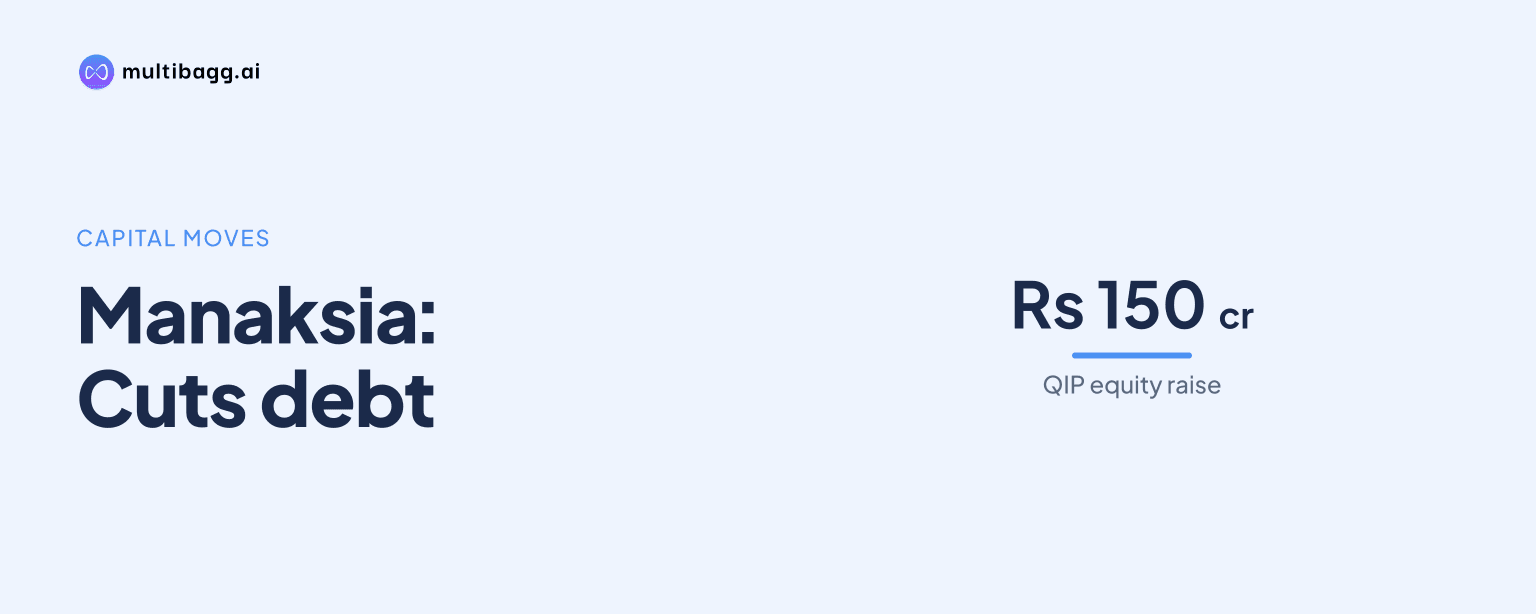
Manaksia Coated Metals & Industries Limited said on November 2, 2026 that its proposed qualified institutional placement, or QIP, of up to Rs 150 crore would first reduce debt, with a stronger balance sheet intended to improve its capacity to raise term debt for future projects. Management did not disclose a final issue size or debt-reduction amount.
Know Manaksia Coated Metals & Industries inside out
Results, valuation, peers and who's buying, in one view.
What will Manaksia do with the QIP proceeds?
Manaksia said the QIP has been floated for an equity investment of up to Rs 150 crore, with debt reduction as the immediate end use. Karan Agrawal described the proposed raise as a means to strengthen the balance sheet, rather than direct funding for a named plant, product line or other individual capital-expenditure project.
The Rs 150 crore figure is the upper limit of the proposed equity raise, not a confirmed inflow or a disclosed capital-expenditure allocation. Management said the longer-term aim is to create funding capacity for upcoming projects through a stronger balance sheet and the ability to raise term debt. The call did not disclose the QIP’s final amount, timing, pricing, target leverage or interest-cost benefit.
How would debt reduction support Manaksia’s expansion plans?
Management said a stronger balance sheet after debt reduction would help Manaksia raise term debt for its required projects. The stated sequence is equity funding through the QIP, immediate debt reduction, and then improved access to project borrowing. Management did not provide bank commitments, a debt-to-equity target or a specific split between equity and term debt for future investments.
The financing approach comes during an investment period that has affected cash flows. Management said cash flow from operations was negative in FY26 solely because it built inventory for the new Colour Coating Line, but operating cash flow was positive as of September 30 in H1 FY27. Cash flow from investing activities remained negative because Manaksia is in a capital-expenditure stage, while management said it was targeting positive operating cash flow through March FY27.
Which projects could need additional funding?
Manaksia identified the Second Colour Coating Line and Captive Solar Power Plant as Phase 1 projects, while the backward-integration project is Phase 2. Management said Phase 2 would start immediately after Phase 1 is commissioned, placing the QIP alongside the completion of the initial project set and preparation for a later investment phase.
Management envisaged that the backward-integration project could be commissioned about 15 months, plus or minus a couple of months, after execution begins. It said the project could potentially increase earnings before interest, tax, depreciation and amortisation, or EBITDA, by Rs 1,500 to Rs 1,700 per tonne through greater value addition. This was a management estimate of potential benefit, not reported performance, and the call gave no project cost or funding split.
Got a follow-up? Ask IRIS
How could backward integration reduce working-capital needs?
Management said backward integration could reduce inventory requirements to 60 to 90 days from the 130 to 140 days discussed on the call. It said lower inventory across stock-keeping units, or SKUs, could reduce working capital deployed and interest costs incurred on inventory. Management characterised the inventory reduction as a certain outcome of the integration project.
The potential working-capital release is relevant because inventory build-up caused the negative FY26 operating cash flow. Management said it accumulated inventory for the Colour Coating Line, which it had earlier expected to start by the end of Q2 but then expected in Q3. Manaksia did not disclose the inventory value, debt tied to that inventory, or the amount of working capital that may ultimately be released.
What demand visibility does Manaksia have during the funding process?
Manaksia disclosed a Rs 525 crore order book from long-term customers for execution during the next five months. Management said the figure excludes spot orders, which are booked and executed regularly, and therefore said H2 potential could be slightly higher than the order book then on hand. The company did not provide a revenue forecast based on the Rs 525 crore figure.
Management distinguished firm orders from annual memoranda of understanding, or MoUs, with customers. MoUs set a target quantity, product type and period for business during the fiscal year, but are not orders; the reported order book comprises firm contracts and orders from domestic and export customers. Management said the order book usually represents three to five months of capacity because prices are renegotiated quarterly.
What operating factors could affect Manaksia’s project funding case?
Management said maintaining EBITDA margins of 10.5% to 11.5% would be a reasonable worst-case outcome if Manaksia preserved cost pass-through discipline and healthy capacity utilisation. It said commodity, fuel, freight and energy costs make EBITDA growth difficult to forecast, although better procurement, cost optimisation and sales diversification could allow EBITDA to grow faster than sales.
The Second Colour Coating Line could give Manaksia more scope for value addition and potentially improve EBITDA per tonne, management said. Separately, management estimated that capitalising the Second Colour Coating Line and Captive Solar Power Plant would increase depreciation by about Rs 4.25 crore annually, rather than quarterly. It did not disclose either project’s total capital cost, commissioning date or the amount of QIP proceeds to be applied.
Conclusion
Manaksia’s proposed QIP is principally a balance-sheet measure under management’s stated plan: up to Rs 150 crore of equity would first reduce debt, while the resulting balance-sheet capacity is intended to support borrowing for projects. The approach links current funding to Phase 1 commissioning, later backward integration and a potential reduction in inventory holding from 130 to 140 days to 60 to 90 days.
The next matters to watch are the final QIP size and completion, the amount of debt reduced, and commissioning of the Second Colour Coating Line and Captive Solar Power Plant. Management has said Phase 2 backward integration would begin after Phase 1 and could take about 15 months, plus or minus a couple of months, to commission after work starts.