










Manaksia Says Rival Curbs Offset Europe's Lower India Quota
Key highlights
- Management said quota cuts for Turkey, Vietnam, Korea and Taiwan ranged from 50% to 80%.
- Manaksia reported just over 20,000 metric tons of Pre-Painted Steel exports and close to 2,000 metric tons of Alu-Zinc exports in the quarter.
- The second Colour Coating Line is targeted within Q3 FY '27 and will raise Pre-Painted Steel capacity to 236,000 metric tons a year.
- Management said its order book provides domestic and export revenue visibility for the next four to five months.
powered by IRIS
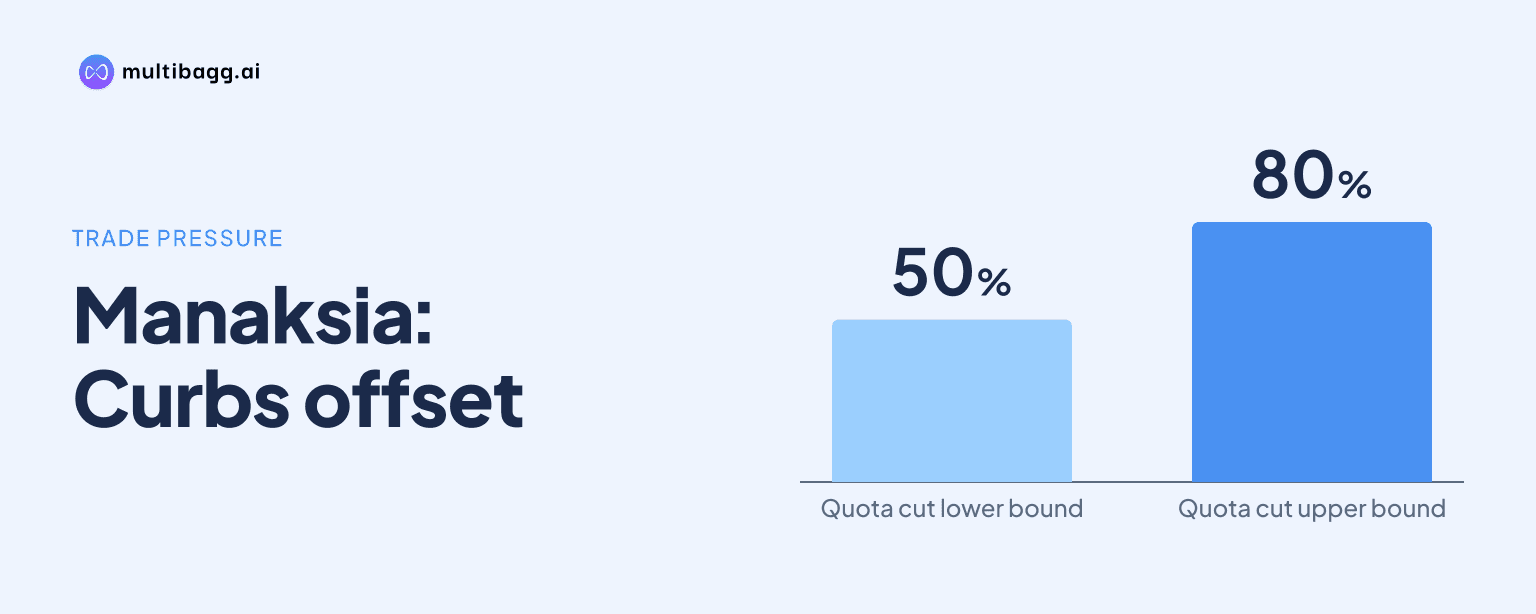
Manaksia Coated Metals & Industries Limited said on November 2, 2026, that it expects European quota changes not to derail export growth because competing suppliers faced 50% to 80% quota reductions and India has additional Free Trade Agreement access, while its order book offered domestic and export revenue visibility for the next four to five months.
Know Manaksia Coated Metals & Industries inside out
Results, valuation, peers and who's buying, in one view.
How do European quota changes affect Manaksia exports?
Manaksia said the European quota revision reduces India’s organic coated-sheet allowance but leaves the country relatively better positioned than several competing suppliers. An analyst cited a fall in India’s quarterly quota to 54,000 metric tons from 79,000 metric tons, while management agreed that quotas had declined but did not independently confirm either figure.
Management’s argument rests on the relative change in access rather than a confirmed total Indian quota. Karan Agrawal said quota reductions for Turkey, Vietnam, Korea and Taiwan ranged from 50% to 80% of their previous entitlements. He said the sharper reductions give India an edge over those countries in supplying the European Union, or EU.
Manaksia also said India can access an additional Free Trade Agreement, or FTA, quota alongside the standard quota. When the analyst suggested the combined entitlement could be about 65,000 metric tons a quarter, Agrawal said that was potentially possible but that he needed to review the figures, leaving the total available quota unconfirmed on the call.
The quota changes came in July, according to management’s response to the analyst’s question. Agrawal said Manaksia maintained growth after the change and cited the company’s order book as evidence of continuing momentum, although it did not disclose the book’s tonnage, value or Europe-specific share.
How exposed is Manaksia to Europe and coated steel exports?
Manaksia remains dependent on Europe as its largest export geography, although management said the region represents less than 90% of total exports. The company is seeking additional business in South America, Central America and the Caribbean, which management described as a way to diversify its regional mix beyond the European market.
Pre-Painted Steel is the dominant export product, making European coated-sheet rules particularly relevant to Manaksia’s current export mix. Management reported just over 20,000 metric tons of quarterly Pre-Painted Steel exports and close to 2,000 metric tons of Alu-Zinc exports, describing the mix as roughly 90% and 10%, respectively.
An analyst referred to European shipments of roughly 18,000 to 20,000 metric tons a quarter and asked whether Manaksia could sustain volumes if imports above quota faced a 50% duty. Agrawal said the duty is paid by the importer, not the exporter, though it is reflected in commercial negotiations, and said he did not see major challenges to maintaining export growth.
Management also based its view on Europe’s stated need for imports. Agrawal said the EU has more than 27 countries and cannot meet all user demand through domestic steel producers, particularly after it stopped imports from Russia and Russian-affiliated countries. He did not quantify the resulting supply gap or Manaksia’s potential share of it.
Got a follow-up? Ask IRIS
Why does Manaksia expect to retain European customers?
Manaksia said its Kutch manufacturing location and customised product offering support its ability to serve export customers. Management said the facility is about 40 to 50 kilometres from Kandla and Mundra ports, which it described as providing lower per-ton transport costs from the factory to vessels for both bulk and container cargo.
The company said it sells directly to large original equipment manufacturers, or OEMs, in Europe and other markets rather than through distributors. Management said repeat business, long-term customer relationships and memoranda of understanding, or MoUs, have raised its share of customers’ raw-material purchases, but it did not identify customers or disclose the number and volume coverage of MoUs.
Manaksia identified thinner gauges, customised colours, grades, hardness, elongation and production-line performance as requirements it can meet for niche export customers. These specifications apply to its value-added product strategy and its largest export category, Pre-Painted Steel, which accounted for just over 20,000 metric tons in the reported quarter.
Management separately attributed higher earnings before interest, tax, depreciation and amortisation, or EBITDA, per ton to three factors: shifting some exports from containers to bulk, producing more tonnage to spread fixed costs, and selling more premium products. It did not disclose a Europe-specific EBITDA figure or quantify the benefit from the shipping change.
Can new capacity support Manaksia’s export growth plans?
Manaksia’s second Colour Coating Line is intended to raise annual Pre-Painted Steel capacity to 236,000 metric tons from 86,000 metric tons, an increase of about 174%. Management said the line was in final trial and pre-commissioning stages, with commissioning targeted within Q3 FY '27.
The full capacity of the single line will become operational when it goes live, but management expects utilisation to build over 60 to 90 days. Agrawal said a stable quarterly production level of about 50,000 metric tons, plus or minus 10%, should be achievable, which he presented as an expectation rather than formal guidance.
Manaksia is not positioning the new line as an export-only project. Management said it intends to balance export and domestic sales across OEM and trade markets, while declining to disclose its selling strategy. It also said domestic sales will become a larger percentage of the mix as new capacity is added.
For FY '27, management said revenue could rise by 35% to 55% over FY '26, aided by a partial Q3 and full Q4 contribution from the new line. It gave no numerical revenue guidance for FY '28, but said the 175,000 to 200,000 metric-ton volume range could be reflected in revenue if the additional capacities are commissioned and ramped as planned.
Conclusion
Manaksia’s assessment is that a lower Indian European quota does not alone determine its export trajectory because rival supplier cuts of 50% to 80% and FTA access may preserve India’s relative position. That view is material because Europe remains its dominant export region and Pre-Painted Steel represented roughly 90% of reported-quarter export volumes.
The next disclosed milestones are commissioning of the second Colour Coating Line within Q3 FY '27 and its planned 60-to-90-day utilisation ramp. Investors can also monitor whether the four-to-five-month order-book visibility converts into sustained export shipments after the July quota changes and whether management reaches its stated FY '27 revenue-growth range of 35% to 55%.