










Max Healthcare says brownfields break even in first quarter
Key highlights
- Max said brownfield expansions typically break even within their first quarter, compared with six months to one year for greenfields.
- Max said Smart Saket reduced overall EBITDA growth to about 20%, from 25% excluding the complex.
- Max had around 6,200 beds in H1 FY27, up 20% year on year, while operating EBITDA rose 17% to Rs 1,524 crore.
- Max expects phased commissioning of 500 beds at Sector-56, Gurgaon by the end of FY27.
powered by IRIS
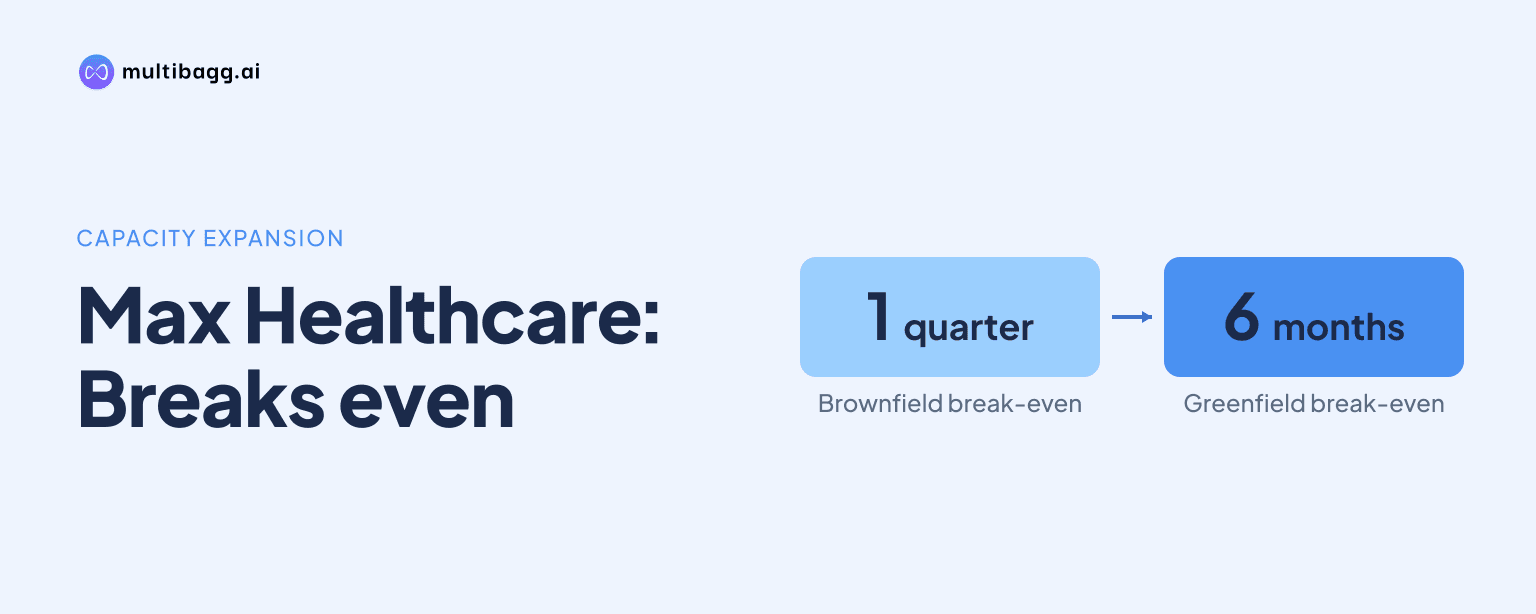
Max Healthcare said its brownfield expansions typically break even in their first quarter, even though preoperative staffing costs initially dilute earnings, and said the Smart Saket ramp reduced overall EBITDA growth to about 20% from 25% excluding that complex. Management cited prior first-quarter break-even at Mohali and Nanavati-Max.
Know Max Healthcare Institute inside out
Results, valuation, peers and who's buying, in one view.
How quickly do Max brownfield expansions break even?
Max said brownfield expansions typically reach break-even within their first quarter, whereas a greenfield hospital may take six months to one year. Management said it generally guides to a one-year break-even period for greenfield facilities, which begin without the operating base of an existing hospital campus.
The company said Mohali was its first brownfield opening to break even in the first quarter, followed by Nanavati-Max in Mumbai. Management said Max Smart, Saket was following the same pattern: its last reported quarter was the first full quarter of operations, and activity had ramped by the end of that quarter despite an earnings before interest, tax, depreciation and amortisation, or EBITDA, drag for the Saket complex.
The distinction is relevant because Max had around 6,200 beds in the first half of financial year 2027, or H1 FY27, up 20% year on year. Network operating EBITDA rose 17% year on year to Rs 1,524 crore, while operating EBITDA per bed increased 4% to Rs 74 lakh and the operating EBITDA margin remained 25.9%, the same as in H1 FY26.
Why did Max Smart Saket dilute EBITDA growth?
Max said Smart Saket diluted profitability because employee costs begin before the new beds attain sufficient occupancy and before the revenue mix matures. Management said it hires most employees before commissioning, although it may not initially hire senior management or the most senior consultants and clinicians, creating a preoperative cost base.
Management quantified the effect by saying overall EBITDA growth was about 20%, compared with 25% if the Smart Saket complex were excluded. It described this as a one-quarter brownfield impact, with the largest burden arising immediately before operations and in the initial period after opening, when the new beds are not yet fully occupied.
Max said occupancy rises first, followed by revenue quality and then EBITDA. The company said the effect had already largely normalised when management answered the analyst’s question, but reported results represented the full-quarter effect of lower early occupancy and stronger activity later in the period.
The company’s H1 FY27 profit after tax was Rs 805 crore, compared with Rs 750 crore in the prior year after normalising for a one-time tax gain of Rs 149 crore. That 7% increase was lower than the 17% rise in operating EBITDA, while bed capacity expanded 20%, placing the Smart Saket ramp within a broader period of expansion spending and capacity additions.
Got a follow-up? Ask IRIS
How does occupancy improve the economics of new Max beds?
Max said a 250-bed brownfield opening may have about 50 occupied beds in its first month, another 100 to 150 beds in its second month, and reach 250 occupied beds by the end of the third or fourth month. Management presented those figures as an illustration of the ramp process rather than a target applicable to every location.
Management said EBITDA can grow faster than revenue once occupancy rises because much of the operating cost is already in place. It illustrated the declining drag with an additional 400 beds: the burden is larger when only 50 beds are occupied, but becomes smaller when occupancy exceeds 250 of the 400 added beds.
Max said that progression creates operating leverage after the initial ramp, with additional occupied beds contributing increasingly to the bottom line. Management linked this approach to its decision to open capacity in stages, rather than open all available beds at once without sufficient first-day occupancy.
The same staged approach applies to greenfields, although management expects a longer route to break-even. For the planned 500-bed Sector-56, Gurgaon hospital, Max said it would typically begin with 150 to 200 beds, ramp them to break-even and then open additional beds, rather than commission all 500 beds at launch.
Which Max projects could create future ramp-up effects?
Max said the balance 205 beds at Nanavati-Max and Max Smart would open after the Diwali puja, while 100 beds at the existing 468-bed Max Lucknow facility would be commissioned over the next two quarters. These are additions to operating facilities, making management’s first-quarter brownfield break-even framework relevant to their reported ramp-up.
The company expects phased commissioning of 500 beds at Sector-56, Gurgaon by the end of FY27 and phased completion of 250 beds at Bhubaneswar over 12 to 15 months. Max said the first part of the Bhubaneswar renovation was expected by the end of the current calendar year, whereas the Gurgaon project is a greenfield and carries management’s stated six-month-to-one-year break-even range.
Max also listed 85 beds at Noida, 100 beds at Nagpur and 400 beds at Zirakpur, Mohali for commissioning by December 2027. Later projects include 200 beds at Pitampura and 400 beds at Patparganj by the end of FY29, plus a 260-bed brownfield tower at Dwarka and 271 beds at Nanavati-Max Phase 2 by FY30.
The FY30 pipeline also includes 450 beds at Pune, 200 beds at Vaishali Tower 3 and 400 beds at Shaheed Path, Lucknow Phase 1. Max said Shaheed Path was awaiting formal environmental clearance and building plans before construction could begin, so its stated FY30 commissioning expectation remains dependent on those approvals.
Conclusion
Max’s comments indicate that brownfield capacity can cause a short-lived earnings dilution as staffing and other preoperative costs precede occupancy, but management expects break-even within the first full quarter. Smart Saket was the current example, with overall EBITDA growth of about 20% versus 25% excluding the complex, while H1 FY27 operating EBITDA rose 17% to Rs 1,524 crore.
The next milestones are the post-Diwali opening of 205 beds at Nanavati-Max and Max Smart, the planned commissioning of 100 beds at Max Lucknow over the next two quarters, and phased commissioning at Sector-56, Gurgaon by the end of FY27. Investors can watch occupancy progression, the pace of staged bed openings and the duration of any reported preoperative EBITDA drag.