










Max Healthcare Institute Ltd Revenue Rises 20% to Rs 3,219 Crore
Key highlights
- Max Healthcare reported Q2 FY27 revenue of Rs 3,219 crore, up 20% year-on-year.
- Operating EBITDA rose 18% year-on-year in Q2 FY27.
- Hospital occupancy was 77% during the quarter.
- The Q2 FY27 earnings call was held on November 3, 2026.
powered by IRIS
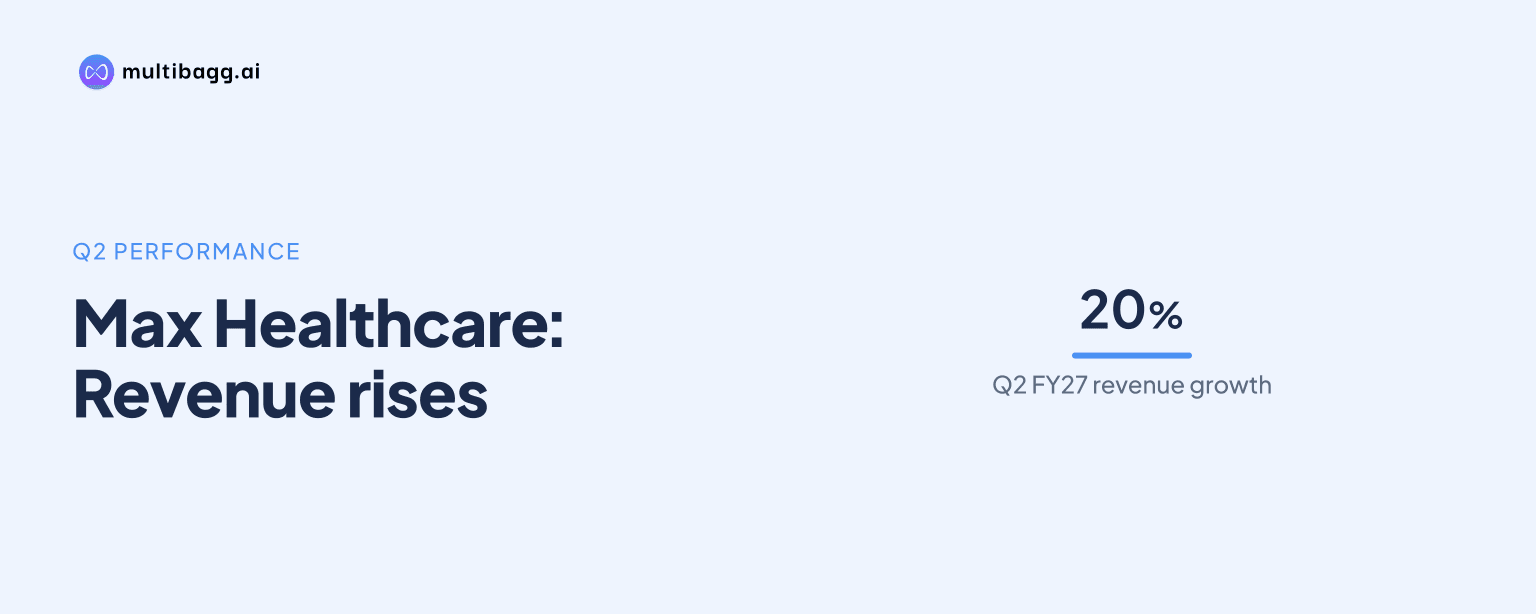
Max Healthcare Institute Limited reported Q2 FY27 revenue of Rs 3,219 crore, up 20% year-on-year, while operating EBITDA increased 18% and hospital occupancy held at 77% despite a larger capacity base. The results place expansion execution, margin management and regulatory developments at the centre of investor attention.
Know Max Healthcare Institute inside out
Results, valuation, peers and who's buying, in one view.
What did Max Healthcare report for Q2 FY27?
Max Healthcare reported revenue of Rs 3,219 crore for the second quarter of FY27, representing 20% year-on-year growth. Operating EBITDA rose 18% from a year earlier, according to earnings-call highlights published after the November 3, 2026 call. The company also reported occupancy of 77% during the quarter.
The result indicates that revenue growth remained ahead of the rate of operating EBITDA expansion. The disclosed figures point to the effects of new capacity ramp-up and other costs associated with expansion, even as the company maintained high utilisation across its network. Management's earnings discussion focused on brownfield expansion, the ramp-up of newer facilities and the contribution from ancillary businesses.
The earnings call was held on November 3, 2026, and Max Healthcare subsequently informed the exchange about the audio recording of the call. The company had previously announced the schedule for the investor and analyst call on October 23, 2026. The call provided investors with management commentary on the quarterly operating performance and ongoing projects.
How are brownfield expansions influencing performance?
Brownfield expansions are influencing Max Healthcare's performance by adding capacity within or alongside existing hospital campuses, with the company highlighting their ramp-up as a contributor to growth. These projects can use an established hospital ecosystem, but their financial contribution can vary as new beds and services are brought into operation.
The earnings-call summary linked the quarterly revenue growth to expansions and improving brownfield ramp-ups. It also noted that new capacity creation had weighed on margins. This is consistent with the difference between revenue growth of 20% and operating EBITDA growth of 18% reported for the quarter, although the available material does not provide a disclosed EBITDA margin figure.
The company has continued to identify capacity growth as a central operational priority in recent quarterly discussions. Its Q1 FY27 call summary referred to major expansions and acquisitions, while earlier updates also discussed brownfield projects. For investors, the Q2 numbers show that the higher capacity base was accompanied by 77% occupancy, rather than a sharp disclosed decline in utilisation.
Ancillary businesses were also identified in the earnings-call summary as supporting the outlook. However, the available information does not quantify their revenue or profitability contribution. Their significance therefore lies in management's stated operating focus rather than in a separately reported financial metric.
Got a follow-up? Ask IRIS
What regulatory and operating issues did management flag?
Max Healthcare flagged drug-pricing rules and greenfield start-up losses as uncertainties alongside its growth plans. The Q2 FY27 earnings-call summary referred to regulatory headwinds weighing on margins, though the supplied material does not specify a financial impact for the quarter.
Drug pricing has been a relevant issue for the hospital industry because changes in product availability, pricing frameworks or prescribing practices can affect oncology and pharmacy-linked activity. Earlier commentary on Max Healthcare's FY26 performance indicated that oncology revenue had declined after policy-driven drug discontinuation, while other specialties and international business offset that impact. That earlier observation provides context for the regulatory caution mentioned in the latest call summary.
The wider regulatory environment has also drawn attention to hospital pharmacy practices. The supplied material refers to a Supreme Court of India ruling that highlighted concerns around cancer-drug mark-ups and reports of patients being directed to particular pharmacies. The material does not attribute any finding, order or allegation to Max Healthcare. It nevertheless shows why drug-pricing and pharmacy-related policy matters remain relevant across the hospital sector.
Greenfield facilities can also create start-up losses before patient volumes and service utilisation reach mature levels. Max Healthcare's commentary identified those losses as an uncertainty, rather than giving a target or a precise timeline for their reduction. Investors will therefore need to assess future disclosures for evidence of the pace at which newly opened assets move towards stable operations.
What does the quarter mean for investors and hospital operations?
The quarter shows that Max Healthcare combined 20% revenue growth with a 77% occupancy level while expanding capacity, but the 18% growth in operating EBITDA highlights the importance of monitoring costs and ramp-up effects. The results matter because hospital expansion requires sustained patient demand, clinical staffing and operational discipline before newer assets can fully contribute to profitability.
For investors, the available data supports a focus on three measurable operating indicators: revenue growth, occupancy and operating EBITDA growth. Revenue rose by Rs 3,219 crore in reported quarterly scale, occupancy was 77%, and EBITDA growth trailed revenue growth by 2 percentage points. No net debt, capital-expenditure amount, earnings-per-share figure or forward financial target was disclosed in the supplied call material.
The stock was quoted at Rs 934 at the close on November 6, 2026, in the provided market-data extract. No day-on-day or post-results share-price movement was supplied, so the available information does not establish how the market reacted specifically to the earnings call. The main disclosed operational response is continued emphasis on expansion and brownfield ramp-up.
For patients and local hospital markets, additional capacity can broaden the availability of hospital services where projects are operational. But the supplied material does not identify the locations, bed count or commissioning dates for Q2 FY27 projects. Any assessment of regional impact would require further company disclosures.
Conclusion
Max Healthcare delivered Q2 FY27 revenue of Rs 3,219 crore, 20% above the previous year, while occupancy remained at 77%. The 18% increase in operating EBITDA shows continuing earnings growth, but also keeps attention on the costs of new capacity, greenfield start-up losses and the effect of regulatory developments on the hospital business.
Investors should watch subsequent disclosures for the pace of brownfield ramp-ups, occupancy trends, the financial effect of drug-pricing rules and any quantified update on greenfield losses. The company has made expansion and ancillary-business growth key themes of its earnings discussion, while the supplied material does not disclose a separate forward target or a project-completion schedule.