










Max Healthcare guides up to Rs 50 crore Gurgaon EBITDA loss
Key highlights
- Max Healthcare indicated a Rs 40 crore to Rs 50 crore cumulative peak EBITDA loss for Sector 56 Gurgaon.
- Max Healthcare's preliminary cumulative peak EBITDA loss estimate for Zirakpur is about Rs 30 crore.
- Max Healthcare's 300-bed Dwarka hospital broke even in 6 months after a Rs 30 crore to Rs 35 crore cumulative peak EBITDA loss.
- Max Healthcare normally guides to breakeven within one year for a new hospital.
powered by IRIS
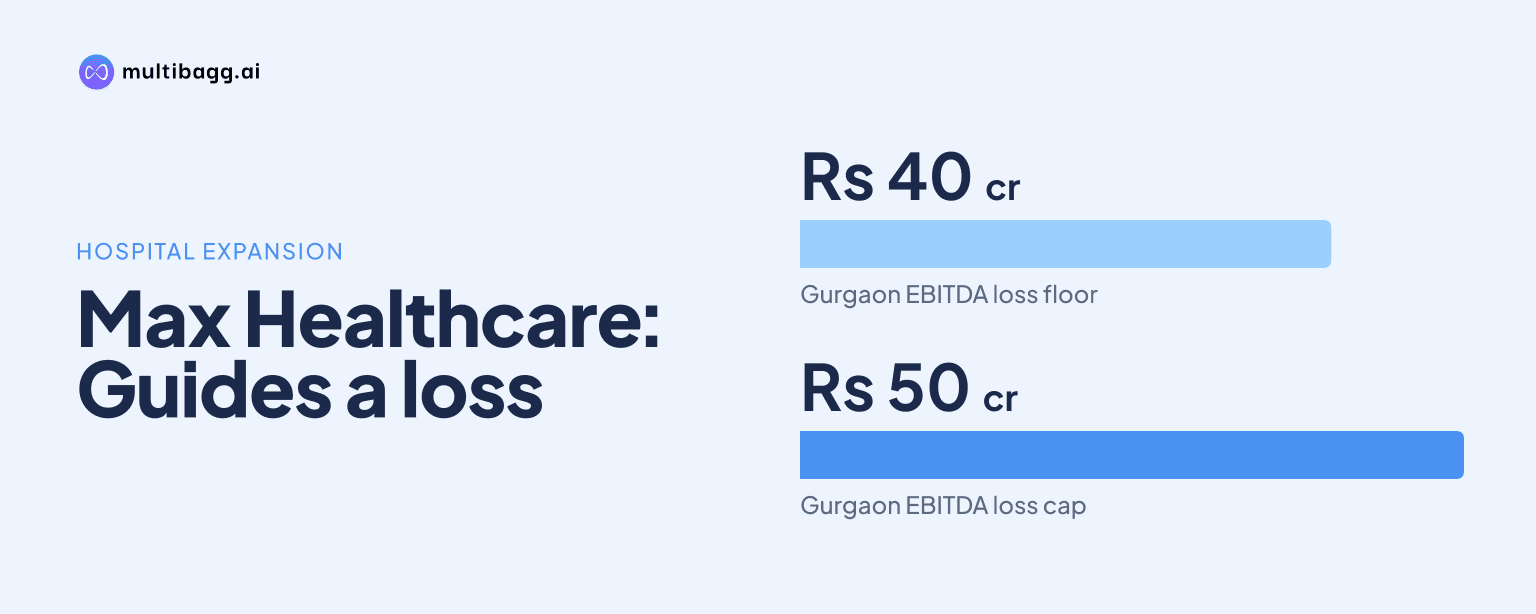
Max Healthcare has indicated a cumulative peak EBITDA loss of Rs 40 crore to Rs 50 crore for its Sector 56 Gurgaon hospital, compared with about Rs 30 crore for Zirakpur, Mohali. Management normally uses a one-year breakeven framework for new hospitals, while its 300-bed Dwarka facility broke even in 6 months.
Know Max Healthcare Institute inside out
Results, valuation, peers and who's buying, in one view.
What loss has Max Healthcare indicated for its new hospitals?
Max Healthcare has indicated a cumulative peak earnings before interest, tax, depreciation and amortisation, or EBITDA, loss of Rs 40 crore to Rs 50 crore for Sector 56 Gurgaon and about Rs 30 crore for Zirakpur, Mohali. Management said Zirakpur’s loss should be “much lower” than Gurgaon’s and described both figures as preliminary estimates.
At the upper end, Gurgaon’s Rs 50 crore estimate is Rs 20 crore higher than Zirakpur’s roughly Rs 30 crore estimate. Max Healthcare did not provide a quarterly loss schedule, annual loss forecast, bed count, revenue forecast or opening date for either of the two greenfields in this exchange.
The estimates refer to cumulative peak losses during a hospital ramp-up, rather than losses assigned to a specified quarter or financial year. An analyst asked whether Gurgaon’s drag would apply through FY28 and whether Zirakpur would affect FY29, but management did not confirm that either amount would be recorded wholly in those respective years.
When does Max Healthcare expect the hospitals to break even?
Max Healthcare normally guides to breakeven within one year for a new hospital, although it said Dwarka reached breakeven in 6 months. Management said the likely outcome for Sector 56 Gurgaon and Zirakpur would be somewhere around its usual one-year framework and the 6-month Dwarka experience.
The 6-month Dwarka result was presented as an operating reference, not as a project-specific forecast for the two forthcoming hospitals. Dwarka had 300 beds and incurred a cumulative peak EBITDA loss of around Rs 30 crore to Rs 35 crore, compared with the Rs 40 crore to Rs 50 crore indication for Gurgaon.
Management did not state a separate breakeven date, occupancy target, revenue target or margin threshold for either Gurgaon or Zirakpur. The disclosed operating marker is therefore the usual one-year breakeven approach, with the faster 6-month Dwarka outcome providing a historical comparison rather than guidance.
The distinction is important because the Gurgaon amount is cumulative, not an annualised EBITDA loss rate. The analyst’s FY28 and FY29 questions established the potential reporting periods under consideration, but management’s response tied the estimates to the post-opening ramp-up rather than to a full financial year.
Got a follow-up? Ask IRIS
Why are the Gurgaon and Zirakpur estimates not final?
Max Healthcare said it had not started onboarding clinical teams for a hospital it described as potentially opening in December of the following year, about 12 months from the call. Management said it could not yet know the cost of those clinical teams, making staffing a key unresolved input in its loss estimates.
Management also cited the eventual performance trough, pre-operating expenses and day-one expenditure as variables still to be determined. These items underpin its description of the Rs 40 crore to Rs 50 crore Gurgaon range and the roughly Rs 30 crore Zirakpur figure as a line-in-the-sand assessment.
More precise figures are expected after clinician teams begin to be onboarded, according to management. The source does not identify which of the two greenfield hospitals was being discussed in the December-next-year example, so that timing should not be treated as a confirmed opening date for either Gurgaon or Zirakpur.
Max Healthcare also did not disclose whether the Rs 30 crore Zirakpur figure includes precisely the same split between pre-operating and post-opening costs as the Rs 40 crore to Rs 50 crore Gurgaon range. Until it provides that detail, the two estimates can be compared by size, but not by a common cost build-up.
How does the Dwarka example compare with Gurgaon and Zirakpur?
Max Healthcare cited Dwarka as its closest disclosed example: the 300-bed Delhi hospital had a cumulative peak EBITDA loss of about Rs 30 crore to Rs 35 crore and broke even in 6 months. Zirakpur’s roughly Rs 30 crore indication is near the bottom of that Dwarka range, while Gurgaon’s Rs 40 crore to Rs 50 crore range is higher.
The comparison does not establish an identical ramp-up path. Management did not disclose bed capacities for Sector 56 Gurgaon or Zirakpur in this discussion, whereas it specified 300 beds for Dwarka, and it did not provide comparable clinician-cost, pre-operating-expense or demand-ramp assumptions for the new sites.
The same call also distinguished brownfield expansion from greenfield commissioning. Max Healthcare said 400 beds were operational at its 500-bed Noida complex and that it would add 85 beds to activated capacity there; management said brownfield capacity is added when utilisation is high, unlike a new hospital’s initial ramp-up.
That distinction means the Noida addition is not a direct benchmark for the two greenfield loss estimates. Gurgaon and Zirakpur are being assessed through cumulative peak EBITDA losses and a one-year breakeven framework, while the 85-bed Noida addition is within an existing 500-bed complex with 400 operational beds.
Conclusion
Max Healthcare has provided an early profitability framework for two greenfield hospitals: Rs 40 crore to Rs 50 crore of cumulative peak EBITDA loss for Sector 56 Gurgaon and about Rs 30 crore for Zirakpur. Compared with Dwarka’s Rs 30 crore to Rs 35 crore cumulative peak loss and 6-month breakeven, management expects Gurgaon to carry the larger initial EBITDA burden.
The next disclosure to watch is management’s planned refinement after clinician onboarding begins, including the final cost of medical teams, pre-operating expenses and day-one expenditure. Investors will also need project-specific opening dates, bed capacities and breakeven progress against Max Healthcare’s normal one-year framework.