










Meenakshi targets 37.5 lakh garment capacity by FY30, up 2.1x
Key highlights
- Meenakshi targets annual garment capacity of 37.5 lakh pieces in FY30, from 18 lakh pieces in FY26.
- Meenakshi plans Rs 40-50 crore of capital expenditure through FY30, including two factories estimated at about Rs 20 crore each.
- Meenakshi targets utilisation of 70% in FY27 and 80% in FY30, compared with 65% in FY26.
- Meenakshi reported H1 FY27 EBITDA of Rs 4 crore, compared with Rs 0.5 crore in H1 FY26.
powered by IRIS
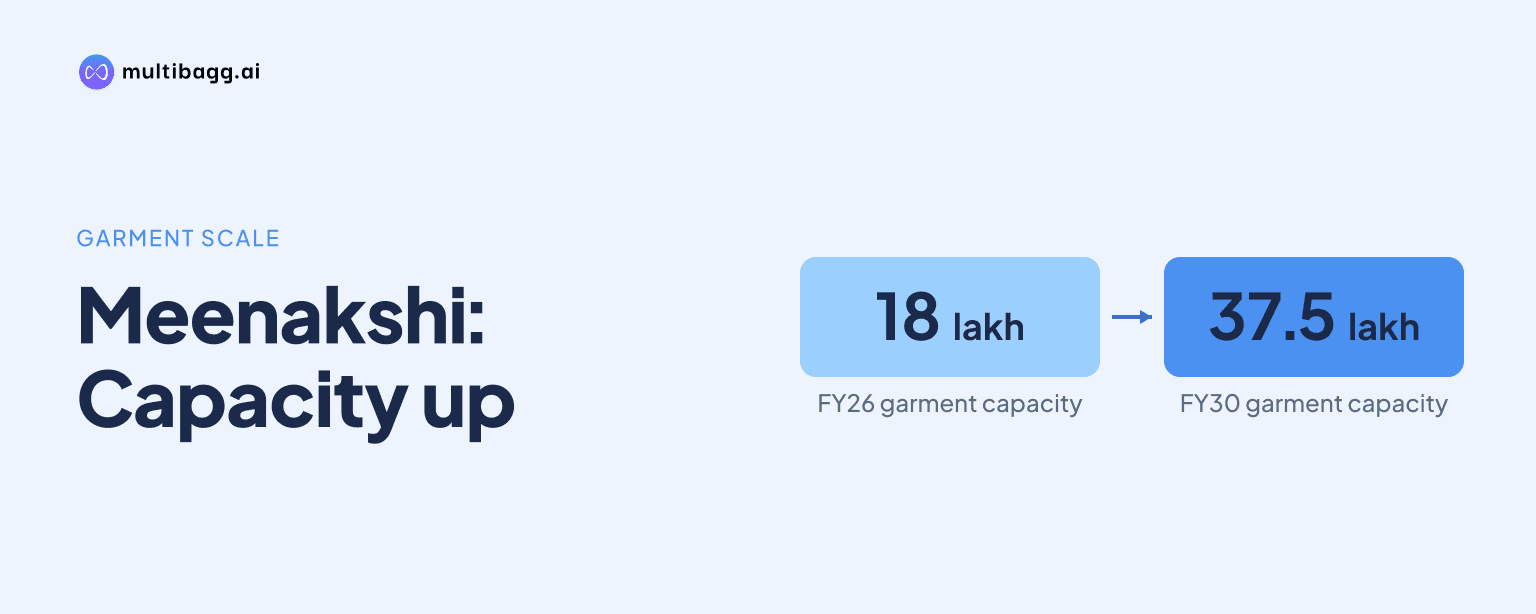
Meenakshi (India) Limited targets annual garment capacity of 37.5 lakh pieces by FY30, a 2.1x increase from 18 lakh pieces in FY26, under a Rs 40-50 crore capital-expenditure programme. Management says internal accruals and about Rs 80 crore of available liquidity will fund the plan, without new equity or debt.
Know Meenakshi (India) inside out
Results, valuation, peers and who's buying, in one view.
How will Meenakshi reach 37.5 lakh garments by FY30?
Meenakshi plans to add capacity in three phases, taking annual garment capacity from 18 lakh pieces in FY26 to 37.5 lakh pieces in FY30. Phase 1 is scheduled for FY28, Phase 2 for FY29 and Phase 3 for FY30. The presentation describes the 19.5 lakh-piece increase as a step-by-step 2.1x expansion.
Meenakshi also plans to raise capacity utilisation from 65% in FY26 to 70% in FY27 and 80% in FY30. Management identified about 70% utilisation in FY27 as a near-term priority. This places the utilisation ramp ahead of the FY28 Phase 1 capacity step and alongside the larger FY30 manufacturing target.
What will Meenakshi spend and how will it fund expansion?
Meenakshi plans Rs 40-50 crore of capital expenditure through FY30, including two new factories estimated at about Rs 20 crore each. The presentation does not identify the locations of those two factories or allocate the remaining amount within the stated Rs 40-50 crore programme.
Management says the programme will be internally funded, using internal accruals and about Rs 80 crore of available liquidity. It explicitly states that no new equity or debt is required. In its H1 FY27 commentary, management again described the Rs 40-50 crore phased capital expenditure plan as fully funded through internal accruals.
The funding plan is linked to an operating target as well as factory spending. Meenakshi aims to lift utilisation by 15 percentage points, from 65% in FY26 to 80% in FY30, while more than doubling annual capacity. Management also said it is progressing towards high-teen earnings before interest, tax, depreciation and amortisation, or EBITDA, margins through capacity expansion, premiumisation, product diversification and operating leverage.
Where is Meenakshi expanding its manufacturing footprint?
Meenakshi has signed a memorandum of understanding, or MoU, in Sri Lanka and has a contract manufacturer in place there. It describes the Sri Lanka arrangement as an alternative country of origin if tariffs turn adverse, making it a disclosed risk-diversification measure rather than a stated owned-factory investment.
Nepal is under evaluation because of labour cost, labour availability and existing skill depth, according to Meenakshi. Odisha and West Bengal are also under evaluation, with the company citing an established apparel ecosystem, government benefits and better labour productivity. These locations differ from Sri Lanka because the presentation does not disclose an MoU, contract manufacturer or committed investment for them.
Meenakshi currently has three manufacturing units in Salem, Tamil Nadu. The source does not assign the two planned factories, each estimated at about Rs 20 crore, to Salem, Sri Lanka, Nepal, Odisha or West Bengal. The distinction leaves the factory locations unresolved while Sri Lanka provides a disclosed alternate-origin option.
Got a follow-up? Ask IRIS
Which categories can Meenakshi add without new plants?
Meenakshi’s core portfolio is men’s woven bottomwear and outerwear, where it cites four decades of specialisation. Its adjacent-category plan includes women’s bottomwear, kidswear and athleisure. The company says women’s bottomwear uses similar construction but requires a new fit block.
Kidswear is already within Meenakshi’s capability, while athleisure is built on existing machinery. The company says these adjacent categories need no new plant and can use its current machinery, raw-material base and operator handling. This separates the product broadening programme from the two-factory capital-expenditure plan through FY30.
The disclosed category approach can support the utilisation path from 65% in FY26 to 70% in FY27 and 80% in FY30 by broadening the types of garments made on existing equipment. However, Meenakshi does not disclose expected revenue, production volumes, customers or order commitments for women’s bottomwear, kidswear or athleisure.
How did H1 FY27 performance compare with H1 FY26?
Meenakshi reported H1 FY27 revenue from operations of Rs 63 crore, compared with Rs 64 crore in H1 FY26, while EBITDA rose to Rs 4 crore from Rs 0.5 crore. EBITDA margin increased to 6.7% from 0.7%. Profit before tax rose to Rs 11 crore from Rs 4 crore, and profit after tax increased to Rs 10 crore from Rs 3 crore.
In Q2 FY27, revenue from operations was Rs 31 crore, unchanged from Q2 FY26, while EBITDA increased to Rs 3 crore from Rs 0.6 crore and EBITDA margin reached 10.1%, against 2%. Management said H1 inventory changes mainly reflected finished goods made against confirmed orders and awaiting scheduled dispatch, with the associated revenue and margin expected in the current quarter. It attributed the sequential decline in profit after tax primarily to mark-to-market movements in foreign-exchange hedges and investments.
Conclusion
Meenakshi’s FY30 strategy combines a 2.1x rise in annual garment capacity, from 18 lakh to 37.5 lakh pieces, with Rs 40-50 crore of internally funded capital expenditure. The plan includes two proposed factories, utilisation rising from 65% to 80%, a Sri Lanka alternate-origin arrangement, and adjacent categories that management says use existing machinery and operators.
The next disclosed operating milestone is about 70% capacity utilisation in FY27, followed by Phase 1 in FY28, Phase 2 in FY29 and the FY30 target. Matters to watch include identification of the two factory locations, progress in evaluating Nepal, Odisha and West Bengal, and management’s stated expectation that finished goods held at the end of H1 FY27 will be dispatched in the current quarter.