










Meenakshi (India) Limited Q2 EBITDA margin reaches 10.1%
Key highlights
- Meenakshi India’s Q2 FY27 EBITDA margin increased to 10.1% from 2.0% in Q2 FY26.
- Q2 FY27 expenses declined 7.7% to Rs 27.6 crore while revenue increased 0.6% to Rs 30.7 crore.
- H1 FY27 revenue fell 1.5% to Rs 62.9 crore, while EBITDA rose to Rs 4.2 crore from Rs 50 lakh.
- Exports accounted for 97% of H1 FY27 sales, compared with 85% in H1 FY26.
powered by IRIS
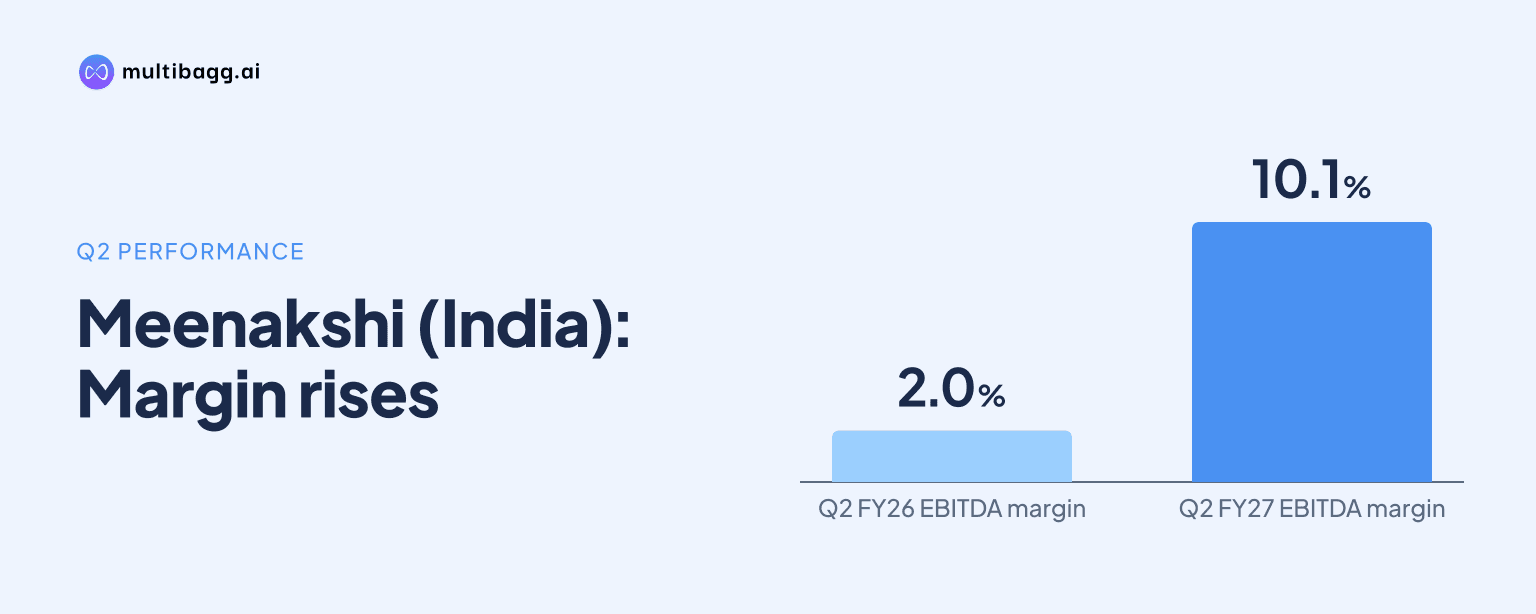
Meenakshi (India) Limited raised its Q2 FY27 earnings before interest, tax, depreciation and amortisation (EBITDA) margin to 10.1% from 2.0% a year earlier, as expenses fell 7.7% to Rs 27.6 crore while revenue from operations increased 0.6% to Rs 30.7 crore. The improvement came despite H1 FY27 revenue declining 1.5% to Rs 62.9 crore.
Know Meenakshi (India) inside out
Results, valuation, peers and who's buying, in one view.
What drove Meenakshi India’s Q2 EBITDA margin recovery?
Meenakshi India’s Q2 FY27 EBITDA margin recovery was driven by lower expenses and operational efficiencies rather than material sales growth. Revenue from operations was Rs 30.7 crore, compared with Rs 30.5 crore in Q2 FY26, while expenses declined to Rs 27.6 crore from Rs 29.9 crore. EBITDA consequently increased to Rs 3.1 crore from Rs 60 lakh.
The 10.1% Q2 FY27 EBITDA margin was 809 basis points above the 2.0% reported a year earlier, with one basis point equal to one-hundredth of a percentage point. Meenakshi India’s profit before tax rose to Rs 3.3 crore from Rs 1.3 crore, while profit after tax increased to Rs 2.5 crore from Rs 80 lakh. Diluted earnings per share rose to Rs 1.11 from Rs 0.34.
The quarterly margin also improved from 3.4% in Q1 FY27. Q2 revenue fell 4.9% sequentially from Rs 32.2 crore, but expenses fell 11.5% from Rs 31.1 crore, producing EBITDA of Rs 3.1 crore versus Rs 1.1 crore in Q1. Management attributed the margin improvement to operational efficiencies and cost discipline.
Why did Meenakshi India’s H1 FY27 revenue decline?
Meenakshi India’s H1 FY27 revenue declined because tariff-related disruption affected the half year while management prioritised customer retention and long-term relationships. Revenue from operations fell 1.5% to Rs 62.9 crore from Rs 63.9 crore in H1 FY26, a reduction of Rs 1 crore.
The lower revenue was accompanied by a larger reduction in expenses, which fell by Rs 4.7 crore to Rs 58.7 crore from Rs 63.4 crore. EBITDA increased to Rs 4.2 crore from Rs 50 lakh, and the H1 EBITDA margin rose to 6.7% from 0.7%. Profit after tax increased to Rs 9.6 crore from Rs 3.6 crore, while diluted earnings per share reached Rs 4.28 from Rs 1.59.
Management said the movement in inventory during H1 FY27 mainly reflected finished goods produced against confirmed orders and held for scheduled dispatch at the half-year end. It expects those shipments to be completed in the current quarter, when the associated revenue and margin would be recognised. Inventories stood at Rs 29.3 crore in September 2026, compared with Rs 23.7 crore in March 2026.
Why did Meenakshi India’s Q2 profit after tax fall from Q1?
Meenakshi India said mark-to-market movements in foreign-exchange hedges and investments, rather than deterioration in underlying operations, primarily caused the sequential fall in Q2 profit after tax. Q2 FY27 profit after tax was Rs 2.5 crore, below Rs 7.1 crore in Q1 FY27, while profit before tax fell to Rs 3.3 crore from Rs 7.6 crore.
Other income was Rs 80 lakh in Q2 FY27, compared with Rs 7.1 crore in Q1 FY27, a sequential decline of 88.5%. This movement coincided with a 56.8% quarter-on-quarter decline in profit before tax. In contrast, EBITDA increased from Rs 1.1 crore in Q1 to Rs 3.1 crore in Q2, separating the operating-margin recovery from movements in other income.
Finance cost was Rs 10 lakh in Q2 FY27, compared with Rs 20 lakh in Q2 FY26, and depreciation was Rs 50 lakh in both periods. At September 2026, short-term borrowings were Rs 3.9 crore, compared with Rs 10 lakh at March 2026, while long-term borrowings declined to Rs 10 lakh from Rs 50 lakh. The presentation does not state why short-term borrowings increased.
Got a follow-up? Ask IRIS
How did Meenakshi India’s H1 FY27 sales mix change?
Meenakshi India became more export-focused in H1 FY27, with exports accounting for 97% of sales versus 85% in H1 FY26. Domestic sales represented 3%, down from 15%, during a period when total revenue from operations declined to Rs 62.9 crore from Rs 63.9 crore.
Europe’s share of H1 sales rose to 74% from 62%, while North America’s share declined to 13% from 19% and Asia Pacific declined to 7% from 15%. Oceania remained at 5% in both periods. The disclosed mix therefore shows greater European concentration alongside the tariff-related disruption described by management.
Product mix changed only marginally. Pant, trouser and cargo products represented 92% of H1 FY27 sales, compared with 91% in H1 FY26; shorts declined to 7% from 8%; and outerwear plus bags remained 1%. Management’s adjacent-category plan covers women’s bottomwear, kidswear and athleisure, which it says can use existing machinery, raw-material base and operator handling.
What are Meenakshi India’s capacity and margin plans?
Meenakshi India plans phased capital expenditure of Rs 40 crore to Rs 50 crore, funded entirely through internal accruals, to double annual manufacturing capacity by FY30. Management has also set a near-term objective of about 70% capacity utilisation in FY27 and said it is progressing towards high-teen EBITDA margins.
The company has three manufacturing units in Salem, Tamil Nadu, and is evaluating Odisha, West Bengal and Nepal for potential expansion. It has signed a memorandum of understanding in Sri Lanka and has a contract manufacturer there, which management describes as an alternative country of origin if tariffs turn adverse. These locations are disclosed as diversification measures rather than completed capacity additions.
Management links the plan to premium woven capabilities and expansion beyond men’s woven bottomwear and outerwear. The reported H1 FY27 EBITDA margin of 6.7% and Q2 margin of 10.1% remain below management’s high-teen margin direction, which is a target rather than a reported outcome.
Conclusion
Meenakshi India’s results show that expense control lifted profitability despite limited revenue momentum. Q2 FY27 revenue increased only 0.6% to Rs 30.7 crore, yet EBITDA margin rose by 809 basis points to 10.1%; for H1, revenue fell 1.5% but EBITDA increased to Rs 4.2 crore from Rs 50 lakh.
The next points to watch are the management-expected dispatch of finished goods held against confirmed orders in the current quarter, progress towards about 70% utilisation in FY27, and execution of the Rs 40 crore to Rs 50 crore capacity programme. Tariff conditions and the 97% export share also remain relevant to the pace of revenue recovery.