










Meghmani targets 20%-22% EBITDA margin from nano fertilisers
Key highlights
- Meghmani targets a 20%-22% EBITDA margin from Crop Nutrition within three years.
- Meghmani commenced Nano DAP, Nano NPK and Nano Zinc production at its Sanand facility in FY27.
- Standalone Q2 FY27 Crop Protection revenue was nearly Rs 496 crore, with an EBITDA margin of about 11%.
- Meghmani plans nano fertiliser trials and registrations through its Crop Protection presence in more than 70 countries.
powered by IRIS
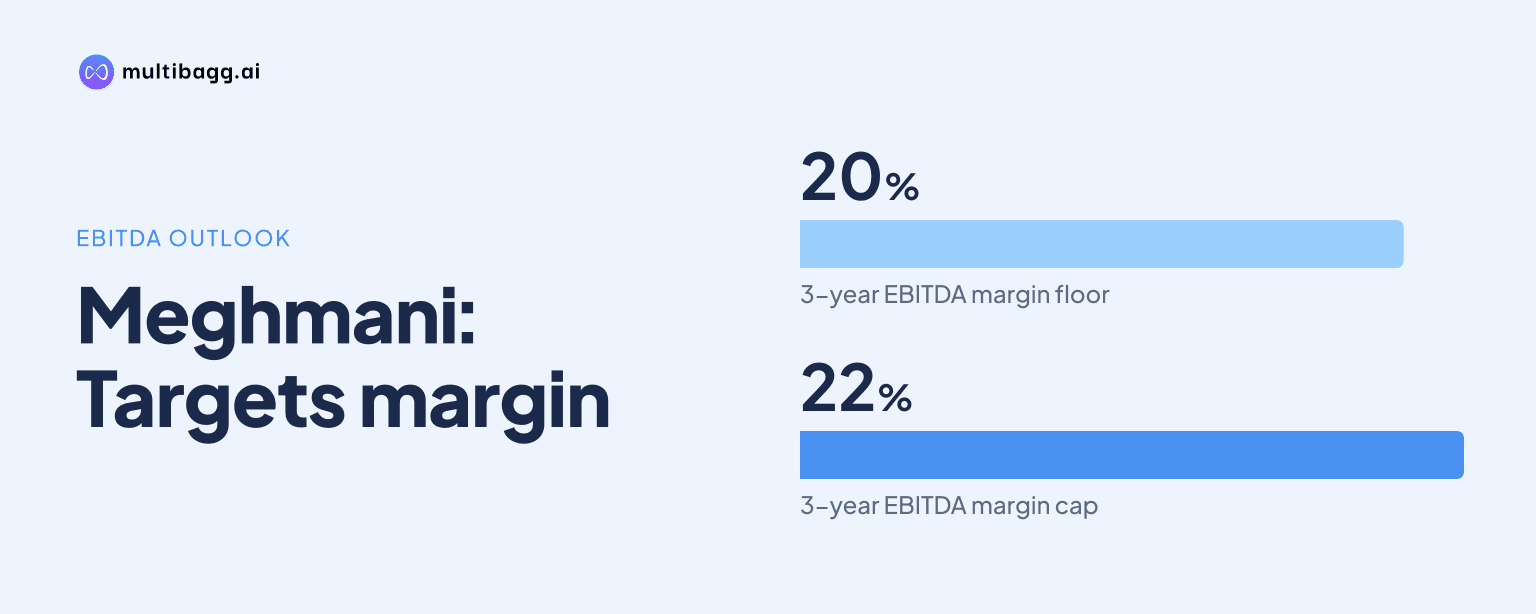
In its November 5, 2026 Q2 FY27 earnings call, Meghmani Organics Limited said newly introduced Nano DAP, Nano NPK and Nano Zinc could generate a 20%-22% earnings before interest, tax, depreciation and amortisation (EBITDA) margin within three years, supported by farmer education, field activity and export-market development.
Know Meghmani Organics inside out
Results, valuation, peers and who's buying, in one view.
What margin does Meghmani target from nano fertilisers?
Meghmani targets a 20%-22% EBITDA margin from its Crop Nutrition business over the next three years. Chairman and Managing Director Ankit Patel said the segment could add healthy profitability as developmental activity and the newly introduced product mix gain traction, although management gave no revenue, volume or annual profit target.
The target applies to a business that management said has a small base and should grow in double digits. Meghmani has commenced production of Nano DAP, Nano NPK and Nano Zinc at its existing Sanand facility, without disclosing a separate plant, capacity expansion or capital-expenditure programme for these products.
Which nano fertiliser products has Meghmani launched?
Meghmani has commenced production of Nano DAP, Nano NPK and Nano Zinc at Sanand in FY27. The products complement its existing Crop Nutrition portfolio, while management said its wider basket includes more than 10 products, including nano urea; no product-level sales, capacity or market-share data were disclosed on the call.
Management said Nano DAP has had a more positive impact in the Indian market than nano urea and had already been introduced during the current financial year. The distinction reflects different adoption requirements: management described Nano DAP as receiving a more favourable response, while nano urea needs education on dosage, timing and application protocol.
Why does Meghmani need to educate farmers on nano urea?
Meghmani says farmer education is needed because nano urea cannot fully replace conventional urea and must be used according to crop and application protocol. Management said earlier marketing by one or two companies created a misconception that one bottle could replace one bag of urea, although it said the product cannot fully replace urea in field use.
Meghmani is conducting field activities and trials to demonstrate appropriate dosage, timing and use across crops. Management said farmers have obtained good results when given the right protocol and that adoption is rising gradually, but it also acknowledged that negative media coverage and online search results have made initial market development more challenging.
How would Crop Nutrition change Meghmani’s current business mix?
Crop Nutrition would add a prospective higher-margin business to Meghmani’s Q2 FY27 standalone revenue mix, which was dominated by Crop Protection. Standalone revenue was nearly Rs 658 crore, up 18% year on year, while Crop Protection generated nearly Rs 496 crore of revenue and Rs 54 crore of EBITDA, for a margin of about 11%.
The comparison shows the difference between the reported performance of Meghmani’s larger segments and the forward-looking Crop Nutrition target. Crop Protection produced nearly 10,000 metric tonnes at 72% capacity utilisation in Q2 FY27, while Pigment produced 4,252 metric tonnes at 51% utilisation; Meghmani did not disclose comparable output or utilisation for nano fertilisers.
Got a follow-up? Ask IRIS
What is Meghmani’s route to nano fertiliser exports?
Meghmani plans to use its Crop Protection presence in more than 70 countries for nano-fertiliser trials, customer demonstrations and product registrations. Management said its existing customer base and infrastructure can support that work, but added that nano fertilisers are a new concept internationally and adoption and registrations will take time.
The overseas programme is therefore developmental rather than a disclosed near-term revenue contributor. Management based its confidence on field results it described as encouraging for customers and farmers, but it did not identify export markets, provide registration timelines or set a Crop Nutrition export-revenue target for the three-year period.
How does the nano fertiliser plan fit Meghmani’s FY27 financial backdrop?
The nano fertiliser initiative comes while Meghmani manages higher costs in its larger operations. Standalone EBITDA in Q2 FY27 was Rs 70.9 crore and was flat year on year despite revenue increasing 18% to nearly Rs 658 crore, as management cited higher input, utility, energy and logistics costs while realisations remained broadly flat.
For the half year ended September 30, 2026, standalone revenue from operations was Rs 1,181 crore, up 3% year on year, EBITDA increased 9% to Rs 164 crore and net profit rose 23% to about Rs 103 crore. Consolidated EBITDA rose 44% to Rs 171 crore on revenue of Rs 1,209 crore, up 2%, with the consolidated EBITDA margin increasing to 14.1% from 10% a year earlier.
Conclusion
Meghmani’s 20%-22% Crop Nutrition EBITDA-margin target positions Nano DAP, Nano NPK and Nano Zinc as a possible higher-margin growth business over three years. The plan remains dependent on farmer education, field demonstrations, product adoption and export registrations, while the company’s reported Q2 FY27 Crop Protection and Pigment margins were about 11% and 10%, respectively.
The next developments to watch are Nano DAP adoption in India and progress in trials and registrations through Meghmani’s network in more than 70 countries. Management also said logistics costs had begun to decline and could normalise in the next few months, while Crop Nutrition sales or profitability disclosures would provide evidence of progress toward the stated three-year margin target.