










Metropolis Healthcare Limited H1 FY27 revenue rises 16% year on year
Key highlights
- Metropolis H1 FY27 revenue was Rs 947 crore, up 16% year on year.
- Metropolis H1 FY27 EBITDA margin increased 190 basis points to 26.2%.
- Metropolis Q2 FY27 patient volume rose 10% to 4.07 million and test volume rose 11% to 8.68 million.
- Metropolis Specialty and TruHealth revenue each grew 20% year on year in Q2 FY27.
powered by IRIS
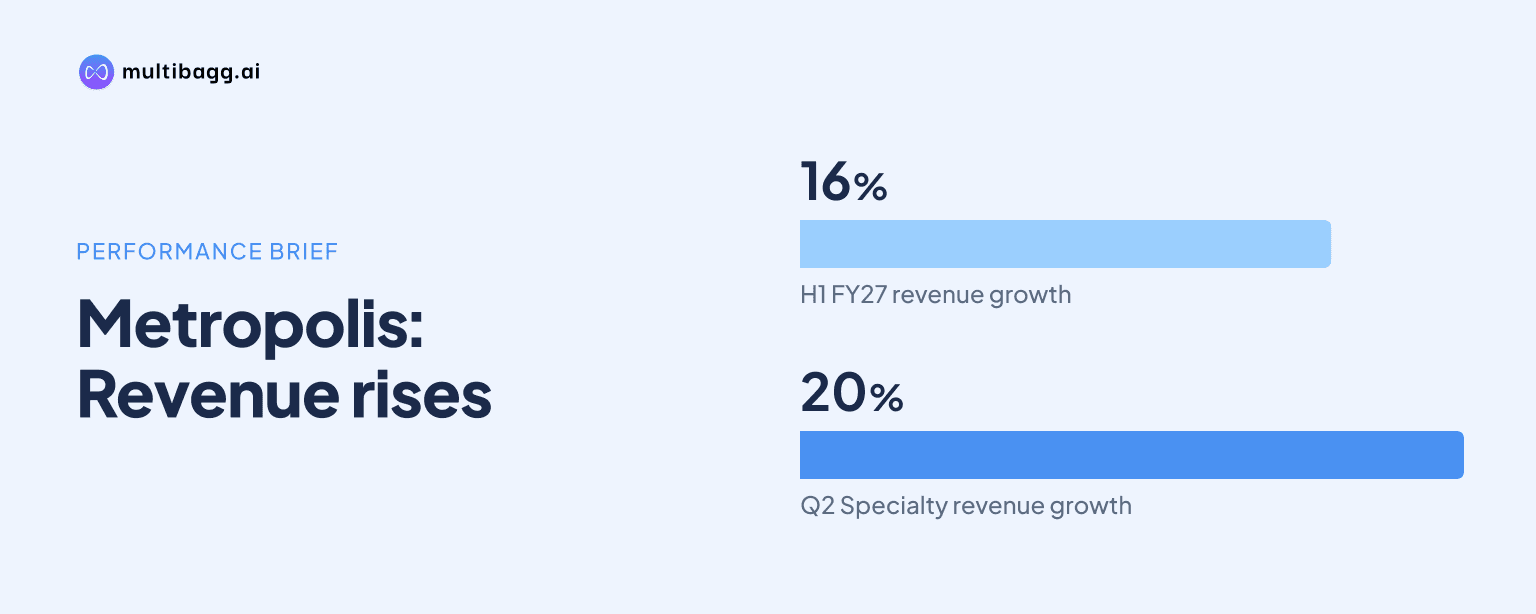
Metropolis reported H1 FY27 revenue of Rs 947 crore, up 16% year on year, and expanded its earnings before interest, tax, depreciation and amortisation (EBITDA) margin by 190 basis points to 26.2%, with management attributing growth to demand, volumes and network throughput rather than price increases.
Know Metropolis Healthcare inside out
Results, valuation, peers and who's buying, in one view.
How did Metropolis perform in H1 FY27?
Metropolis delivered Rs 947 crore of revenue in H1 FY27, a 16% year-on-year increase, supported by sustained demand and higher throughput from its expanded Lab & Center network. Management said the mid-teen growth was ahead of its guidance and was delivered without price hikes.
EBITDA rose 25% year on year to Rs 248 crore, exceeding the 16% revenue growth rate. EBITDA margin reached 26.2%, up 190 basis points, or 1.9 percentage points, with management citing operating leverage, automation, productivity gains and continued process efficiencies.
Profit after tax (PAT) was Rs 132 crore in H1 FY27, up 35% year on year, while PAT margin increased 200 basis points to 14.0%. PAT grew faster than EBITDA, which rose 25%, although the presentation does not provide a bridge between EBITDA and PAT.
What drove Metropolis revenue growth without price hikes?
Metropolis said H1 FY27 growth came from sustained demand and increasing throughput at its expanded Lab & Center network, rather than from price increases. Q2 FY27 operating data showed patient volume rose 10% year on year to 4.07 million and test volume increased 11% to 8.68 million.
Revenue per patient was Rs 1,221 in Q2 FY27, up 6% year on year, and Metropolis explicitly said there was no price increase. Revenue per test increased 5% to Rs 572, while management attributed quarterly growth to volume, favourable mix and improved realizations.
Specialty and TruHealth each recorded 20% year-on-year revenue growth in Q2 FY27, compared with 16% for Semi-specialty and 4% for Routine diagnostics. Specialty was the largest reported segment, representing 40% of revenue and contributing Rs 198 crore, while TruHealth represented 17% and contributed Rs 86 crore.
Got a follow-up? Ask IRIS
Why did Metropolis EBITDA margin rise faster than revenue?
Metropolis attributed the H1 FY27 EBITDA-margin increase of 190 basis points to operating leverage, automation, productivity gains and process efficiencies. The presentation does not quantify the contribution of each factor, but EBITDA growth of 25% was nine percentage points above revenue growth of 16%.
The pattern continued in Q2 FY27, when revenue rose 16% year on year to Rs 497 crore and EBITDA increased 24% to Rs 135 crore. Q2 EBITDA margin was 27.2%, up 180 basis points and 1.0 percentage point above the 26.2% H1 FY27 margin.
Q2 FY27 PAT reached Rs 75 crore, a 43% year-on-year increase, and PAT margin rose 290 basis points to 15.2%. The Q2 PAT margin was 1.2 percentage points higher than the 14.0% H1 FY27 margin, though Metropolis did not disclose detailed drivers below EBITDA.
The two reported periods therefore showed the same relationship between revenue and operating profit: H1 EBITDA rose 25% against 16% revenue growth, while Q2 EBITDA rose 24% against 16% revenue growth. Management linked this difference to its operating model and automation initiatives, not price hikes.
Which Metropolis channels and products contributed in Q2 FY27?
Metropolis generated Rs 289 crore of business-to-consumer (B2C) revenue in Q2 FY27, up 17% year on year, and Rs 208 crore of business-to-business (B2B) revenue, up 15%. B2C represented 58% of quarterly revenue, compared with 42% for B2B.
Within B2C, TruHealth revenue grew 21% and Specialty revenue grew 23% year on year. Metropolis cited 60-minute home collection and faster reports in key markets, local digital activity, app adoption, its MetLink franchise engagement programme and wider partner-portal use as channel measures.
Within B2B, TruHealth grew 19% and Specialty grew 18% year on year. The B2B channel includes laboratories, hospitals, government customers, corporates and clinical trials, while management cited a dedicated helpdesk for high-end partners and a specialty portfolio focused on genomics.
TruHealth volume growth was led by Tier 3 and rural markets, and Metropolis said 30% of diet and dietician bundle traction in B2C came through digital channels. In Specialty, the company launched a 1,000-gene next-generation sequencing panel, NIPT Advance and pre-eclampsia screening during the period.
Conclusion
Metropolis combined 16% H1 FY27 revenue growth with faster expansion in EBITDA and PAT, which rose 25% and 35%, respectively. The Q2 results showed broad-based channel growth, with B2C increasing 17%, B2B rising 15%, and both Specialty and TruHealth growing 20% at the segment level.
The next results will show whether the company can sustain demand-led growth without price increases as it expands Lab & Center throughput. Management’s disclosed plan focuses on automation, process efficiencies, digital adoption, franchise engagement and further scaling of its Specialty and genomics menu.