










Metropolis Healthcare Limited's Specialty, TruHealth Rise 20%
Key highlights
- Metropolis specialty revenue grew 20% year on year to Rs 198 crore in Q2FY27, representing 40% of revenue.
- Metropolis TruHealth revenue grew 20% year on year to Rs 86 crore, or 17% of Q2FY27 revenue.
- Metropolis routine testing grew 4% in Q2FY27, compared with 16% growth in semi-specialty testing.
- Metropolis B2C specialty revenue grew 23% in Q2FY27, while B2B specialty revenue grew 18%.
powered by IRIS
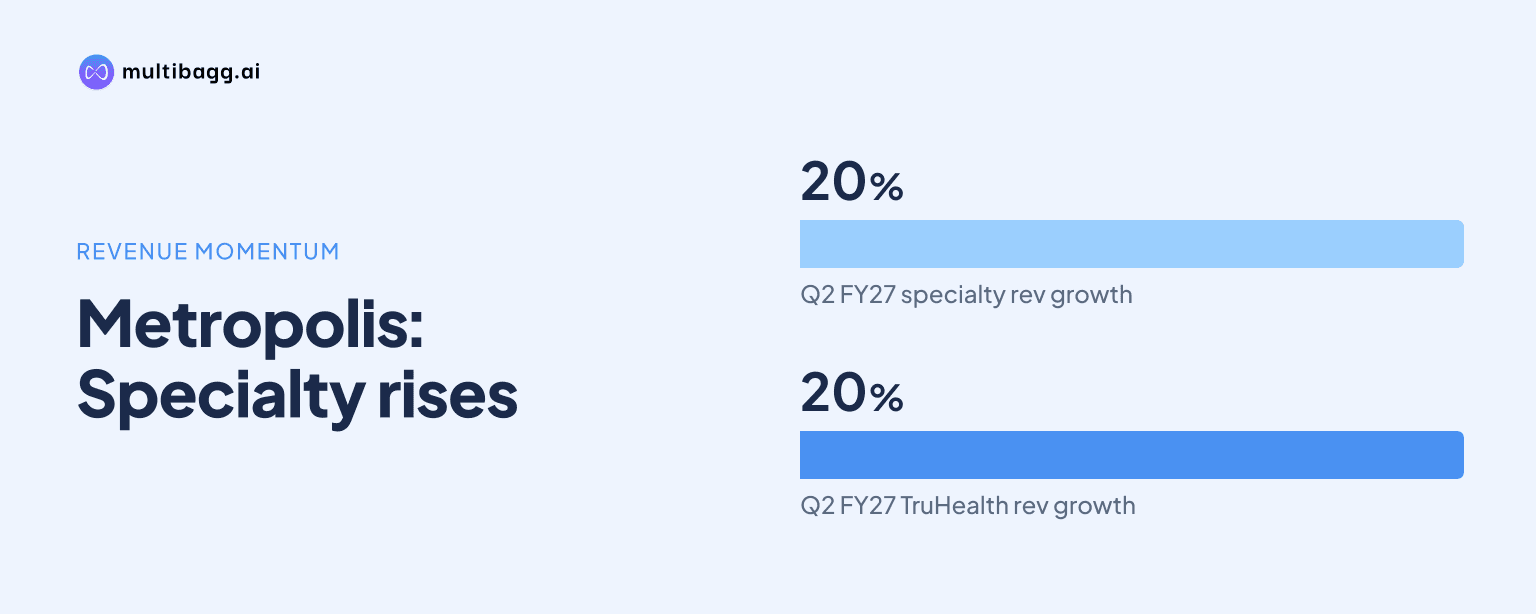
In Q2FY27, Metropolis Healthcare Limited's specialty and TruHealth diagnostics each grew 20% year on year, while routine testing grew 4%. Specialty contributed Rs 198 crore, or 40% of quarterly revenue, and TruHealth contributed Rs 86 crore, or 17%, as revenue from operations increased 15.8% to Rs 496.8 crore.
Know Metropolis Healthcare inside out
Results, valuation, peers and who's buying, in one view.
Why did Metropolis's revenue mix change in Q2FY27?
Metropolis's revenue mix shifted because specialty and TruHealth each grew five times faster than routine testing in Q2FY27. Specialty was the largest disclosed segment at Rs 198 crore and 40% of revenue, while TruHealth supplied Rs 86 crore and 17%. Semi-specialty represented 25% of revenue and grew 16%, compared with routine testing's 18% share and 4% growth.
Specialty and TruHealth together accounted for 57% of Q2FY27 revenue, compared with 18% for routine testing. The disclosed data do not provide a prior-period segment-revenue mix or segment margins, so they show relative growth and current contribution rather than the precise extent of any margin impact from the shift.
Metropolis reported Q2FY27 revenue from operations of Rs 496.8 crore, up from Rs 429.2 crore in Q2FY26. The presentation attributed the 15.8% increase to volume and favourable mix across channels, regions, TruHealth and specialty diagnostics; it also reported no price increase, even as revenue per patient rose 6% to Rs 1,221.
Which channels led Metropolis specialty and TruHealth growth?
Both business-to-consumer and business-to-business channels led growth in specialty and TruHealth, with the consumer channel reporting faster rates in Q2FY27. Business-to-consumer, or B2C, revenue rose 17% year on year to Rs 289 crore and made up 58% of revenue. Within B2C, specialty grew 23% and TruHealth grew 21%.
Metropolis linked B2C outlet volumes to 60-minute home collection, faster reports in key markets, local digital promotion and app adoption. It also cited the MetLink franchise-partner engagement programme and Partner Portal as channel initiatives, but did not quantify the revenue contribution of any individual programme in Q2FY27.
Business-to-business, or B2B, revenue increased 15% to Rs 208 crore and accounted for 42% of Q2FY27 revenue. TruHealth grew 19% in B2B and specialty grew 18%, below the corresponding B2C rates of 21% and 23%. The B2B channel includes laboratories, hospitals, government, corporate customers and clinical trials.
Metropolis listed a dedicated helpdesk for high-end B2B partners, a specialty portfolio focused on genomics and wider Partner Portal use to improve transparency. The 18% B2B specialty growth and 19% B2B TruHealth growth both remained well above the 4% growth reported for routine testing across the segment mix.
Got a follow-up? Ask IRIS
What products and programmes support Metropolis's mix shift?
Metropolis associated TruHealth's 20% Q2FY27 growth with premium packs, digital sales and demand from Tier III and rural markets. Diet and dietician bundles gained B2C traction, with 30% sold through digital channels. The presentation also said bundling lifted revenue per test on premium packs and revenue per patient in focus cities on TruHealth diet bundles.
Operating indicators were consistent with a volume-led quarter: patient volume rose 10% to 4.07 million and test volume increased 11% to 8.68 million in Q2FY27. Revenue per test rose 5% to Rs 572, while revenue per patient increased 6% to Rs 1,221, despite the company's statement that there had been no price increase.
For specialty diagnostics, Metropolis connected 20% growth to clinician engagement, scientific expansion and new test launches. Digital promotion was used to build consumer awareness of tests such as Alzheimer's testing, while genomics events, conferences and podcasts were used to widen key opinion leader reach.
The Q2FY27 launch list included a 1,000-gene next-generation sequencing, or NGS, panel, NIPT Advance and pre-eclampsia screening. Management said core-menu development and genomics scale-up are intended to speed specialty growth, but the presentation did not provide a future specialty-revenue target or timetable for these plans.
How did the mix shift coincide with Metropolis's financial results?
The mix shift coincided with faster growth in earnings than revenue in Q2FY27, although Metropolis did not disclose profitability by diagnostic segment. Reported earnings before interest, tax, depreciation and amortisation, or EBITDA, rose 23.9% to Rs 134.9 crore, ahead of the 15.8% revenue increase to Rs 496.8 crore. EBITDA margin increased by 180 basis points to 27.2% from 25.4% in Q2FY26.
Profit after tax increased 42.7% to Rs 75.5 crore from Rs 52.9 crore, and the profit-after-tax margin rose by 290 basis points to 15.2%. Metropolis attributed EBITDA-margin expansion to operating leverage, automation and continued process efficiencies, while citing patient and test volumes, richer mix and improved realisations as quarterly growth factors.
For H1FY27, revenue from operations rose 16.2% to Rs 947 crore from Rs 815.3 crore in H1FY26. Reported EBITDA increased 25.3% to Rs 248.2 crore, lifting the H1FY27 EBITDA margin by 190 basis points to 26.2% from 24.3% in the prior-year period.
Metropolis had 213 laboratories and 5,119 service points in H1FY27, after adding 116 service points in Q2FY27. Its network covered about 750 towns, compared with 300 in FY23; the presentation identifies higher throughput from the expanded laboratory and centre network as a contributor to growth, without assigning a specific revenue amount to new locations.
Conclusion
Metropolis's Q2FY27 results show that specialty and TruHealth are contributing a larger disclosed share of revenue than routine testing while growing substantially faster. Specialty's 40% share and 20% growth, alongside TruHealth's 17% share and equal growth rate, contrast with routine testing's 18% contribution and 4% increase, while company revenue rose 15.8% and EBITDA grew 23.9%.
The next disclosures to watch are management's core-menu and genomics scale-up plans, including the 1,000-gene NGS panel, NIPT Advance and pre-eclampsia screening. Investors can also monitor whether the 30% digital share of TruHealth diet and dietician bundles, and further network additions after 116 service points in Q2FY27, continue to support patient volumes and realisations without price increases.