










MobiKwik Plans 10% NBFC Disbursals Through Co-Lending
Key highlights
- MobiKwik used a hypothetical Rs 6,000 crore next-year digital-lending disbursal target to explain its NBFC plan.
- MobiKwik would aim to route at least 10%, or Rs 600 crore, of that illustrative target through its NBFC.
- MobiKwik said a 10:90 co-lending structure would require roughly Rs 60 crore for Rs 600 crore of disbursals.
- MobiKwik’s current lending disbursal mix is 79% FLDG and 21% pure distribution.
powered by IRIS
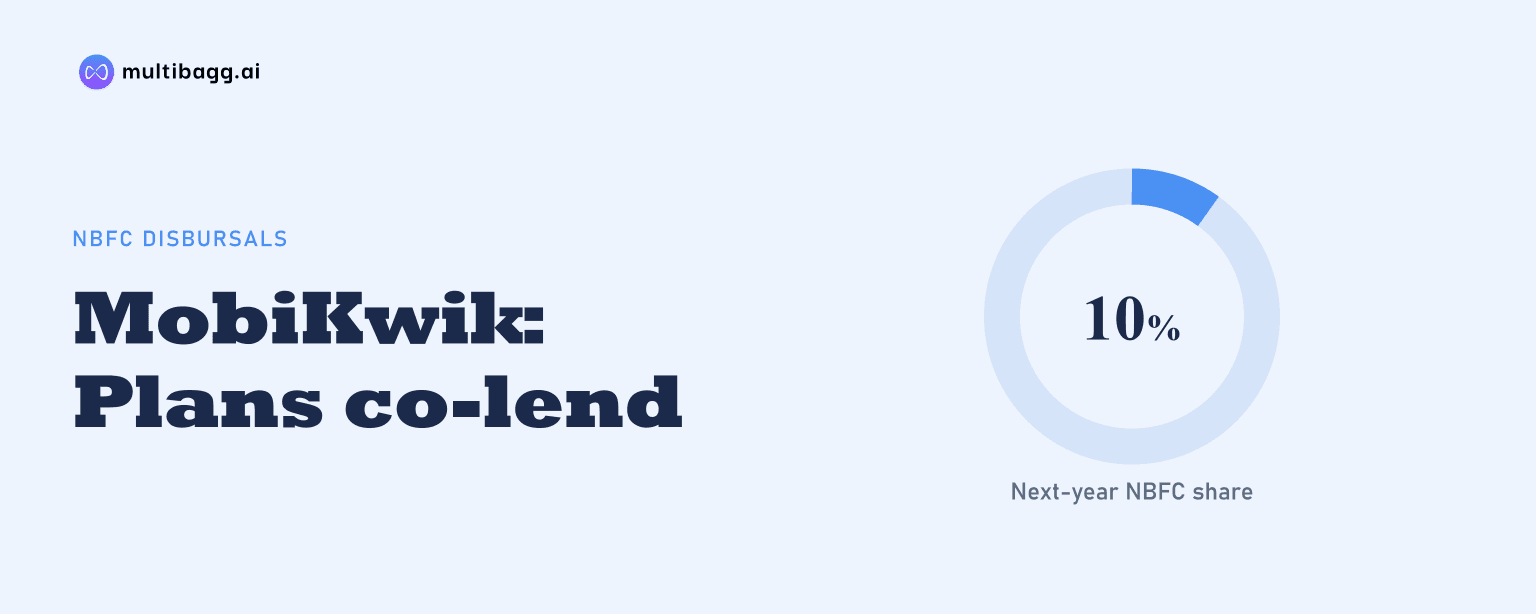
MobiKwik plans to route at least 10% of a hypothetical next-year Rs 6,000 crore digital-lending disbursal target through its own NBFC, initially using co-lending that management said would require roughly Rs 60 crore for Rs 600 crore of disbursals. The plan remains conditional on Reserve Bank of India approval to begin NBFC operations.
Know One Mobikwik Systems inside out
Results, valuation, peers and who's buying, in one view.
What is MobiKwik’s NBFC strategy?
MobiKwik’s short-run NBFC strategy is to remain asset light by keeping only a limited portion of digital-lending disbursals within its own non-banking financial company, or NBFC. Management illustrated the approach with a hypothetical next-year target of Rs 6,000 crore in digital-lending disbursals, of which it would aim to execute at least 10%, or about Rs 600 crore, through the NBFC.
That example was a plan rather than financial guidance or a committed disbursal forecast. Management said the initial route for the Rs 600 crore NBFC component would be co-lending with a larger NBFC or a bank, an arrangement it described as common and understood across the industry. MobiKwik intends to use its existing credit underwriting and collections capabilities in that NBFC business.
How would co-lending limit MobiKwik’s balance-sheet exposure?
Co-lending would limit MobiKwik’s on-book exposure because management’s illustrative structure puts up 10% equity in a 10:90 model rather than funding the entire Rs 600 crore NBFC disbursal amount. On that basis, management said it would need roughly Rs 60 crore to support Rs 600 crore of disbursals, while the co-lending partner would provide the larger funding share.
The NBFC approach differs from MobiKwik’s first loss default guarantee, or FLDG, model, where it provides a guarantee while lending partners fund the loans. Management said it operates within the Reserve Bank of India’s 5% default-loss guarantee guidance under its regulations. In the proposed NBFC co-lending model, management described its contribution as 10% equity, but did not provide expected credit losses, yields or returns for either structure.
What must happen before MobiKwik starts NBFC lending?
MobiKwik must receive the Reserve Bank of India’s final go-ahead before it can obtain its Certificate of Registration, or CoR, and begin NBFC operations. Management said the company had completed the required migration and slump sale in August and had met all regulatory conditions, but was still waiting for the regulator’s final approval at the time of the call.
The pending approval means the Rs 6,000 crore illustration does not establish an operating timetable. Management called the co-lending model its early NBFC plan and did not state when the CoR would be granted, when the first loan would be originated through the NBFC, or which bank or larger NBFC would become its co-lending partner.
Got a follow-up? Ask IRIS
How does the NBFC plan fit MobiKwik’s current lending distribution business?
MobiKwik’s existing lending business was 79% FLDG and 21% pure distribution by disbursal mix, so the NBFC proposal would add another lending route rather than replace either current model. In pure distribution, MobiKwik said it earns an upfront sourcing or distribution commission without providing an FLDG guarantee.
Management said it is agnostic between expanding pure distribution and FLDG because its primary objective is to raise total lending disbursals. It said FLDG can bring stronger repeat business and better partner economics, while pure distribution provides fee income without guarantees. The eventual mix will depend on risk-adjusted returns and partner appetite, rather than a predetermined ratio such as the current 79% and 21% split.
MobiKwik also explained that FLDG revenue is not limited to the sourcing fee earned at disbursal. It manages portfolios and collections for lenders and receives a share of income generated during a loan’s tenure. For loans lasting 12 months or 15 months, that arrangement can produce income each month, alongside collection incentives and other contractually negotiated revenue heads.
What investment will MobiKwik make while building the NBFC?
MobiKwik said it will need to invest in employees as it builds Merchant Payments and new businesses including the NBFC, even after recording four quarters of profitability. Management said it would not avoid people investments if those investments support its new revenue-growth targets, while also saying it would remain mindful of its spending.
Management expects fixed cost as a proportion of total income to decline in upcoming quarters, although it did not specify a quarter or percentage target. It attributed the year-on-year rise in employee benefit expense partly to a low comparison base in the corresponding second quarter of the prior financial year, when the company was more cautious on hiring while seeking to turn profitable.
The capital-light lending design therefore sits alongside a broader build phase rather than a stand-alone balance-sheet initiative. Management’s stated sequence is to secure the CoR, start through co-lending, deploy underwriting and collections capabilities already developed in FLDG, and seek expansion without taking the full funding burden of a Rs 600 crore NBFC loan book in its illustrative case.
Conclusion
MobiKwik’s plan is to enter regulated lending with a deliberately limited initial balance-sheet role: at least 10% of a hypothetical Rs 6,000 crore digital-lending disbursal target would pass through its NBFC, and that Rs 600 crore component would itself begin in a 10:90 co-lending structure. This would complement, rather than displace, a lending mix that was 79% FLDG and 21% pure distribution.
The next item to watch is the Reserve Bank of India’s final approval and issuance of the CoR, which management said are necessary before operations can start. After approval, management’s plan points to the timing of the first co-lending arrangement, the actual proportion of disbursals routed through the NBFC, and whether fixed costs decline as a share of total income in the upcoming quarters.