










MobiKwik targets Rs 100 crore FY28 PAT if UPI MDR is implemented
Key highlights
- MobiKwik targets Rs 100 crore of FY28 PAT if UPI MDR is implemented, versus its earlier Rs 75 crore to Rs 80 crore target.
- Management estimates UPI MDR could add at least Rs 100 crore of FY28 payments revenue and Rs 20 crore to Rs 25 crore of EBITDA or PAT contribution.
- MobiKwik said merchant payments generate roughly 3 bps to 4 bps of net take rate, compared with more than 16 bps in consumer payments.
- MobiKwik's lending-disbursal mix is 79% FLDG and 21% pure distribution.
powered by IRIS
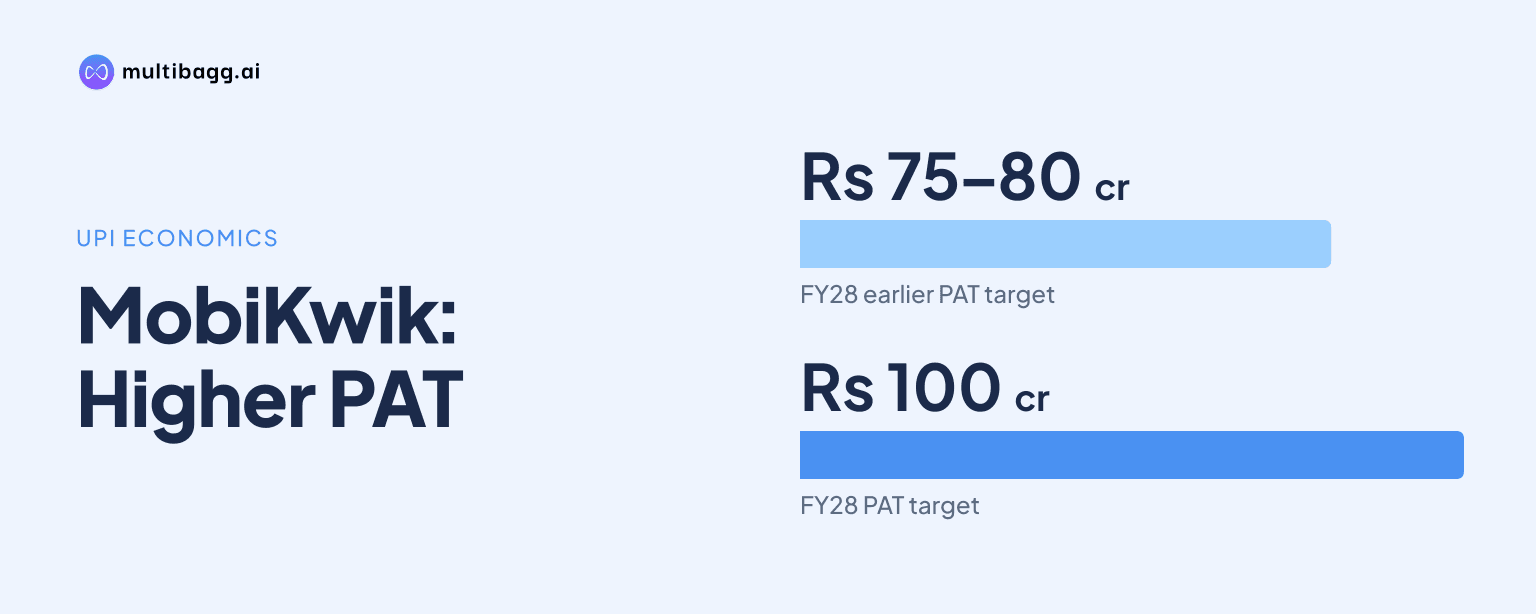
MobiKwik is targeting Rs 100 crore profit after tax (PAT) in FY28 if a Unified Payments Interface merchant discount rate (UPI MDR) is implemented, versus its previous Rs 75 crore to Rs 80 crore target, after management estimated at least Rs 100 crore of incremental FY28 payments revenue.
Know One Mobikwik Systems inside out
Results, valuation, peers and who's buying, in one view.
How would UPI MDR change MobiKwik's FY28 profit target?
MobiKwik's FY28 PAT target would rise to Rs 100 crore if UPI MDR is implemented, compared with its earlier Rs 75 crore to Rs 80 crore target. Management also said it had a Rs 40 crore target for the current year, making the potential MDR benefit an addition to its next-year plan rather than reported earnings.
The Rs 100 crore target remains conditional because the final UPI MDR implementation date has not been announced. Management said it would provide more guidance once implementation occurs, meaning the outcome depends both on the policy's final structure and its effective date.
The revised target implies Rs 20 crore to Rs 25 crore more PAT than the earlier FY28 range. That matches management's estimate that Rs 20 crore to Rs 25 crore of the proposed MDR-driven revenue could reach earnings before interest, tax, depreciation and amortisation (EBITDA) or PAT levels.
What revenue could UPI MDR add for MobiKwik?
MobiKwik estimates that UPI MDR could add at least Rs 100 crore to FY28 payments revenue. Management said this was the most specific guidance it could offer before an implementation date is announced and did not disclose a transaction-level eligibility split for consumer and merchant payments.
On eligible merchant transactions above Rs 2,000, management described a 40-basis-point (bps) gross MDR. It said other participants, including the customer's bank, issuing bank, third-party application provider (TPAP) and payment service provider (PSP) supporting the consumer TPAP, would share in the economics.
MobiKwik estimates that roughly 20% to 25% of merchant-side gross revenue could reach the bottom line. Management separately said that, on consumer payments, an illustrative 20% share of a 40-bps charge would mean 8 bps flowing to net take rate, although some transactions may instead carry flat fees.
Why would MobiKwik's consolidated take rate rise only modestly?
MobiKwik does not expect a 2.5-bps increase in its consolidated payments take rate because merchant payments remain a smaller part of its payments business than consumer payments. Management said merchant payments generate a net take rate of roughly 3 bps to 4 bps, compared with more than 16 bps in consumer payments.
Merchant payments are growing faster than consumer payments, which shifts the business mix toward a lower-take-rate segment. Management said take rates were stable between the preceding quarter and the quarter under discussion, but a larger merchant share can reduce the blended rate even if individual product economics do not change.
UPI MDR would improve merchant payments take rates and partly improve consumer payments take rates, according to management. However, it said consolidated gross and net rates would not improve dramatically because consumer payments account for a larger share of revenue and include prepaid payment instrument-linked income with already higher take rates.
Management said the blended take rate could move by 1 bps or 2 bps after MDR implementation, depending on merchant payments' share of total payments. On the merchant side, it estimated that 8 bps to 10 bps could be realised on a net basis from the 40-bps gross rate, while noting that competition could affect the final outcome.
Got a follow-up? Ask IRIS
What operating issues could affect MobiKwik's FY28 plan?
MobiKwik said consumer UPI activity was soft in the quarter discussed, resulting in no consumer-side growth, and described the period as seasonally weaker. Management expects the pace to pick up in Q3 because of the festive season, which could alter the consumer-to-merchant payments mix.
The company has completed four quarters of profitability but plans continued employee investment for merchant payments and newer business lines. Management expects fixed costs as a percentage of total income to decline in upcoming quarters, while saying hiring will continue where it supports revenue-growth targets.
MobiKwik completed its migration and slump sale in August, met Reserve Bank of India conditions, and is awaiting final approval to receive a certificate of registration for non-banking financial company (NBFC) operations. Management said the initial NBFC approach would be asset light and based on co-lending to limit on-book exposure.
How is MobiKwik planning lending growth and NBFC operations?
MobiKwik's lending-disbursal mix is 79% under the first loss default guarantee (FLDG) model and 21% under pure distribution. Under pure distribution, it provides no FLDG and earns distribution or upfront sourcing commission, while in FLDG it operates within the Reserve Bank of India's 5% digital-lending guarantee guidance.
Management does not intend to set a fixed ratio between the 79% FLDG and 21% pure-distribution models. It said the choice will depend on partner appetite and risk-adjusted returns, while the main aim is to increase total lending disbursals.
For its NBFC illustration, management said that Rs 6,000 crore of next-year digital-lending disbursals could include at least 10%, or Rs 600 crore, originated through its own NBFC. A 10:90 co-lending model for that Rs 600 crore could require roughly Rs 60 crore, compared with a 5% guarantee under the FLDG model.
In FLDG, MobiKwik receives an upfront sourcing fee, manages portfolios and collections, and earns a share of income over a loan's tenure. Management said a 12-month or 15-month loan can therefore generate income after disbursal, while its NBFC plan would use existing underwriting and collections capabilities.
Conclusion
MobiKwik's conditional Rs 100 crore FY28 PAT target rests on management's estimate of at least Rs 100 crore in additional payments revenue from UPI MDR and Rs 20 crore to Rs 25 crore reaching EBITDA or PAT levels. The benefit would be meaningful to the earnings plan, but consumer payments' larger revenue share limits the expected improvement in consolidated take rates.
The main next trigger is the final UPI MDR structure and implementation date, after which management has said it will provide further guidance. Investors can also watch for the expected Q3 festive recovery in consumer UPI activity and final Reserve Bank of India approval for MobiKwik's NBFC certificate of registration.