










Monarch H1 operating cash reaches Rs 46.9 crore while cash falls
Key highlights
- Monarch generated Rs 46.9 crore of standalone operating cash in H1 FY27 after an Rs 37.7 crore outflow in FY26.
- Standalone investing outflows of Rs 55.5 crore exceeded H1 FY27 operating cash generation and reduced closing cash to Rs 14.8 crore.
- Standalone trade receivables rose to Rs 77.1 crore on September 30, 2026, from Rs 53.1 crore on March 31, 2026.
- Monarch reported an approximately Rs 865 crore order book, stated to be executable over 24 to 36 months.
powered by IRIS
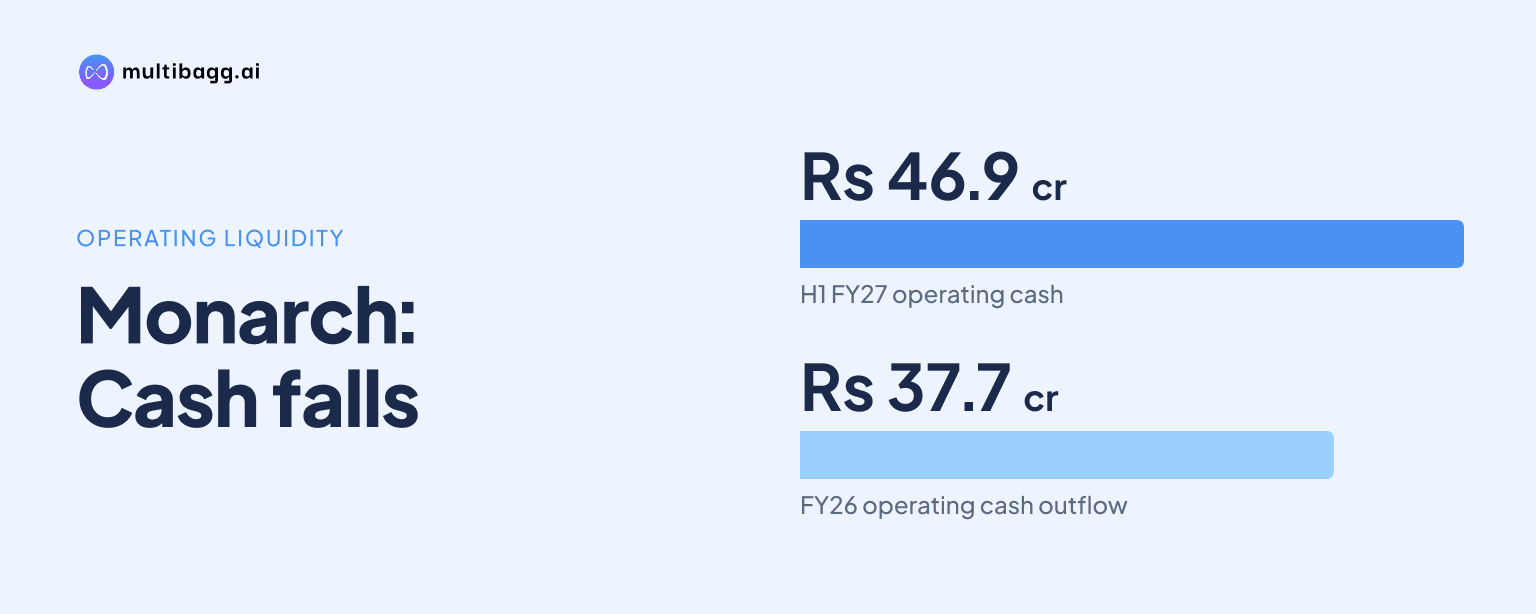
Monarch generated Rs 46.9 crore of standalone net operating cash in H1 FY27, the first half of financial year 2027, reversing an Rs 37.7 crore outflow in FY26, but Rs 55.5 crore of investing outflows and Rs 5 crore of financing outflows reduced closing cash to Rs 14.8 crore on September 30, 2026.
Know Monarch Surveyors and Engineering Consultants inside out
Results, valuation, peers and who's buying, in one view.
How did Monarch's operating cash flow change in H1 FY27?
Monarch's standalone operating cash flow turned positive in H1 FY27, with net cash from operating activities of Rs 46.9 crore, compared with a net operating cash outflow of Rs 37.7 crore in FY26 and an inflow of Rs 2.8 crore in FY25. The H1 FY27 result followed Rs 50.4 crore of cash generated from operations and Rs 3.5 crore of direct taxes paid.
The change was principally associated with working-capital movements. Operating profit before working-capital changes was Rs 27 crore in H1 FY27, compared with Rs 53.6 crore in FY26, while changes in working capital contributed Rs 23.4 crore in H1 FY27 after consuming Rs 79.2 crore in FY26. Non-cash items and other investment or financial adjustments were Rs 4.5 crore in H1 FY27, compared with Rs 3.1 crore in FY26.
The periods are not directly equivalent because H1 FY27 covers six months, while FY26 and FY25 are full financial years. However, the Rs 23.4 crore working-capital contribution in H1 FY27 contrasts with the Rs 79.2 crore use in FY26 and explains the change in operating cash despite the lower operating profit before working-capital changes.
Why did Monarch's cash balance decline despite operating inflow?
Monarch's closing standalone cash and cash equivalents declined because investing and financing outflows exceeded the Rs 46.9 crore operating inflow. Investing activities used Rs 55.5 crore and financing activities used Rs 5 crore during H1 FY27, producing a net decrease in cash and cash equivalents of Rs 13.6 crore.
Cash and cash equivalents consequently fell from Rs 28.4 crore at the beginning of H1 FY27 to Rs 14.8 crore at the end of the period. In FY26, Rs 81.2 crore of financing inflow more than offset the Rs 37.7 crore operating outflow and Rs 25.9 crore investing outflow, producing a Rs 17.6 crore rise in cash to Rs 28.4 crore.
The presentation reports the Rs 55.5 crore investing cash outflow only as an aggregate. It therefore establishes that investment cash use was the largest H1 FY27 outflow, but does not identify the amounts spent on property, plant and equipment, investments, loans or other individual uses.
What do Monarch's receivables and balance sheet show?
Monarch's standalone trade receivables increased to Rs 77.1 crore on September 30, 2026, from Rs 53.1 crore on March 31, 2026 and Rs 39.6 crore on March 31, 2025. The Rs 24 crore rise over six months means a larger balance was due from customers at the reporting date, even though the cash-flow statement showed a positive Rs 23.4 crore aggregate working-capital movement.
The presentation does not provide components for that Rs 23.4 crore working-capital movement, so the specific cash effect of higher receivables cannot be separated from payables, advances and other current-balance changes. Trade payables declined to Rs 3.2 crore at September 30 from Rs 11.8 crore at March 31, while other current assets fell to Rs 32 crore from Rs 84.2 crore.
Standalone property, plant and equipment and intangible assets rose to Rs 58.6 crore at September 30 from Rs 49.1 crore at March 31, while non-current investments were Rs 11.8 crore compared with nil at March 31. Total assets increased to Rs 282.7 crore from Rs 268.8 crore, and total equity rose to Rs 249.2 crore from Rs 231.1 crore.
Got a follow-up? Ask IRIS
How does Monarch's consolidated cash flow compare with standalone cash flow?
Monarch's consolidated H1 FY27 operating cash flow was Rs 49.4 crore, Rs 2.5 crore above the standalone Rs 46.9 crore, while consolidated closing cash and cash equivalents were Rs 15.9 crore, compared with standalone closing cash of Rs 14.8 crore. The presentation says its consolidated H1 FY27 numbers include GMR Engineering, acquired in July 2026.
On the consolidated basis, cash generated from operations was Rs 52.9 crore, including Rs 27.2 crore from changes in working capital, and direct taxes paid were Rs 3.5 crore. Consolidated profit before tax was Rs 21.2 crore, below the standalone Rs 22.5 crore, while both statements reported Rs 4.5 crore of non-cash and other investment or financial adjustments.
Consolidated investing activities used Rs 56.8 crore and financing activities used Rs 5 crore, resulting in a Rs 12.5 crore reduction in cash from an opening Rs 28.4 crore. The consolidated balance sheet reported Rs 16 crore of cash and bank balances at September 30, 2026, while the cash-flow statement reported Rs 15.9 crore of closing cash and cash equivalents.
What is Monarch planning to do about cash discipline?
Monarch says its near-term execution priorities include margin and cash discipline, with debtor days reported at 110 to 117 as of September 2026. Management's stated actions are tighter milestone terms on new contracts, sharper collections and a broader private-sector client base.
The plan accompanies an order book of about Rs 865 crore across 22 states, which Monarch says is executable over the next 24 to 36 months. About 48% of orders are in rail and highways, including a Rs 130 crore Northern Railway contract over 36 months and the Somnath-Dwarka mandate valued at more than Rs 100 crore.
Management identifies approval, land and subcontractor delays before billing milestones as matters to identify during execution. Its technology plan includes fixed-wing light detection and ranging equipment, drones, Trimble GEDO CE 2.0 trolleys for rail-track audits, and web-based geographic information system and building information modelling platforms, although the presentation does not quantify their future cash effect.
Conclusion
Monarch's H1 FY27 cash flow indicates that standalone operations generated Rs 46.9 crore after the Rs 37.7 crore FY26 operating outflow, supported by a Rs 23.4 crore positive working-capital movement. That operating inflow did not increase cash because Rs 55.5 crore of investing outflows and Rs 5 crore of financing outflows reduced standalone closing cash to Rs 14.8 crore.
The next measures to watch are whether receivables, which reached Rs 77.1 crore on September 30, move in line with management's stated 110-to-117 debtor-day focus and tighter milestone terms. Execution of the approximately Rs 865 crore order book over the stated 24-to-36-month period, particularly the 36-month Rs 130 crore Northern Railway contract, will also affect billing and collection timing.