










Moneyview GNPA falls to 2.42% as collection efficiency rises
Key highlights
- Moneyview reported GNPA of 2.42% in Sep’26, compared with 2.65% in Sep’25.
- Collection efficiency increased to 98.64% in Sep’26 from 98.27% a year earlier.
- Moneyview says its underwriting uses more than 100,000 data variables and more than 3,000 user segmentations.
- AI voice bots handled 67% of Moneyview’s collection calls, according to the presentation.
powered by IRIS
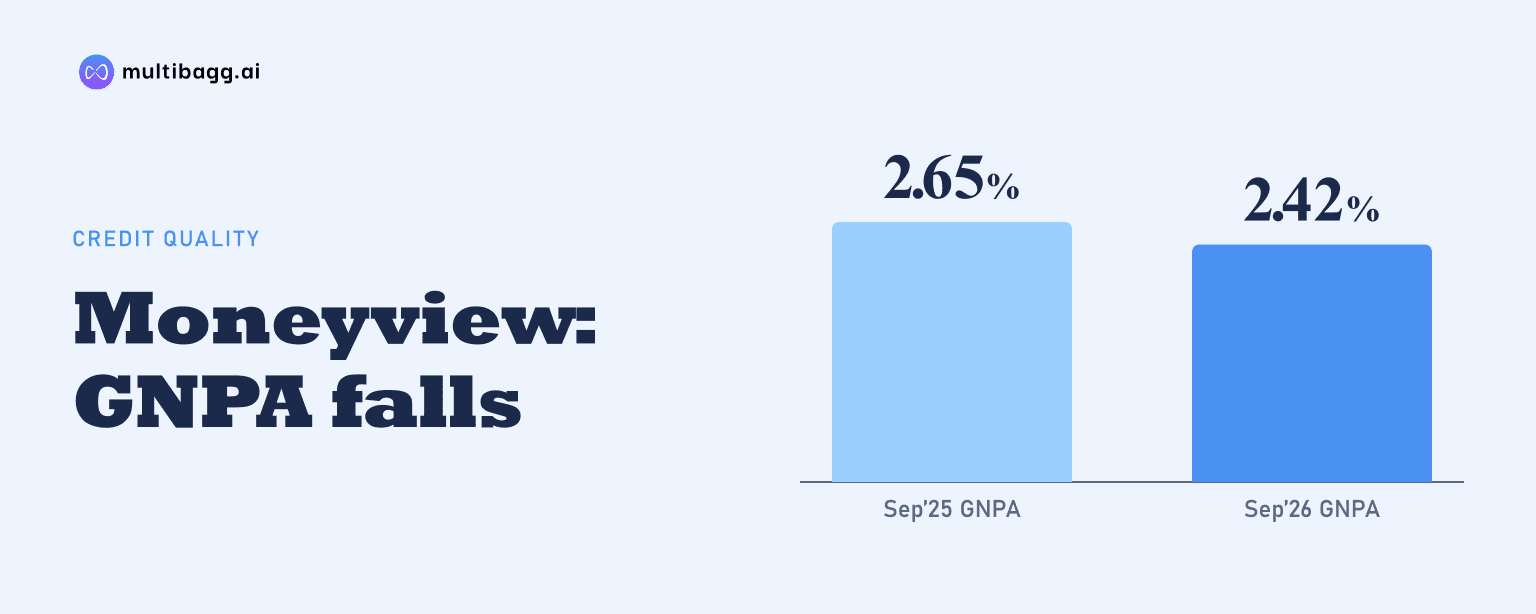
Moneyview reported gross non-performing assets (GNPA) of 2.42% in Sep’26, down from 2.65% in Sep’25, while collection efficiency rose to 98.64% from 98.27%. The company attributes the movement to underwriting using more than 100,000 data variables, micro-segment scoring and artificial intelligence (AI)-enabled collections across its managed portfolio.
Know Moneyview inside out
Results, valuation, peers and who's buying, in one view.
How did Moneyview’s asset quality change?
Moneyview’s GNPA declined by 23 basis points year on year to 2.42% in Sep’26 and by 2 basis points from 2.44% in Jun’26. Collection efficiency moved higher by 37 basis points from Sep’25 and by 3 basis points sequentially to 98.64% in Sep’26. Moneyview describes these changes as steady improvements in risk performance supported by in-house AI and machine-learning (ML) models.
The movement between Jun’26 and Sep’26 was incremental rather than sharp, with GNPA falling from 2.44% to 2.42% and collection efficiency increasing from 98.61% to 98.64%. The presentation does not provide a product-level split of either metric for personal loans, repeat loans or other customer cohorts.
How does Moneyview assess borrowers using data?
Moneyview says it creates personalised risk-based offers using more than 100,000 data variables and more than 3,000 user segmentations. Its inputs include bureau credit history; SMS and bank-statement data on cash flows, purchases and card usage; device data; application details such as education and employment; and verification data from the Employees’ Provident Fund Organisation, anti-money-laundering checks and Goods and Services Tax records.
The company also includes collections information, including payment consistency, auto-debit data and voice-interaction data, in its listed sources. More than 15 contextual ML models are continuously tested against new features, according to the presentation. The models score users within micro-segments, rather than applying one assessment across the full user base.
Moneyview says that risk assessment feeds a pricing engine for risk-based pricing, an offer engine for personalised and flexible offers, and an automated fraud and verification engine. It links this data-driven approach to a 7% reduction in annualised impairment of financial instruments as a percentage of average managed assets under management (AUM), to 4.94% in Q2’FY27 from 5.30% in Q2’FY26. This impairment measure is distinct from GNPA, although both measures were lower in the cited periods.
How does Moneyview use AI in collections?
Moneyview says its collections engine uses behavioural risk signals, payment-intent modelling and delinquent-user classification to determine actions by risk segment. Before the first call, each account is scored for its likelihood of payment. Call, message and tone are then changed according to delinquency stage and the customer’s situation.
Its in-house conversational AI uses multilingual, human-like voice agents with contextual understanding and intent detection, according to the presentation. Moneyview reported that AI voice bots handled 67% of collection calls. The company also says every collection call is audited and mined for more than 1,000 signals that re-score an account and set the next action.
The collection process includes AI-based post-call quality analysis and real-time feedback into collection strategy. Payment-consistency and auto-debit information also form part of the collections data used in user assessment. Moneyview presents the 98.64% collection-efficiency result for Sep’26 alongside these features, but does not quantify the separate effect of voice bots, payment-intent models or post-call analysis on that outcome.
Got a follow-up? Ask IRIS
What does Moneyview’s risk trend mean alongside growth?
Moneyview reported managed AUM of Rs 23,892 crore in Q2’FY27, up 28.4% from Rs 18,603 crore in Q2’FY26 and 6.1% from Rs 22,520 crore in Q1’FY27. Its Sep’26 GNPA of 2.42% was below both the 2.65% reported in Sep’25 and the 2.44% reported in Jun’26. The comparison shows that the disclosed asset-quality ratio improved while managed AUM expanded.
The off-book share of AUM was 74.7% in Q2’FY27, compared with 74.9% in Q2’FY26 and Q1’FY27. Moneyview describes its lending service provider model as 75% off-book AUM and its own non-banking financial company model as 25% on-book AUM. The reported managed AUM therefore covers both off-book and on-book exposures in the company’s hybrid capital model.
Moneyview also reported loan disbursals of Rs 7,701 crore in Q2’FY27, up 41.3% from Rs 5,449 crore in Q2’FY26 and 7.7% from Rs 7,152 crore in Q1’FY27. Registered users reached 149 million, versus 120 million a year earlier, while monetised users rose to 13 million from 9 million. These reported growth figures provide the context for Moneyview’s emphasis on automated assessment and collections processes.
How do AI and technology feature in Moneyview’s operating model?
Moneyview says more than 50% of its employees are in technology and data roles, supported by an in-house technology platform built over 12 years. The company says its modular architecture supports product development, customised products and application programming interface integrations with financial partners. These capabilities sit alongside the 15-plus contextual ML models used in risk assessment.
The company reported operating expense as a percentage of total income of 34.5% in Q2’FY27, compared with 38.4% in Q2’FY26 and 35.9% in Q1’FY27. Moneyview calculated the year-on-year improvement at 10.1% and the quarter-on-quarter improvement at 3.9%. Operating expenses in that calculation include other expenses, employee benefits, and depreciation and amortisation.
Moneyview also reported that AI-assisted processes wrote and tested 80% of code, while AI increased conversion by 12% at key steps of the loan journey. In customer support, it said AI resolved 78% of queries at one-third of turnaround time, while its collections metric showed AI voice bots handling 67% of calls. The presentation does not assign a separate financial effect to each of these AI applications.
Conclusion
Moneyview’s Sep’26 disclosures show lower GNPA and higher collection efficiency during a period of growth in managed AUM and disbursals. The company reported GNPA of 2.42%, collection efficiency of 98.64%, managed AUM of Rs 23,892 crore in Q2’FY27 and disbursals of Rs 7,701 crore, while attributing risk outcomes to granular data assessment and AI-enabled collections.
The next reported periods will show whether Moneyview’s continuous testing of more than 15 ML models, call-level feedback and AI-based post-call analysis sustain the Sep’26 trend. The presentation provides no forward GNPA or collection-efficiency target, leaving subsequent disclosures on these two metrics important as managed AUM and disbursals change.