










Moneyview says AI assists 80% of code and 67% of collection calls
Key highlights
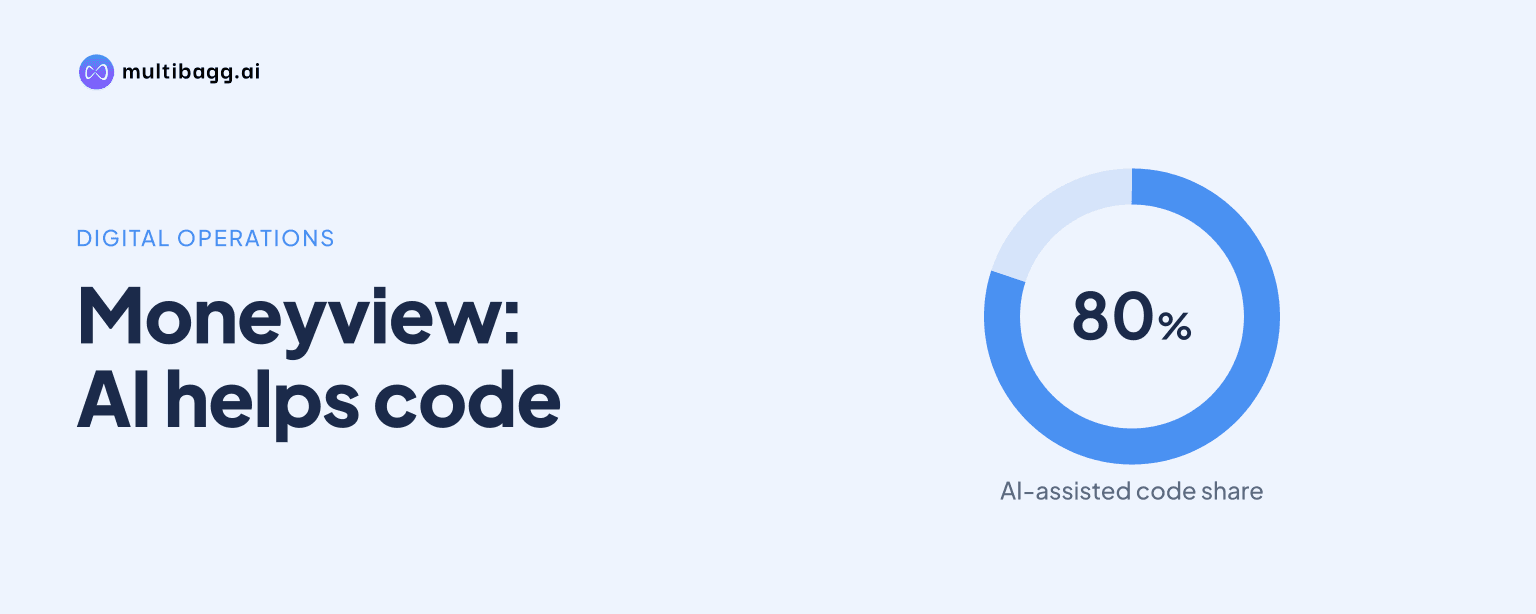
- Moneyview says AI assisted the writing and testing of 80% of code.
- AI voice bots handled 67% of Moneyview collection calls.
- Moneyview reported 12% higher conversion at key loan-journey steps through AI personalisation.
- Operating expense was 34.5% of total income in Q2’FY27, versus 38.4% in Q2’FY26.
powered by IRIS
Moneyview says artificial intelligence (AI) assisted the writing and testing of 80% of its code and handled 67% of collection calls in its Q2’FY27 disclosures. The company also reported 12% higher conversion at key loan-journey steps and AI resolution of 78% of customer queries at one-third the turnaround time (TAT).
Know Moneyview inside out
Results, valuation, peers and who's buying, in one view.
How does Moneyview use AI in software development?
Moneyview says AI accelerates the design, build and testing of new products, with 80% of code written and tested with AI assistance. The company presents this as part of a system-development process intended to shorten release cycles, enable quicker launches and improve code review, testing and security. The metric measures AI-assisted code production and testing, rather than stating that AI independently develops 80% of the company’s software.
The automation sits on an in-house technology platform that Moneyview says has been built over 12 years. More than 50% of employees are in technology and data roles, according to the company, while its modular platform architecture is intended to support customised and non-standard products. This infrastructure is relevant because the disclosed code-assistance metric covers product development rather than a standalone customer-facing AI feature.
Moneyview says its technology is integrated across product development, lending journeys, collections and support. The company did not disclose engineer numbers, release frequency, defects, or the portion of code generated rather than reviewed or tested by AI. Its stated evidence is the 80% AI-assistance measure alongside claims of faster cycles and higher-quality releases.
What AI results has Moneyview reported in loan journeys and support?
Moneyview reports 12% higher conversion at key steps of the loan journey through AI profiling of users and tailored onboarding, communication and language. The company says AI guides users through completion of their loan journey using data and behaviour to build deeper user profiles. It does not identify the individual steps, baseline conversion rate, or period used for the 12% comparison.
The personalisation process is connected to Moneyview’s risk-data system, which uses more than 100,000 data variables and more than 3,000 user segmentations for assessment. Disclosed inputs include credit-history data, cashflow and purchase behaviour from text messages (SMS) and bank statements, device data, application details, verification data and collections interactions. Moneyview says it uses more than 15 contextual machine-learning (ML) models that are continuously tested against new features.
In customer support, Moneyview says AI resolves 78% of queries at one-third the TAT. Its support model provides 24x7 assistance and real-time personalised responses, while human experts handle sensitive cases. The company says AI identifies gaps, drafts and tests fixes, but people approve every release.
The 78% query-resolution metric differs from the 12% loan-journey conversion measure: one covers support contacts and the other covers specified lending stages. Moneyview provides no count of support queries, definition of a resolved query, or breakdown by language, customer segment or issue type. The presentation therefore gives operational percentages but not the underlying volumes.
Got a follow-up? Ask IRIS
How are AI voice bots used in Moneyview collections?
Moneyview says AI voice bots handle 67% of collection calls after each account is scored for its likelihood of payment before the first call. Its collections approach changes the call, message and tone by delinquency stage and customer situation. This places voice automation within a risk-segmented collections strategy rather than describing it as a generic calling tool.
Every collection call is audited and mined for more than 1,000 signals, according to Moneyview. Those signals re-score an account and determine the next action, while its conversational AI is described as multilingual, human-like and capable of contextual understanding and intent detection. The company also cites AI-based post-call quality analysis and real-time feedback into collection strategy.
Gross non-performing assets (GNPA) declined from 2.65% in Sep’25 to 2.42% in Sep’26, including 2.44% in Jun’26. Collection efficiency rose from 98.27% in Sep’25 to 98.64% in Sep’26, after 98.61% in Jun’26. Moneyview attributes steady risk-performance improvement to in-house AI and ML models, but does not isolate the effect of voice bots from underwriting or other collection measures.
Has AI coincided with lower operating-expense intensity at Moneyview?
Moneyview’s operating expense as a percentage of total income fell to 34.5% in Q2’FY27 from 38.4% in Q2’FY26 and 35.9% in Q1’FY27. That was a 3.9-percentage-point year-on-year decline and a 1.4-percentage-point sequential decline based on the reported ratios. Moneyview labels the changes as 10.1% year-on-year and 3.9% quarter-on-quarter operating-expense improvement.
The company says AI embedded across business functions is driving faster execution, sharper decisions and operating leverage. Its disclosed applications span AI-assisted coding, profile-based loan journeys, AI voice collections and AI-first customer support. Moneyview does not provide an expense-category split, AI spending figure, or calculation assigning part of the ratio change to AI.
Scale increased during the same comparison. Registered users rose from 120 million in Q2’FY26 to 149 million in Q2’FY27, while monetised users increased from 9 million to 13 million. Loan disbursals rose from Rs 5,449 crore to Rs 7,701 crore, a reported 41.3% year-on-year increase.
Managed assets under management (AUM) increased to Rs 23,892 crore in Q2’FY27 from Rs 18,603 crore a year earlier. Off-book AUM accounted for 74.7% in Q2’FY27, compared with 74.9% in Q2’FY26. Moneyview’s hybrid model combines lending-service-provider activity with its non-banking financial company (NBFC) subsidiary, meaning expense intensity reflects both technology deployment and lending structure.
Conclusion
Moneyview provides specific AI-use measures across four functions: 80% of code written and tested with AI assistance, 12% higher conversion at specified loan-journey steps, 67% of collection calls handled by AI voice bots, and 78% of support queries resolved by AI at one-third the TAT. During the same broad period, operating expense as a share of total income declined to 34.5% in Q2’FY27 while loan disbursals reached Rs 7,701 crore.
The key item to watch next is the unresolved link between AI deployment and financial outcomes. Moneyview reports 2.42% GNPA and 98.64% collection efficiency as of Sep’26, but the presentation does not quantify how much of either measure results specifically from AI voice bots, personalisation or AI-assisted development.