










Mphasis prioritises AI growth over EBIT margin midpoint
Key highlights
- Mphasis retained FY27 EBIT margin guidance of 14.75% to 15.75% after first-half margin of about 14.8%.
- Mphasis raised FY27 revenue-growth guidance to low double digits from high-single-digit to low-double-digit growth.
- Mphasis reported a record pipeline, up 23% year on year, with 71% classified as AI-led.
- Mphasis recorded Q2 TCV wins of US$46.6 crore and trailing-12-month TCV of US$180 crore.
powered by IRIS
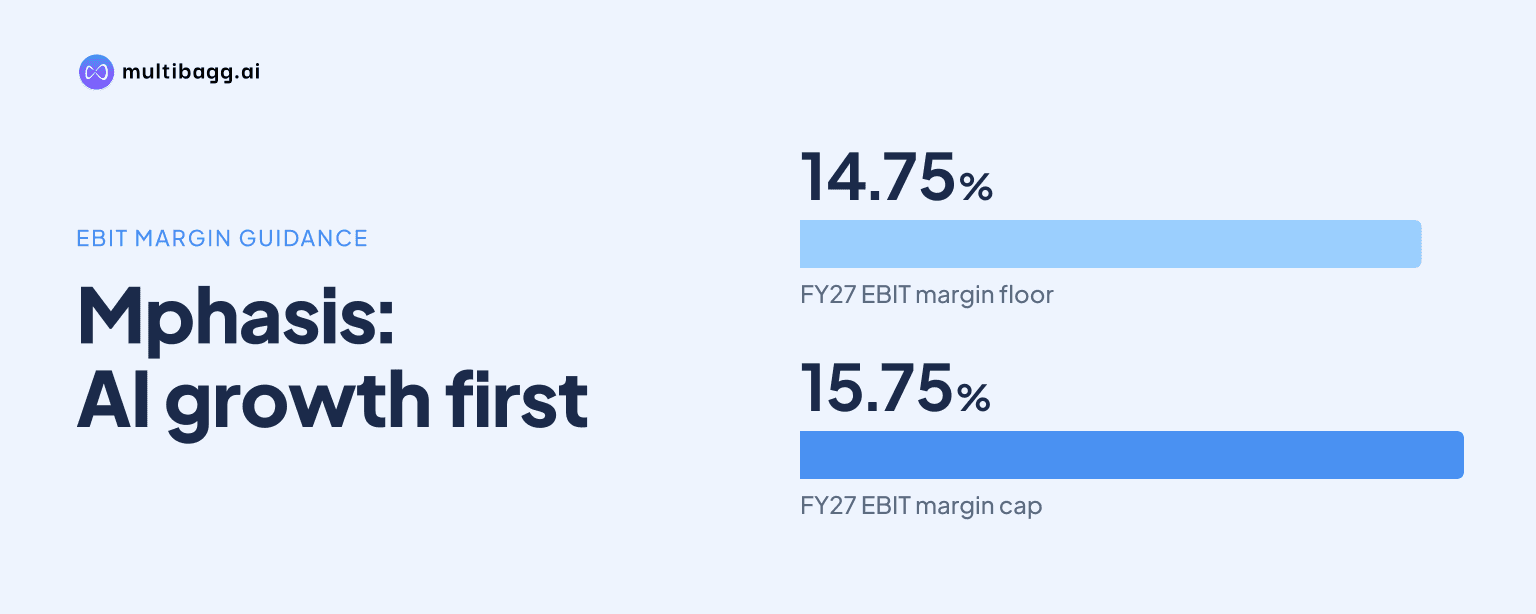
Mphasis is prioritising enterprise AI growth over reaching the midpoint of its FY27 EBIT margin range, retaining guidance of 14.75% to 15.75% despite first-half margin of about 14.8%. Management said onsite-heavy early AI programmes and Tria-related costs are pressuring profitability, but it considers revenue capture and client wallet-share gains the immediate priority.
Know Mphasis inside out
Results, valuation, peers and who's buying, in one view.
Why is Mphasis putting growth ahead of the margin midpoint?
Mphasis is accepting the prospect of being below the midpoint of its 14.75% to 15.75% FY27 EBIT margin range to pursue enterprise AI programmes and expand wallet share. Chief executive Nitin Rakesh said management has greater control over later margin normalisation through internal optimisation than over growth, which depends on client demand and the ability to win work when enterprise AI budgets are being allocated.
The company’s decision follows an upgraded FY27 revenue outlook. Mphasis now expects low-double-digit revenue growth for FY27, compared with prior guidance of high-single-digit to low-double-digit growth, after direct revenue increased 3.5% sequentially and 11.3% year on year in Q2. Management attributed its confidence to backlog, pipeline, deal propensity, client additions and a higher in-quarter revenue run rate.
Management also said the composition of total contract value, or TCV, matters more for near-term revenue than the headline amount alone. Q2 TCV wins were US$46.6 crore, including five large deals, and trailing-12-month TCV was US$180 crore. Rakesh illustrated the conversion point by saying a US$1 crore, six-month engagement can have the same near-term revenue propensity as a US$10 crore, five-year contract.
What is currently pressuring Mphasis EBIT margin?
Mphasis identified Tria-related amortisation and a significant shift towards onsite delivery in early AI programmes as the main pressures on FY27 profitability. Chief financial officer Aravind Viswanathan said the acquisition associated with Tria and TAP added amortisation costs during FY27, while short-cycle AI work often begins onsite before delivery can progress into later phases.
First-half EBIT margin was about 14.8%, near the lower end of the 14.75% to 15.75% target band that Mphasis has retained for the full year. Viswanathan did not provide separate H2 guidance within that range, but said the company remained committed to the stated FY27 target despite the investment and delivery-mix effects.
The onsite effect is connected to the kind of demand Mphasis is pursuing. Management said clients are prioritising AI foundations, AI harnesses, infrastructure, cyber hardening and savings-led transformation, with work spanning data modernisation, deployment and application remediation. Those programmes can generate rapid revenue conversion, but the initial onsite portion has increased costs before scaled delivery can improve the underlying mix.
How does Mphasis expect Tria to affect margins later?
Mphasis expects Tria-led delivery to provide a gross-margin tailwind over time, rather than improve profitability by reducing investment in the platform. Rakesh said the company will continue investing in Tria in the near future because AI technology and client requirements are changing quickly, creating a need to avoid commoditisation across the platform’s delivery layers.
Tria remains early in commercial deployment. Mphasis launched the platform in May and said its first deployments were going live during the call, but it did not disclose Tria revenue, pipeline share, TCV contribution or the number of adopting clients. Management described FY27 as a foundational year and said it would evolve relevant metrics over the next two quarters.
The planned mechanism is to validate initial deployments and then extend them across additional client operations and lines of business. Mphasis said Tria-led opportunities are present in both its pipeline and deal wins across multiple verticals. Its stated approach is to improve delivery economics through adoption, while continuing investment in intellectual property, sales coverage and platforms instead of constraining those expenditures to lift margin.
Got a follow-up? Ask IRIS
What supports Mphasis’s AI-led revenue growth plan?
Mphasis reported a record pipeline that was 23% higher year on year, with 71% classified as AI-led. TCV below US$2 crore in the pipeline rose 35%, faster than the 23% increase in the overall pipeline. Management linked that difference to urgent, short-cycle work on AI engineering, cyber capabilities and client transformation programmes.
Client growth was also spread across account bands in Q2. Mphasis added two clients in the US$5 crore-plus bracket sequentially, three clients in the US$2 crore-plus bracket year on year, and five clients in the US$50 lakh-plus bracket year on year. Its top five clients grew 15.1% year on year, while clients ranked 11 to 20 grew 22.7% year on year.
Management views the pipeline as a lead indicator for future deal conversion, while warning that large deals are inherently lumpy. Mphasis has recorded net new TCV above US$40 crore in each of the past six quarters and expects TCV to stay healthy or increase over the next two to four quarters if conversion remains at least as high as current levels. That is management’s expectation rather than a forecast of particular contract dates.
Which cash-flow and execution measures should Mphasis meet in FY27?
Mphasis reported Q2 earnings per share of Rs 29.4, up 14.6% sequentially, while EBIT margin was flat sequentially. Operating cash flow was US$3.4 crore after normalising for US$3.95 crore of remittances initiated on September 30 and received in October. Management continues to target operating-cash-flow conversion equal to 80% of net income in FY27, with further normalisation in FY28.
Collections are a disclosed part of that target. Days sales outstanding, or DSO, was 105 days in Q2 after adjusting for delayed remittances, and management said normalised DSO had risen by about 10 days between Q1 and Q2. Viswanathan expects DSO to return to double-digit levels in Q3, which management identified as the basis for improved cash flow in subsequent quarters.
Free-cash-flow outcomes will also reflect acquisition spending. Mphasis said the Red Oak transaction carried a US$2.8 crore commitment and that its closing conditions were expected to conclude in November. Management said payments for contract acquisition consideration should be lower in FY28 than FY27, although the eventual reduction will depend on how many additional deals the company completes.
Conclusion
Mphasis is deliberately preserving growth capacity rather than managing solely for the midpoint of its FY27 EBIT margin range. The trade-off reflects Tria amortisation and an onsite-heavy mix in early AI programmes, while a 23% year-on-year pipeline increase, 71% AI-led pipeline share and low-double-digit FY27 revenue-growth outlook support management’s decision to focus on enterprise AI demand.
The next indicators are whether Tria’s live deployments produce metrics that Mphasis has said it will develop over the next two quarters, and whether DSO returns to double digits in Q3. Management’s November expectation for the Red Oak closing, its FY27 80% operating-cash-flow conversion target and its view that FY28 acquisition-related payments will be lower also remain execution points to watch.