










Mphasis broker-dealer deal uses recurring revenue sharing
Key highlights
- Mphasis reported US$46.6 crore of Q2 FY2027 net new TCV and five large deal wins.
- The broker-dealer agreement uses recurring revenue sharing and has expansion potential across the client’s advisor network.
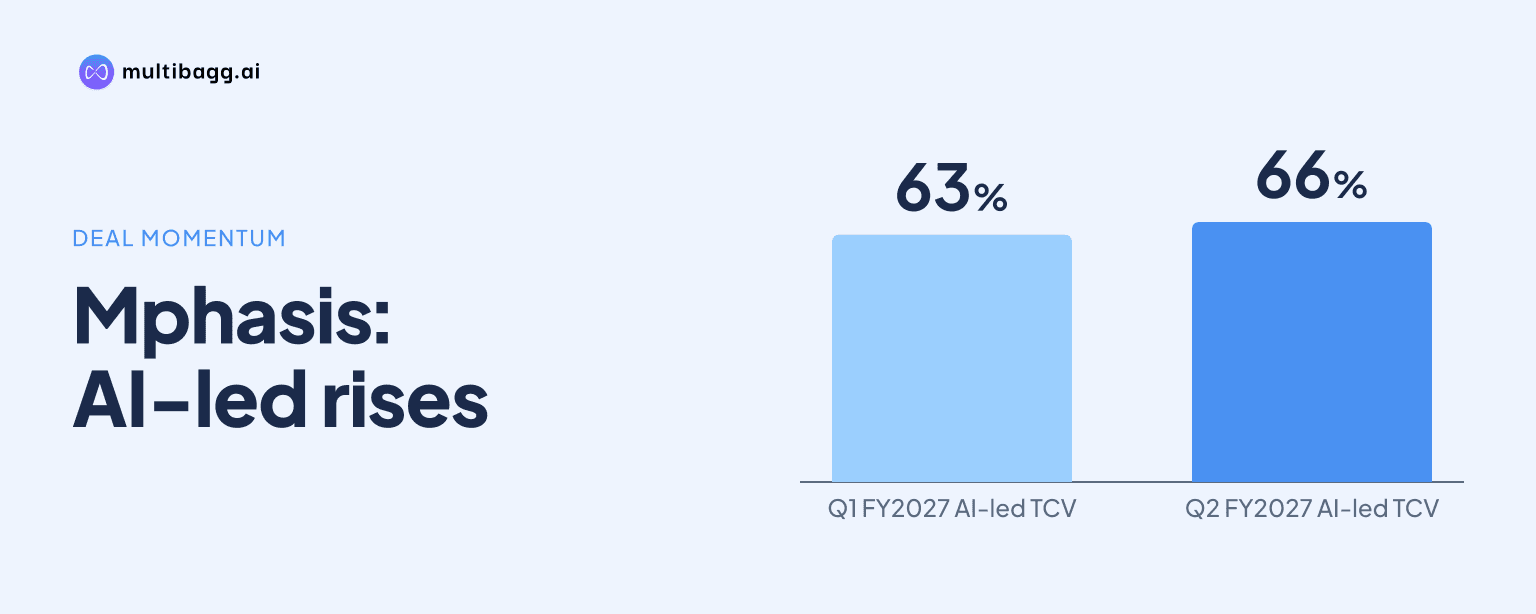
- Mphasis said 66% of Q2 FY2027 TCV wins were AI-led, up from 63% in Q1 FY2027.
- Mphasis’s total pipeline rose 4.4% sequentially and 23% year on year in Q2 FY2027.
powered by IRIS
Mphasis Limited disclosed in Q2 FY2027 that a large broker-dealer selected it for a recurring revenue-share arrangement to scale advisor administration across front- and middle-office services, with expansion potential across the advisor network. The win formed part of five large deals as quarterly net new total contract value reached US$46.6 crore.
Know Mphasis inside out
Results, valuation, peers and who's buying, in one view.
What did Mphasis win from the broker-dealer?
Mphasis won a large engagement to scale the broker-dealer’s advisor administration business across front- and middle-office services. Management disclosed the deal during its November 6, 2026 earnings call, but did not name the client, provide the contract duration or disclose an individual total contract value, or TCV, for the engagement.
The contract was one of five large deals Mphasis closed in Q2 FY2027. Its US$46.6 crore of quarterly net new TCV took trailing-12-month TCV to US$180 crore, while 66% of the quarter’s TCV wins were AI-led, up from 63% in the preceding quarter. Mphasis did not state whether the broker-dealer engagement itself was classified as AI-led.
The deal’s disclosed scope is advisor administration rather than a broader technology transformation mandate. Management said it covers both front-office and middle-office services, but gave no detail on the processes to be delivered, the number of advisors involved, implementation timing or the revenue expected from the initial work.
How does Mphasis’s revenue-share structure work?
Mphasis said the broker-dealer agreement uses a recurring revenue-share model and has significant potential to expand across the client’s advisor network. The company did not disclose the revenue-share percentage, the performance formula, any minimum commitment or the operational milestones that would trigger further expansion.
Management presented the structure as an example of outcome-linked commercial constructs that are emerging as business and operations leaders fund artificial intelligence, or AI, programmes alongside chief information officers. Chief Executive Officer Nitin Rakesh said buyer discussions increasingly cover revenue leakage, planning latency and slow execution, rather than technology costs alone.
Mphasis linked this commercial approach to its Mphasis Tria platform, which management described as a closed loop to understand, decide, act, measure and improve. The company said humans govern exceptions while routine decisions feed back into models, but it did not identify a Tria product, outcome metric or governance process used in the broker-dealer engagement.
How does the deal fit Mphasis’s Q2 pipeline?
The broker-dealer win fits a Q2 FY2027 pipeline that Mphasis said reached a record level, rising 4.4% sequentially and 23% year on year. AI-led opportunities represented 71% of the pipeline, compared with 12% when Mphasis.ai was launched three years earlier, although management did not separately quantify broker-dealer opportunities.
Mphasis reported six consecutive quarters of net new TCV above US$40 crore. Management said the sustained level of closures, together with backlog and shorter-cycle deals, supported revenue conversion during Q2 and near-term visibility for the remainder of FY2027.
Deals below US$2 crore grew 35% year on year and 9% sequentially in the pipeline, while their trailing-12-month TCV rose 26%, according to management. This points to increased shorter-cycle activity alongside the five large deals, rather than a pipeline composed solely of large, multi-year contracts.
Management said Tria-led opportunities are increasingly larger and multi-year, combining optimization, transformation and ongoing operations. Such opportunities often begin with a proof of value on a client’s own processes, and Mphasis said initial deployments can generate reusable assets for expansion within an account; it did not quantify prospective expansion from the broker-dealer deal.
Got a follow-up? Ask IRIS
Which Mphasis businesses support outcome-linked deals?
Mphasis said it has organized its delivery model around value streams, forward-deployed and engineering solutions teams, and a product-and-platform team. The value streams package recurring Banking, Insurance and Healthcare problems into offerings with identified buyers, outcome measures and reusable assets.
Management said its forward-deployed teams work through four stages: framing a client problem, composing capabilities, proving the approach with evidence and scaling it. Mphasis is certifying client-facing technology leaders on these playbooks and expanding forward-deployed engineering capacity, but did not disclose headcount, spending or a completion date.
Direct revenue rose 3.5% sequentially and 11.3% year on year in constant currency in Q2 FY2027. Within Direct, Banking, Financial Services and Insurance, or BFS, grew 4.5% sequentially and 15.0% year on year, while Insurance increased 1.8% sequentially and 14.7% year on year, supported by Tria-led work in underwriting, claims and risk operations.
Enterprise Applications accounted for 75.6% of revenue and grew 3.7% sequentially and 14.4% year on year in Direct constant-currency terms, driven predominantly by AI-led modernization deals. Business process outsourcing grew 6.6% sequentially and 18.7% year on year in Direct, while information technology outsourcing declined 4.9% sequentially as build elements of integrated build-and-run projects moved into steadier run phases.
What does Mphasis expect after the Q2 win?
Mphasis raised its FY2027 revenue-growth guidance to low double digits from high single digits to low double digits. Management attributed the revision to Q2 run-rate revenue, backlog, a record pipeline, deal propensity and continued conversion of signed work, rather than to a specific forecast for the broker-dealer engagement.
Management retained its expectation for stable margins within a 14.75% to 15.75% target band while investing in delivery capabilities. It also continued to target operating cash flow conversion equal to 80% of net income in FY2027, with further normalization expected in FY2028; these are management targets rather than reported outcomes from the revenue-share arrangement.
Geographic performance was uneven despite the company-wide growth outlook. Americas Direct revenue rose 3.1% sequentially and 12.4% year on year in constant currency on large-deal ramp-ups and new logos, while Rest of the World grew 16.4% sequentially and Europe, the Middle East and Africa declined 3.3% because a globally structured engagement was allocated across regions.
Conclusion
The broker-dealer engagement provides Mphasis with a disclosed example of an outcome-linked commercial model: recurring revenue share tied to advisor-administration services and potential network expansion. It arrived alongside US$46.6 crore in Q2 FY2027 net new TCV, five large deal wins and a pipeline that was 23% higher year on year, indicating that both large and shorter-cycle opportunities contributed to deal activity.
The next markers are management’s low-double-digit FY2027 revenue-growth guidance, its 14.75% to 15.75% margin target band and the conversion of backlog into revenue during the second half. Mphasis has not disclosed a contract value, implementation schedule or revenue contribution for the broker-dealer deal, leaving those items unresolved as the advisor-network opportunity develops.