










Mphasis raises FY27 outlook as short AI deals convert faster
Key highlights
- Mphasis raised FY27 revenue-growth guidance to low double digits from high single digits to low double digits.
- Q2 net new TCV was US$46.6 crore, while trailing-12-month TCV reached US$180 crore.
- The total pipeline rose 23% year on year, while opportunities below US$2 crore grew 35%.
- Q2 Direct revenue increased 3.5% sequentially and 11.3% year on year in constant currency.
powered by IRIS
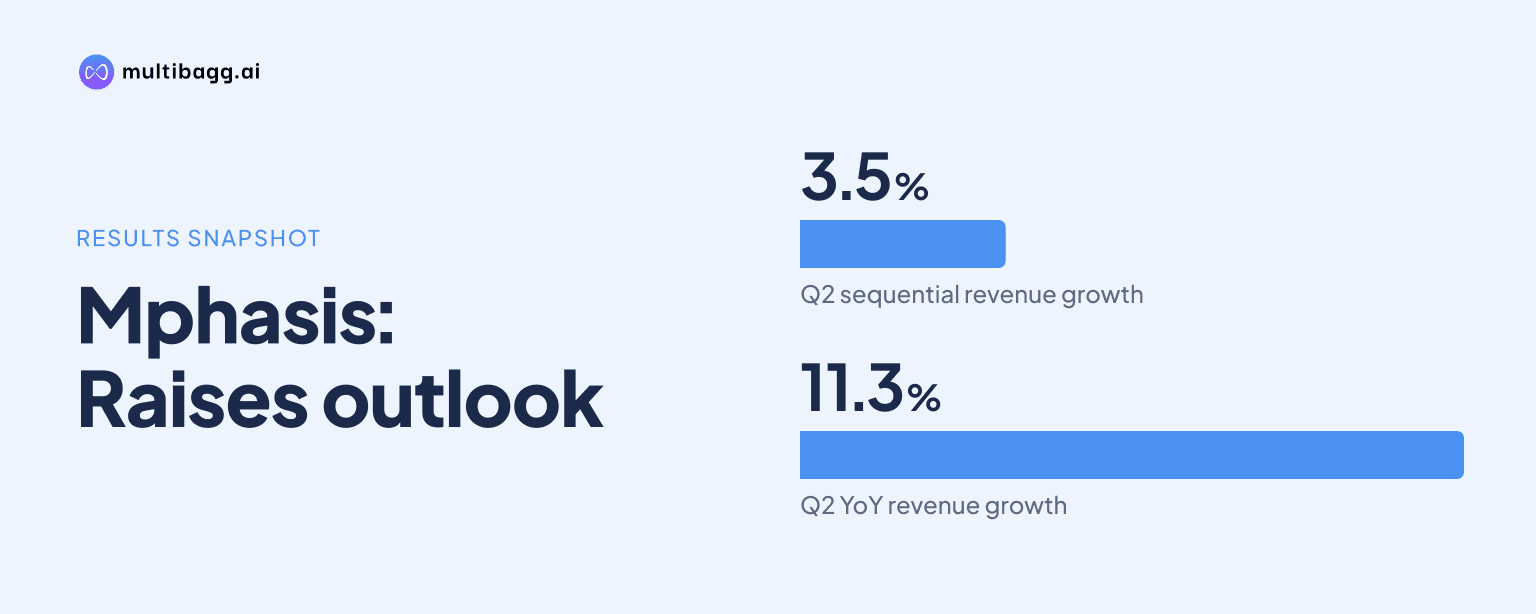
Mphasis raised its fiscal year 2027 (FY27) revenue-growth outlook to low double digits after Q2 Direct revenue rose 3.5% sequentially in constant currency, supported by a record pipeline, backlog conversion and faster revenue recognition from shorter-cycle artificial intelligence (AI) deals. Net new total contract value (TCV) was US$46.6 crore in Q2.
Know Mphasis inside out
Results, valuation, peers and who's buying, in one view.
What did Mphasis change in its FY27 guidance?
Mphasis now expects low-double-digit revenue growth for FY27, replacing its previous outlook of high-single-digit to low-double-digit growth. Management based the upgrade on Q2 performance, a record pipeline, backlog conversion and six consecutive quarters in which net new TCV exceeded US$40 crore.
The company retained its profitability and cash-conversion targets despite raising revenue guidance. Management continues to expect stable earnings before interest and tax (EBIT) margin within a 14.75% to 15.75% range and targets operating cash flow equal to 80% of net income in FY27. Q2 EBIT margin was flat, while earnings per share increased 14.6% sequentially to Rs 29.4.
Chief Executive Officer Nitin Rakesh said the confidence does not come from headline TCV alone. He cited healthy revenue added in Q2, which lifts the base for the second half, as well as client-account growth and the mix of signed work. Trailing-12-month TCV reached US$180 crore, and 66% of Q2 wins were AI-led, up from 63% in the preceding quarter.
Why are shorter AI deals helping Mphasis grow revenue sooner?
Shorter AI deals are helping Mphasis convert bookings into revenue faster because their delivery periods are much shorter than those of multi-year contracts. Rakesh said a US$1 crore, six-month contract can have the same near-term revenue-growth propensity as a US$10 crore, five-year contract, despite having one-tenth of the TCV.
TCV from deals below US$2 crore rose 26% over the trailing 12 months. Opportunities below US$2 crore in the pipeline rose 35% year on year and 9% sequentially, exceeding the total pipeline's 23% annual increase and 4.4% sequential rise. That comparison indicates a rising contribution from smaller opportunities with shorter conversion cycles.
Management linked these deals to AI engineering work, including data modernization, AI infrastructure and enterprise deployment foundations. It also cited cyber-estate hardening and AI-led savings-and-transformation programmes. These projects are prioritised by larger clients seeking immediate implementation work, while Mphasis said some AI-led operations and vendor-consolidation contracts can still be larger and multi-year.
The guidance revision therefore does not depend on an announced step-up in quarterly deal-value targets. Q2 net new TCV of US$46.6 crore was within the US$40 crore-plus range sustained for six quarters, but management said backlog, in-quarter additions and the shorter-duration profile of deals give it better visibility on FY27 revenue conversion.
How did Mphasis perform across markets and services in Q2?
Mphasis delivered 3.5% sequential and 11.3% year-on-year Direct revenue growth in constant currency in Q2, which management described as its best sequential constant-currency growth in three years. The Americas, its principal growth market, grew 3.1% sequentially and 12.4% year on year on large-deal ramp-ups and new client additions.
The Rest of the World grew 16.4% sequentially and 23.5% year on year, led by participation in global capability centre programmes. By contrast, Europe, the Middle East and Africa declined 3.3% sequentially and 9.0% year on year. Management said the EMEA result reflected regional allocation of revenue from a globally structured engagement rather than a change in the underlying business.
Enterprise Applications, which accounted for 75.6% of revenue, grew 3.7% sequentially and 14.4% year on year in Direct, primarily on AI-led modernization work. Business process outsourcing rose 6.6% sequentially and 18.7% year on year in Direct on new wins and AI-led propositions. Information technology outsourcing declined 4.9% sequentially and 21.3% year on year as build components of transformation programmes moved into steadier run phases.
Got a follow-up? Ask IRIS
Which sectors and clients are supporting Mphasis growth?
Banking and financial services (BFS) is supporting Mphasis growth with Direct revenue up 4.5% sequentially and 15.0% year on year in constant currency. Its BFS pipeline rose 4.1% sequentially, while management attributed the revenue performance to wallet-share gains in existing accounts and new deal wins.
Insurance returned to growth, rising 1.8% sequentially and 14.7% year on year in Direct, supported by Tria-led programmes in underwriting, claims and risk operations. Technology, media and telecommunications grew 10.9% sequentially and 14.5% year on year after a recovery and new-deal ramp-ups. Over the trailing 12 months, BFS, Insurance and technology, media and telecommunications grew 15%, 28% and 12%, respectively.
Client-account metrics extended beyond the largest accounts. Mphasis's top five clients grew 15.1% year on year, its top 10 grew 13.0%, and clients ranked 11 to 20 grew 22.7%. The company added two clients to the US$5 crore-plus band sequentially, three to the US$2 crore-plus band year on year, and five to the US$50 lakh-plus band year on year.
What does Mphasis still need to execute on?
Mphasis still needs to turn its backlog, record pipeline and first Tria deployments into sustained revenue while keeping margins within its FY27 target range. Tria was launched in May, and management said its first deployments were going live during the call, but it has not disclosed Tria's revenue, pipeline or TCV contribution.
The company said it will use FY27 as a foundational year for establishing Tria measures and may share relevant metrics over the next two quarters. Since the Mphasis.ai launch three years ago, the pipeline has grown to three times its original size and the AI-led share has risen from 12% to 71%, but management said it was premature to quantify Tria's financial contribution.
Cash conversion is another execution item. Operating cash flow was US$3.4 crore in Q2 after normalising for US$3.95 crore of remittances initiated on September 30 and received in October. Days sales outstanding, a measure of collection time, was 105 days on a normalised basis, about 10 days higher than Q1; management expects it to return to double-digit days in Q3.
Management also said continuing investment in Tria, sales coverage, platforms and onsite delivery can affect margins. It cited amortisation from the TAP acquisition and a greater onsite mix in short-cycle AI programmes as current cost factors. Nevertheless, it reaffirmed the 14.75% to 15.75% FY27 EBIT-margin range while prioritising revenue growth.
Conclusion
Mphasis's guidance increase reflects faster conversion of shorter AI engineering work alongside backlog and an expanding pipeline, rather than a major change in reported quarterly TCV. Direct revenue grew 3.5% sequentially in Q2, the pipeline grew 23% year on year, and sub-US$2 crore pipeline opportunities rose 35%, giving management greater visibility on FY27 revenue.
The next disclosures to watch are Q3 days sales outstanding, which management expects to return to double-digit levels from 105 days, and the Tria measures it plans to develop over the next two quarters. Management also expects large-deal conversion to support healthy or potentially higher TCV over the next two to four quarters, although it noted that large wins are inherently lumpy.