










MSWIL expects FY'27 copper-cost recovery within FY'27
Key highlights
- MSWIL said most copper-cost recoveries occur after about three months, with some cases taking up to six months.
- Copper prices increased approximately 54% year on year and 6% sequentially in Q2 FY'27.
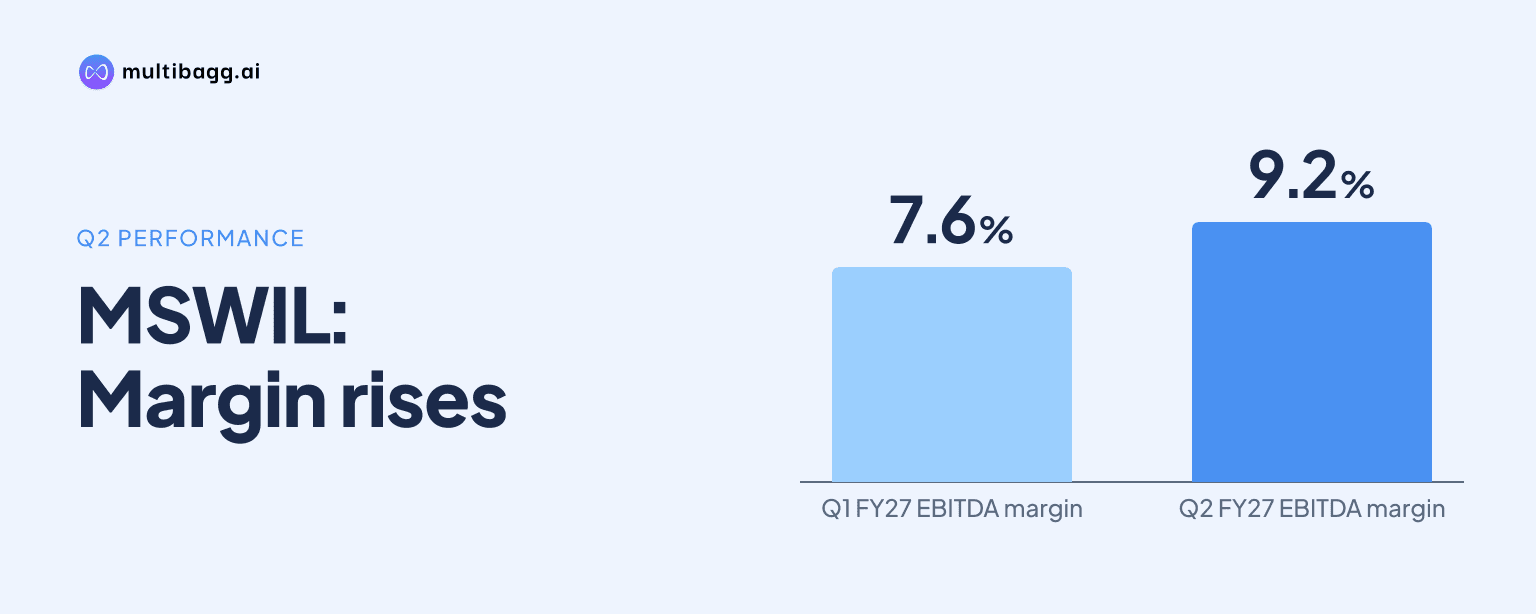
- MSWIL's Q2 FY'27 EBITDA margin rose to 9.2% from 7.6% in Q1 FY'27.
- MSWIL expects FY'27 capital expenditure of approximately Rs 200 crore.
powered by IRIS
Motherson Sumi Wiring India Limited said on October 30, 2026, that it expects better numbers within FY'27 as most higher copper costs are recovered from customers after about three months, though some cases can take up to six months. Copper prices increased approximately 54% year on year and 6% sequentially in Q2 FY'27.
Know Motherson Sumi Wiring India inside out
Results, valuation, peers and who's buying, in one view.
Why does MSWIL expect copper-cost recovery in FY'27?
MSWIL expects most copper-cost recovery in FY'27 because the majority of customer arrangements have a lag of roughly one quarter. Management described copper as a pass-through item, with a typical recovery period of about three months for most customers. Chairman V.C. Sehgal said copper and wage-cost matters were under negotiation and that MSWIL would report better numbers within the financial year.
The lag matters because copper prices rose approximately 6% quarter on quarter and 54% year on year in Q2 FY'27. When copper prices rise before customer billing is revised, MSWIL carries higher input costs in the intervening period. Chief Operating Officer Anurag Gahlot said recovery from major customers operates with a quarterly lag and should affect the next quarter.
The expected improvement is conditional on movements in copper rather than a fixed margin commitment. Management said that if copper prices stayed unchanged for one, two or three quarters, MSWIL would ultimately buy and sell at the same price. It also said copper had not stabilised at its Q2 FY'27 level, so it could not quantify pending under-recovery or provide a normalised gross-margin forecast.
How much of MSWIL's Q2 FY'27 growth came from demand?
MSWIL did not quantify how much Q2 FY'27 revenue growth reflected copper pass-through rather than operating demand. It reported revenue growth of 47% year on year and 19% sequentially, while citing higher customer volumes, new programme launches and contributions from three Greenfield plants. The passenger-vehicle industry recorded volume growth of 25% year on year and 14% sequentially during the quarter, according to management.
Copper pass-through can increase reported revenue when the metal price rises, but MSWIL gave no rupee amount or percentage for that effect. Instead, it identified vehicle premiumisation, higher content per vehicle and launches across electric-vehicle and internal-combustion-engine platforms as growth factors. Electric vehicles accounted for 10% of Q2 FY'27 revenue and 9.3% of first-half revenue.
The second half faces a higher comparison base following the goods and services tax reduction implemented in the prior year. Management nevertheless said it expected healthy industry growth on current visibility and described the third quarter as usually seasonally strong. It also noted that the Shradh period can partly offset that seasonal pattern, while new vehicle programmes continue to be launched.
Got a follow-up? Ask IRIS
What changed in MSWIL's margins and plant utilisation?
MSWIL's EBITDA margin was 9.2% in Q2 FY'27, compared with 7.6% in Q1 FY'27, despite higher copper prices, minimum-wage revisions and other inflationary pressures. EBITDA, or earnings before interest, tax, depreciation and amortisation, rose 34% year on year and 45% sequentially. Profit after tax increased 35% year on year and 54% sequentially.
The sequential margin improvement occurred as the three Greenfield plants progressed through ramp-up and reached an optimal utilisation level, according to management. Pankaj Mital said the sites had incurred costs before corresponding revenue started, and that cost ratios improved as revenues increased. Management now includes the three sites with its regular plants for capacity-utilisation assessment.
MSWIL does not disclose plant-level margins or state whether the Greenfield sites have reached the company-wide margin level. An analyst referred to raw-material cost of 70% of revenue in Q2 FY'27, but management neither confirmed a future figure nor gave a gross-margin target. It said cost reimbursement can lift both revenue and costs, affecting reported margin percentages even when input inflation is compensated.
What could affect MSWIL's recovery and capacity plans?
MSWIL's recovery of minimum-wage inflation remains less certain than copper recovery because it is under negotiation with customers. Chairman V.C. Sehgal said MSWIL would try to achieve full recovery, but did not disclose an agreed recovery percentage or settlement date. The three-to-six-month timeframe discussed on the October 30 call covered both input-cost and wage-cost discussions.
Copper remains the immediate variable because most cases are recovered after about three months, while smaller cases can take up to six months. Further changes in copper prices can extend the timing difference between MSWIL's purchase costs and the price embedded in customer billing. Management therefore did not state the amount of price increases still due from customers at Q2 FY'27 copper-price levels.
Capital expenditure is the other disclosed commitment as volumes and programmes expand. Chief Financial Officer Gulshan Pahuja said FY'27 capital expenditure should be approximately Rs 200 crore, broadly in line with the previous year. MSWIL gave no FY'28 capital-expenditure indication because customer schedules and future facility locations had not been finalised; management said it enters expansion mode when utilisation approaches 80%.
Conclusion
MSWIL's Q2 FY'27 performance combines 47% year-on-year revenue growth and a 9.2% EBITDA margin with a timing gap in copper-cost recovery. Management attributes growth to vehicle volumes, programme launches and Greenfield plant utilisation, while the 54% year-on-year increase in copper prices makes customer pass-through timing the key near-term profitability factor.
What to watch next is the recovery management expects after the usual three-month customer lag, alongside progress in negotiations on minimum-wage inflation that can take up to six months. The next disclosed operating markers are demand through the second half's higher comparison base and execution of the approximately Rs 200 crore FY'27 capital-expenditure plan.