










MTAR wins Rs 504 crore Kaiga order, expands nuclear pipeline
Key highlights
- MTAR won a Rs 504 crore Kaiga 5 and 6 order, its largest single civil-nuclear order inflow.
- MTAR received more than Rs 130 crore of separate FY27 orders for reactor refurbishment.
- Civil nuclear generated Rs 8.7 crore in H1FY27, or 1% of revenue, but represented 13.6% of the Rs 5,976.5 crore order book at 30 September 2026.
- MTAR's H1FY27 revenue rose to Rs 767.5 crore and EBITDA increased to Rs 184.2 crore, with the EBITDA margin reaching 24.0%.
powered by IRIS
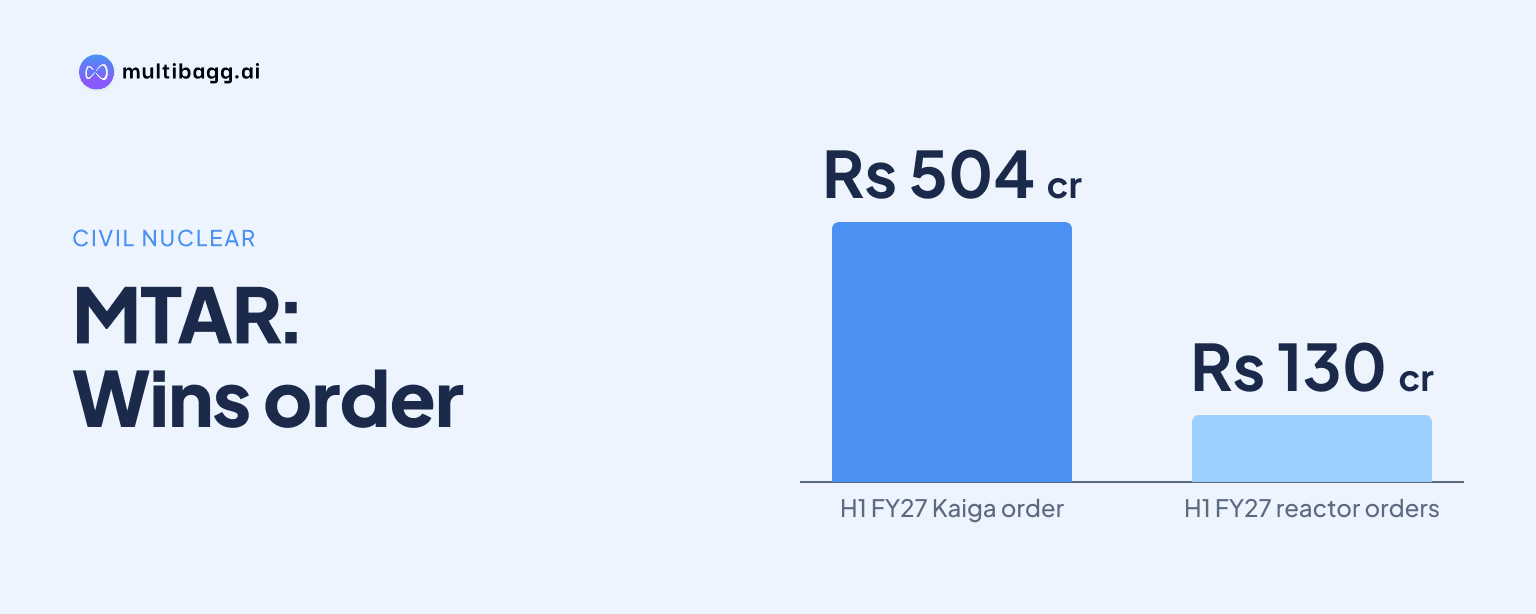
MTAR has received a Rs 504 crore order for the Kaiga 5 and 6 projects, its largest single civil-nuclear order inflow, and more than Rs 130 crore of FY27 orders from reactors due for refurbishment. The new work adds disclosed order visibility to a segment that generated Rs 8.7 crore in H1FY27 and represented 13.6% of the Rs 5,976.5 crore order book on 30 September 2026.
Know MTAR Technologies inside out
Results, valuation, peers and who's buying, in one view.
What is MTAR's Kaiga nuclear order worth?
MTAR's order for the Kaiga 5 and 6 projects is worth Rs 504 crore and is its largest single order inflow in civil nuclear power. The presentation does not disclose the customer, delivery schedule, execution period or individual products covered by this order, but says it strengthens civil-nuclear order visibility.
MTAR also received more than Rs 130 crore of orders in FY27 from reactors due for refurbishment. Those orders are separate from the Kaiga project and give the company disclosed exposure to both construction-related work and refurbishment of existing reactor assets.
The civil-nuclear product range includes critical fuel-handling assemblies for reactor cores, coolant-channel assemblies, grid plates, drive mechanisms, and top-hatch cover beam and deck-plate assemblies. MTAR states that it has served nuclear-sector customers for more than 35 years and makes more than 15 kinds of products for a range of applications.
How large is MTAR's civil-nuclear business today?
MTAR recorded Rs 8.7 crore of civil-nuclear revenue in H1FY27, representing 1% of its revenue mix. This compares with Rs 23.6 crore in FY26, Rs 18.4 crore in FY25, Rs 61.9 crore in FY24 and Rs 43.8 crore in FY23; the segment's revenue mix was 3% in FY25 and FY26 and 11% in FY24.
Civil nuclear made up 13.6% of MTAR's Rs 5,976.5 crore order book as of 30 September 2026, a substantially higher share than its 1% contribution to H1FY27 revenue. The presentation identifies the Rs 504 crore Kaiga order and the more than Rs 130 crore of refurbishment orders as disclosed additions to visibility in the segment.
The comparison shows civil nuclear remained smaller in reported H1FY27 revenue than MTAR's other operating verticals. Fuel cells, hydel and other clean-energy activities generated Rs 452.1 crore in H1FY27, while products and others generated Rs 226.3 crore, against Rs 8.7 crore from civil nuclear.
What equipment does MTAR supply for nuclear reactors?
MTAR supplies fuel-handling assemblies for reactor cores, including a fuel machining head containing more than 700 components used to load and unload fuel bundles. Its coolant-channel assembly components include shield plugs, liner tubes and sealing plugs, which the presentation describes as products used in the core of civil nuclear reactors.
MTAR also produces grid plates that rest fuel sub-assemblies in the Prototype Fast Breeder Reactor, or PFBR, and drive mechanisms used for normal regulation and shutdown under undesirable operating conditions. Its top-hatch cover beams and deck-plate assemblies require high positional and dimensional accuracy, according to the presentation.
MTAR identifies Nuclear Power Corporation of India Limited, or NPCIL, as its partner in the nuclear sector and says NPCIL controls operational, under-construction and planned reactors in India because private participation is not allowed. This structure is relevant to MTAR's preliminary quotations to private-sector players bidding for construction work on four reactors at Mahi Banswara under an NTPC-NPCIL partnership.
Got a follow-up? Ask IRIS
What role has MTAR played in the PFBR programme?
MTAR says it supplied a majority of the critical reactor-core assemblies for the PFBR, whose recent achievement of criticality is described as a strategically significant milestone for India's nuclear-energy programme. The company's PFBR material lists equipment including a grid plate, control plug, fuel elements, electromagnet and fuel-transfer machinery.
The presentation cites an in-vessel fuel transfer machine, or IFTM, with a height of 22 metres and weight of 200 tonnes. It also lists an item with a diameter of 7 metres and weight of 85 tonnes, illustrating the specifications of equipment in the PFBR programme rather than the scope or value of the Kaiga order.
MTAR has submitted budgetary quotations for the Fast Breeder Reactor, or FBR, programme, for which it says tenders are expected in the future. These quotations are not confirmed orders and should be distinguished from the Rs 504 crore Kaiga order and the more than Rs 130 crore of FY27 refurbishment orders already received.
Which nuclear opportunities could follow the Kaiga order?
MTAR identifies new-reactor construction, reactor refurbishment and maintenance contracts as potential routes for future civil-nuclear orders. It has submitted preliminary quotations for reactor-core assemblies to private-sector players bidding for four Mahi Banswara reactors, but the presentation gives no quotation value, award date or indication that the bids will become orders.
The presentation links the longer-term opportunity to the Government of India's aim of reaching 100 gigawatts electric, or GWe, of civil-nuclear capacity by 2047. This is a government objective, not MTAR guidance, and MTAR provides no forecast for its future nuclear revenue, margin or share of reactor spending.
At group level, MTAR received Rs 1,207.2 crore of orders across sectors in Q2FY27. Its order book increased from Rs 5,143.3 crore on 30 June 2026 to Rs 5,976.5 crore on 30 September 2026 after Rs 374 crore of sales restated at order book, excluding foreign-exchange fluctuations, price escalations and scrap sales.
How does the Kaiga order fit MTAR's financial performance?
MTAR reported revenue of Rs 767.5 crore in H1FY27, compared with Rs 292.2 crore in H1FY26. Earnings before interest, tax, depreciation and amortisation, or EBITDA, rose to Rs 184.2 crore from Rs 45.4 crore, and EBITDA margin increased to 24.0% from 15.5% over the same periods.
Gross profit margin declined to 46.2% in H1FY27 from 52.8% in H1FY26, even as gross profit increased to Rs 354.5 crore from Rs 154.3 crore. Profit after tax rose to Rs 110.1 crore from Rs 15.1 crore, while its margin rose to 14.3% from 5.2%.
MTAR's inventories were Rs 678.8 crore at September 2026, compared with Rs 500.5 crore at March 2026, while capital work-in-progress rose to Rs 112.9 crore from Rs 34.4 crore. Total working-capital days fell to 50 in September 2026 from 172 in March 2026, with work-in-progress days declining to 55 from 88.
Conclusion
The Rs 504 crore Kaiga 5 and 6 order and more than Rs 130 crore of FY27 refurbishment orders add defined civil-nuclear work to MTAR's order pipeline. They are notable against civil-nuclear revenue of Rs 8.7 crore in H1FY27 and a segment order-book share of 13.6% at 30 September 2026, while the business retains a product range spanning fuel handling, core assemblies and shutdown equipment.
The next disclosed markers are future FBR tenders, for which MTAR has submitted budgetary quotations, and the outcome of preliminary quotations for four Mahi Banswara reactors. Execution of the Rs 504 crore Kaiga order will also be a key matter to track because the presentation does not state a delivery timetable or revenue-recognition schedule.