










MTAR customers enter volume production as AMCA orders arrive
Key highlights
- GKN Aerospace is in volume production for engine components and sub-assemblies, while Thales is producing storage boxes.
- MTAR received AMCA orders for a Main Landing Gear Support Structure Test Box assembly and a Fuselage Door Assembly.
- MTAR reported Aerospace and Defence revenue of Rs 80.2 crore in H1FY27, representing 10% of company revenue.
- Aerospace and Defence accounted for 7.2% of MTAR’s Rs 5,976.5 crore order book as of 30 September 2026.
powered by IRIS
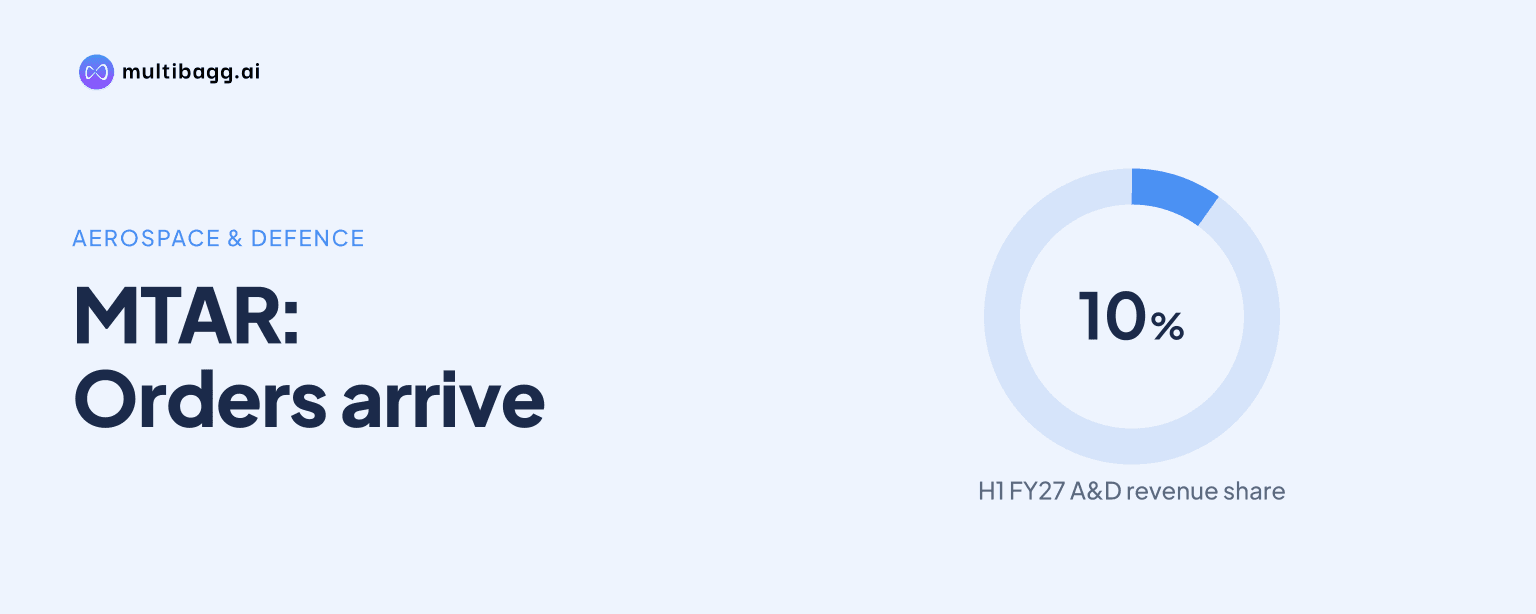
MTAR reports that GKN Aerospace is in volume production for engine components and sub-assemblies, while Thales is producing storage boxes. MTAR has also received AMCA orders for a Main Landing Gear Support Structure Test Box assembly and Fuselage Door Assembly. Aerospace and Defence revenue was Rs 80.2 crore in H1FY27.
Know MTAR Technologies inside out
Results, valuation, peers and who's buying, in one view.
Which MTAR customers are in volume production?
MTAR identifies GKN Aerospace as being in volume production for engine components, sub-assemblies and other products after delivering first articles. This is the presentation’s clearest customer-specific evidence of a transition from first-article work to recurring manufacture. MTAR says programmes are moving from first-article qualification to volume ramp-up across a majority of its multinational aerospace customers.
MTAR says Thales has volume production underway for storage boxes, while qualification is still in progress for RADAR structures. The two Thales workstreams are therefore at different production stages: storage boxes are in production, whereas RADAR structures have not yet completed qualification. MTAR has also completed design and development of a load-bearing Z Adapter for Thales Alenia Space.
MTAR places IAI at an earlier stage than GKN Aerospace and Thales. IAI first articles are under progress, and MTAR says volume production will be taken up under a long-term agreement after their completion in this fiscal year. The presentation lists Rafael and Elbit among customers in its export aerospace business but provides no programme-stage update for either customer.
How has MTAR aerospace revenue changed?
MTAR reported Aerospace and Defence revenue of Rs 80.2 crore in H1FY27, equal to 10% of company revenue for that half year. The segment generated Rs 103.8 crore in FY26 and Rs 93.2 crore in FY25, compared with Rs 58.7 crore in FY24 and Rs 64.5 crore in FY23. The H1FY27 figure is a half-year amount and is therefore not directly comparable with the full-year totals.
MTAR’s Aerospace and Defence segment combines domestic launch-vehicle and aircraft work with export manufacturing. Its disclosed launch-vehicle products include Vikas Engine systems, Cryogenic Engine Upper Stage Assemblies, electro-pneumatic modules and critical structures. Its export aerospace portfolio includes engine components, housings, ground-support equipment, storage boxes and sub-assemblies.
MTAR reported that exports contributed 78% of company revenue in H1FY27, up from 75% in Q2FY27, while domestic revenue represented 22% and 25%, respectively. Those figures cover the company rather than Aerospace and Defence alone, but they provide context for the export programmes at GKN Aerospace, Thales and IAI. Aerospace and Defence accounted for 7.2% of MTAR’s Rs 5,976.5 crore order book as at 30 September 2026.
Got a follow-up? Ask IRIS
What AMCA and LCA Tejas work has MTAR received?
MTAR has received AMCA orders for the Main Landing Gear Support Structure Test Box assembly and the Fuselage Door Assembly. These are disclosed orders for domestic fighter-aircraft structural assemblies, although the presentation gives no order value, quantity, delivery timetable or production schedule for either assembly.
MTAR had previously identified development of the Main Landing Gear Support Structure assembly for the AMCA programme among its initiatives over the past five years. In the LCA Tejas programme, MTAR says it has delivered critical aerospace components and assemblies, including landing-gear parts, and its portfolio includes actuator assemblies. The presentation distinguishes these delivered and ordered products from work that remains prospective.
MTAR says it is participating in various other tenders for structural assemblies for fighter-jet programmes. It also says significant orders are expected for actuator assemblies for the LCA Tejas Mark IA programme. Tender participation and expected orders are not reported order awards, and MTAR does not disclose a potential value for either opportunity.
What capabilities support MTAR’s aerospace production ramp?
MTAR commissioned a dedicated aerospace facility in January 2025, tailored to specific customer requirements. The company says the facility was established within an accelerated timeframe to support customer needs, but it does not disclose installed capacity, capital expenditure, utilisation or customer-specific output from the site.
MTAR has also established a Nadcap-accredited special-processes facility with approvals covering more than 30 processes. The company presents the facility as part of its in-house manufacturing capability for aerospace work. Separately, MTAR cites more than three decades of launch-vehicle propulsion experience, including Cryogenic Engine products such as turbo pumps, injector heads, gas generators, booster pumps, interfaces and start-up systems for the Geosynchronous Satellite Launch Vehicle.
Conclusion
MTAR’s disclosures show that the aerospace production ramp has begun at specific export programmes rather than across every customer at the same stage. GKN Aerospace is in volume production, Thales is producing storage boxes, and AMCA orders add two domestic structural assemblies. At the same time, IAI remains in first-article execution and Thales RADAR structures remain in qualification, alongside Rs 80.2 crore of H1FY27 Aerospace and Defence revenue.
The next disclosed milestone is completion of IAI first articles in this fiscal year, after which MTAR says volume production will be taken up under its long-term agreement. Progress on Thales RADAR-structure qualification and any conversion of LCA Tejas Mark IA actuator expectations or other fighter-aircraft tenders into orders will also determine how broadly the production ramp extends.