










MTAR targets 100 working-capital days after 50-day result
Key highlights
- MTAR reported 50 working-capital days in September 2026, down from 172 days in March 2026.
- Management targets around 100 working-capital days by FY27-end and around 150 days over the longer term.
- Cash flow from operations rose to Rs 350 crore in H1 FY27 from Rs 39.8 crore in H1 FY26.
- MTAR expects GST refunds of around Rs 70 crore to Rs 80 crore a year.
powered by IRIS
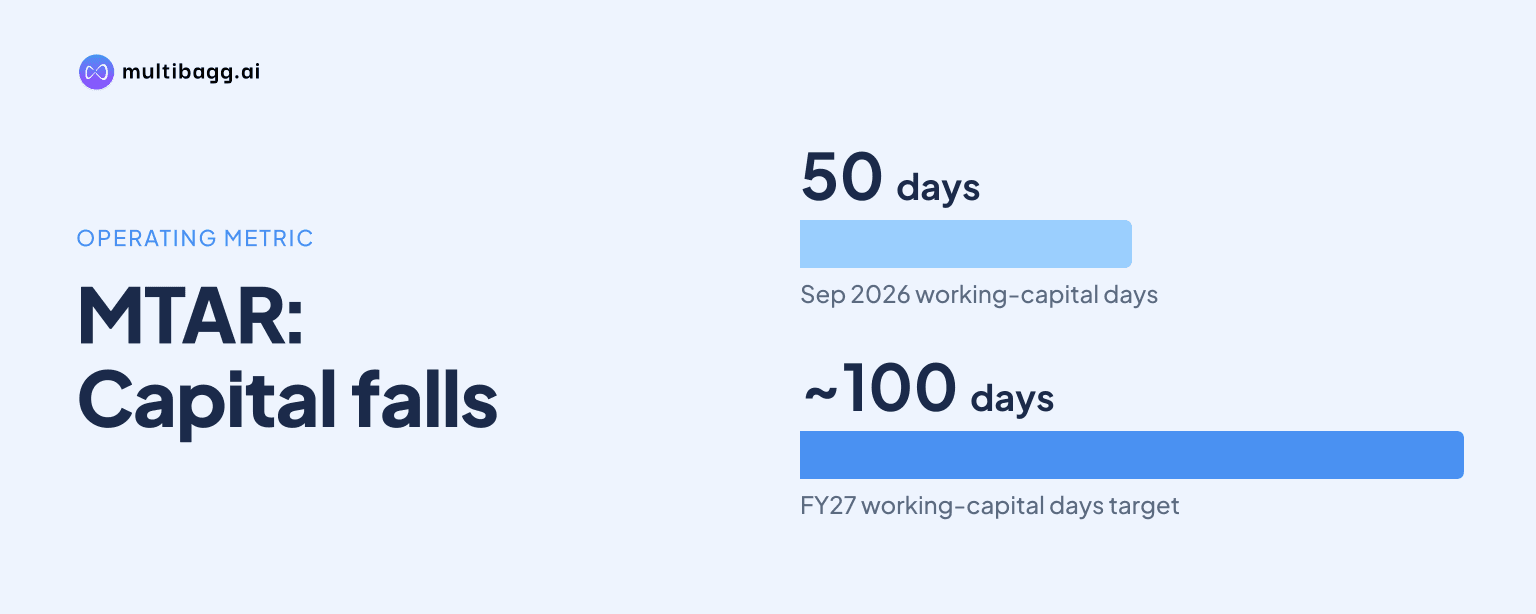
MTAR Technologies Limited (MTAR) targets around 100 working-capital days by the end of FY27 after reporting 50 days in September 2026, down from 172 days in March 2026. Management said customer advances, improved payment terms, tighter controls and expected Goods and Services Tax (GST) refunds supported the reduction, but stronger H2 FY27 execution will increase receivables and inventory.
Know MTAR Technologies inside out
Results, valuation, peers and who's buying, in one view.
How far did MTAR reduce working-capital days?
MTAR reduced working-capital days by 122 days, from 172 in March 2026 to 50 in September 2026. The chief financial officer attributed the improvement initially to better margins and tighter working-capital management, while subsequent answers identified customer advances and improved payment cycles as additional measures. The 50-day figure represents the position at the end of H1 FY27, not an average for the six-month period.
The lower working-capital requirement coincided with higher operating cash generation in H1 FY27. Cash flow from operations was Rs 350 crore in H1 FY27, compared with Rs 39.8 crore in H1 FY26, an increase of Rs 310.2 crore. Management attributed the increase to stronger profitability and working-capital management, and said it provides a base for capacity expansion.
Why will MTAR working-capital days rise by FY27 end?
MTAR expects working-capital days to reach around 100 by FY27-end because management expects H2 FY27 revenue to be higher than H1 FY27 revenue. The chief financial officer said a stronger fourth quarter would add to receivables, even after actions on advances and customer terms. Management therefore does not present the 50-day September position as the expected year-end level.
Inventory is the second stated reason for the increase from 50 days. MTAR said it must bring in materials one to two months before the FY27 year-end to support execution in the following financial year. Those purchases would remain in inventory at the year-end while revenue from the materials would be recognised in the next year.
The expected rise also reflects management's view that incremental revenue requires incremental working capital. MTAR reported revenue from operations of Rs 406.8 crore in Q2 FY27, up 12.8% from Rs 360.7 crore in Q1 FY27 and 200% from Rs 135.6 crore in Q2 FY26. Management said the company is on a growth trajectory, which will raise its funding requirement for receivables and inventory.
What actions lowered MTAR working capital to 50 days?
MTAR said customer advances, better commercial terms and GST refunds are the principal measures being used to manage working capital. Management said it had received advances from customers across its sectors and was negotiating advances with customers in civil nuclear power, hydel, fuel cells and other businesses. Better payment cycles can shorten the period between executing an order and receiving cash.
GST refunds are another stated element of the plan. MTAR said it expects GST refunds of around Rs 70 crore to Rs 80 crore a year and is working across all components of working capital. The call did not disclose how much of the September 2026 improvement resulted separately from advances, payment terms, margins or GST refunds.
MTAR also said the improvement was achieved organically, with only limited receivables discounting. The company did not disclose receivables, inventory or payables balances in the call, so investors cannot independently calculate how each balance-sheet component contributed to the fall from 172 days in March 2026 to 50 days in September 2026.
Got a follow-up? Ask IRIS
Is 50 working-capital days sustainable for MTAR?
MTAR does not identify 50 working-capital days as its long-term sustainable level; management's long-term goal is around 150 days over the next two to three years. The chief financial officer said the company could have remained in a 50-to-60-day range if activity continued in the same manner, but higher execution requires more working capital. Management said it would monitor working capital weekly.
The contrast between the end-FY27 target of around 100 days and the longer-term goal of around 150 days reflects anticipated growth rather than the abandonment of advances or commercial-term negotiations. Management confirmed both targets during the call, while noting it had not issued formal working-capital guidance. Its disclosed approach is to retain the operational measures while accommodating higher receivables and inventory as revenue rises.
The company reported earnings before interest, tax, depreciation and amortisation (EBITDA) of Rs 99.2 crore in Q2 FY27, compared with Rs 85.1 crore in Q1 FY27 and Rs 17 crore in Q2 FY26. EBITDA margin was 24.4%, versus 23.6% in Q1 FY27 and 12.5% in Q2 FY26. Management linked the quarterly margin improvement to revenue growth, product mix and operating leverage.
How does MTAR's expansion plan affect cash requirements?
MTAR's expansion plan creates a further call on cash as the company builds inventory and capacity. Management retained its guidance of 80% revenue growth and a 24% EBITDA margin, while saying it expected performance to be above those levels. The company plans around Rs 500 crore of capital expenditure by the end of FY27, subject to timely project execution.
Of the Rs 500 crore plan, management allocated around Rs 350 crore to fuel cells and around Rs 150 crore to oil and gas, aerospace and other verticals. It said 75% of the expansion plan is intended to be funded by debt and 25% by internal accruals. Management later clarified that the Rs 500 crore total includes around Rs 100 crore incurred in FY26 and around Rs 400 crore expected in FY27.
MTAR reported total debt of around Rs 465 crore, comprising Rs 189 crore of long-term debt and Rs 276 crore of short-term debt, alongside investments of Rs 358 crore. Management calculated debt after adjusting for investments at around Rs 107 crore. It also said annual sustenance and growth capital expenditure could be around Rs 50 crore to Rs 100 crore over the next one to two years.
Conclusion
MTAR's reduction to 50 working-capital days in September 2026 from 172 days in March 2026 accompanied a rise in operating cash flow to Rs 350 crore in H1 FY27 from Rs 39.8 crore a year earlier. However, management's targets of around 100 days at FY27-end and around 150 days longer term show that it expects higher growth to require more receivables and inventory.
The next measure to watch is the FY27 closing working-capital position as H2 execution accelerates. Management expects a stronger H2, plans to hold one to two months of material before year-end for subsequent execution, and expects around Rs 400 crore of FY27 capital expenditure within a Rs 500 crore programme. Those disclosed factors will influence whether MTAR reaches its approximately 100-day FY27 target.