








MV Electrosystems Limited retains FY27 ₹400-crore revenue target

Find your next multibaggerBe a Pro Investor
Research stocks and track your picks on the go. Download the app.
Key highlights
- MV Electrosystems retained its FY27 revenue target of Rs 400 crore.
- Management plans to produce 40 locomotive propulsion systems a month from January.
- MV Electrosystems billed 7 locomotive propulsion systems in September FY27 and said it built 7 more in October.
- Unit 1 and Unit 2 are expected to provide capacity for 50 locomotive propulsion systems a month.
powered by IRIS
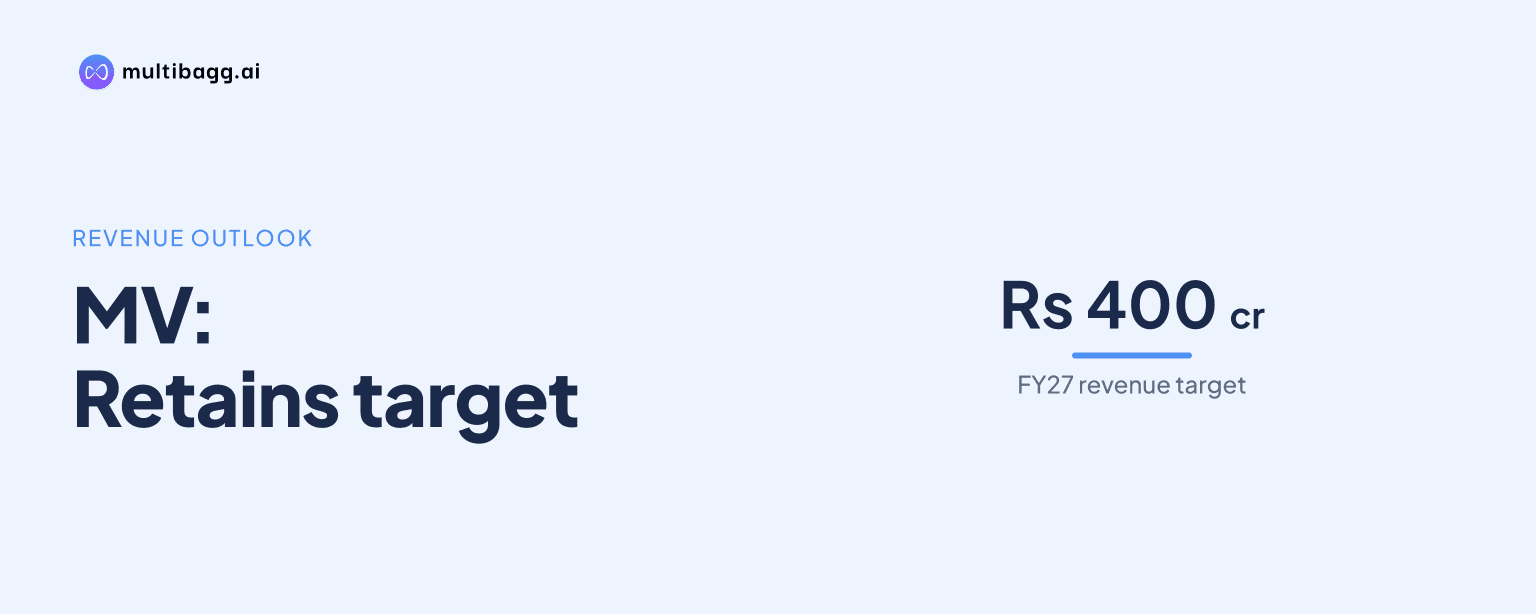
MV Electrosystems Limited retained its FY27 revenue target of Rs 400 crore, with management linking delivery of the target to a planned output of 40 locomotive propulsion systems a month from January. The company said most initial component shortages had been addressed, while the remaining test capacity was expected to be installed by December 15.
Know MV Electrosystems inside out
Results, valuation, peers and who's buying, in one view.
Can MV Electrosystems achieve its FY27 revenue target?
MV Electrosystems said it would not revise its Rs 400 crore FY27 revenue target because it expects the production scale-up to mature in January. Management said resolving the remaining inventory issues and reaching the planned delivery rate would keep the company on track with the guidance.
Management’s arithmetic places particular weight on the January-to-March period. It said a locomotive propulsion system is generally built at about Rs 1.96 crore, or tentatively Rs 2 crore. Production of 120 systems across three months at 40 a month would represent about Rs 235.20 crore at the Rs 1.96 crore indicative value, before regular-business revenue and Q3 activity.
The guidance is therefore contingent on future execution rather than based on a disclosed H1 revenue number. Management did not state H1 FY27 revenue in the supplied call. It also said earnings before interest, taxes, depreciation and amortisation, or EBITDA, could turn positive in Q3 FY27, although it expected this more clearly in Q4 FY27.
What delayed MV Electrosystems’ production ramp?
MV Electrosystems attributed the initial uneven production to lengthy procurement cycles for a broad range of electronic components. Management said bulk ordering began after its late-August listing, and lead times at mainly international suppliers reached as long as six months in some cases.
An analyst referred to an earlier expectation of 70 propulsion sets by the end of Q3 FY27, whereas management set out a current progression of 15 expected systems in November and 25 in December. Management said a difference of two, three or four systems can occur because each propulsion system uses thousands of parts, including semiconductors, and a shortage in one month can be recovered later.
Management said the supply issue had “almost” been resolved, with only two, three or four categories of small components still creating difficulty. It cited sensors and light-emitting diode, or LED, parts as examples. In contrast, it said insulated-gate bipolar transistors, or IGBTs, and capacitors were covered through bulk orders placed with two to three shortlisted suppliers.
MV Electrosystems said imported and domestic procurement each accounted for almost equal portions of its material sourcing. That split applies alongside management’s statement that IGBTs and capacitors, which have long delivery periods, had been secured in advance against order schedules. The company did not quantify the value of procurement or the number of component categories remaining unresolved.
How will MV Electrosystems reach 40 systems a month?
MV Electrosystems plans to reach 40 locomotive propulsion systems a month from January through additional test capacity and more stable component inventory. Management said four test setups are needed for this production and billing level, of which two were operational at the time of the call.
Equipment for the remaining two test setups was being delivered to the factory, and management expected installation by December 15. It said the infrastructure at its first factory was already aligned for the ramp. The company described January as the first mature delivery month, after production scale-up began in September.
The first factory was fully operational and occupied, while Unit 2 was under execution. Management expected Unit 2 to be fully built and ready to make propulsion systems by December 15 or the third week of December. These completion dates underpin the January production plan rather than representing completed capacity at the time of the call.
Management said Unit 1 and Unit 2 would together have capacity for 50 propulsion systems a month. It does not plan to use more than 40 systems of that capacity for locomotive work initially, leaving buffer capacity for future electric multiple unit, or EMU, and mainline electric multiple unit, or MEMU, propulsion products.
Got a follow-up? Ask IRIS
Which projects could expand MV Electrosystems’ revenue base?
MV Electrosystems identified locomotive propulsion as the near-term revenue driver, while MEMU propulsion and rail-electrification products remain in development. Management expects the first MEMU propulsion prototype in the second or third quarter of calendar year 2027, followed by prototype trials and testing by Indian Railways and the Research Designs and Standards Organisation, or RDSO.
The company is also developing an automatic fault locator for 2x25 kilovolt alternating-current rail-electrification lines under a transfer-of-technology agreement with a South Korean company. Management said the product had been offered for prototype testing and was expected to receive prototype clearance in the ongoing month or by early December, after which it would seek RDSO approval.
Management estimated the prevailing value of an automatic fault locator set at about Rs 1.25 crore. It described a set as field equipment installed around a traction substation and intervening line sections. The company said manufacturing would be in-house from the beginning, using its surface-mount technology lines, electronic manufacturing facility, assembly lines and integration facilities.
For longer-term space, MV Electrosystems said it had received an allocation of 10 acres at a Gwalior industrial area for Unit 3. The disclosed lease rate is Rs 1 per square metre per year. Management did not give a project capital-expenditure figure because factory and office plans had not been prepared, but said execution could begin in January or February.
How do order allocation and pricing affect the ramp?
MV Electrosystems said Indian Railways typically allocates propulsion-system quantities among suppliers to preserve the supply ecosystem. Management said its allocation had moved from about 25% in a previous order to about 20% in the latest order, adding that allocations could range from 15% to 25% depending on the tender.
Management said it did not view the lower allocation as evidence of a major price reduction by competitors. It also said Indian Railways purchase orders include an input-cost formula, based on a formula associated with the Institute of Electrical and Electronics Engineers, for major materials such as copper, steel and aluminium. The billed price can therefore change from the indicative order price when these commodity inputs move.
On cash collection, management said payments have historically followed the terms in Indian Railways purchase orders and are generally received about 15 days after equipment is supplied and reaches the customer. It also said maintenance typically accounts for 3% to 5% of a purchase-order value, with timing specified in each order.
Conclusion
MV Electrosystems has retained its Rs 400 crore FY27 revenue target despite the component-led delays because management expects a rapid January-to-March increase in locomotive propulsion output. The disclosed run rate of 40 systems a month, at an indicative Rs 1.96 crore per system, would represent about Rs 235.20 crore over three months, supplemented by regular business and earlier-quarter production.
The next disclosed milestones are installation of the two remaining test setups by December 15, Unit 2 readiness in December and the planned 40-system monthly delivery rate from January. Further evidence will come from whether the remaining two to four component categories are resolved, whether EBITDA becomes positive in Q3 or Q4 FY27, and progress on RDSO approval for the automatic fault locator and MEMU prototype trials.

