










MV Electrosystems Ltd. spent 15.99% of FY26 revenue on R&D
Key highlights
- MV Electrosystems spent Rs 7.9 crore on engineering, R&D, design and development in FY26.
- R&D expenditure equalled 15.99% of MV Electrosystems' FY26 revenue from operations.
- MV Electrosystems reported 45 R&D team members as of September 30, 2026.
- The Department of Scientific and Industrial Research recognised the MV Electrosystems R&D centre in June 2026.
powered by IRIS
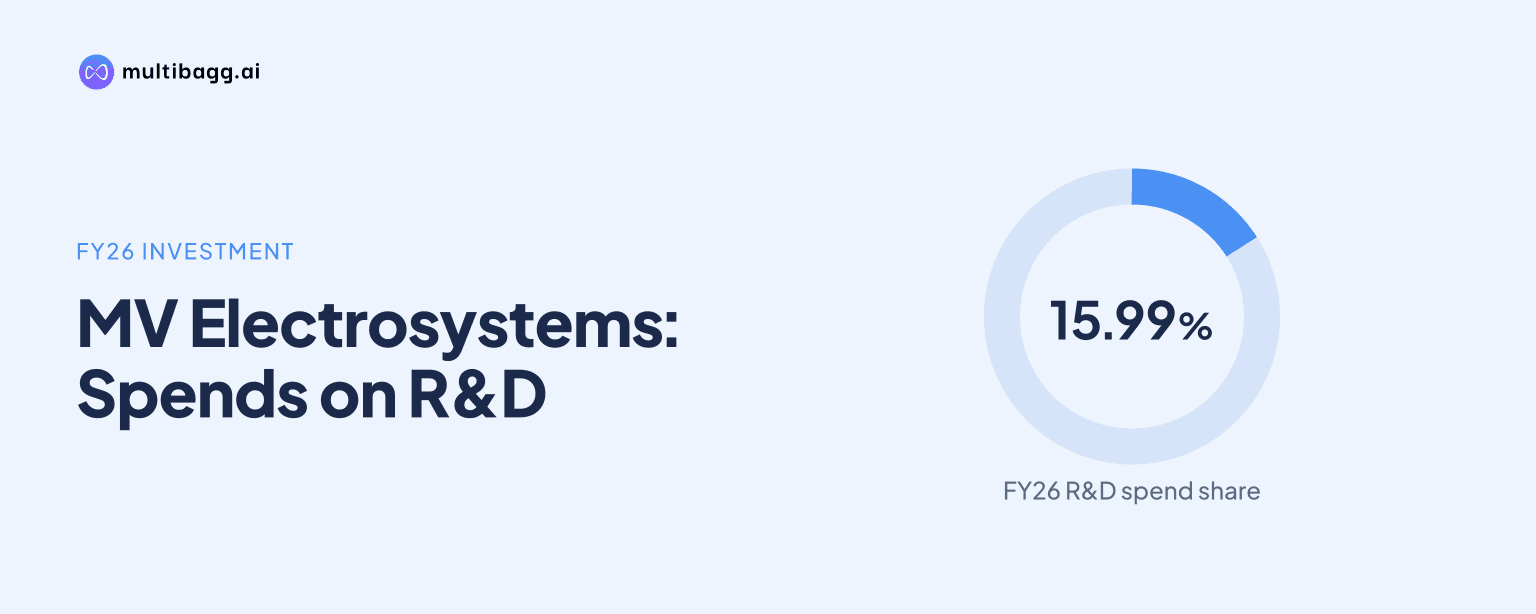
MV Electrosystems Ltd. spent Rs 7.9 crore on engineering, research and development (R&D), design and development in FY26, equal to 15.99% of revenue from operations, and reported a 45-member R&D team as of September 30, 2026. Its Faridabad centre covers design, simulation, prototyping and validation for railway electrical and power-electronics systems.
Know MV Electrosystems inside out
Results, valuation, peers and who's buying, in one view.
How much did MV Electrosystems spend on R&D in FY26?
MV Electrosystems reported Rs 7.9 crore of engineering, R&D, design and development expenditure in FY26, representing 15.99% of revenue from operations. The presentation does not divide this amount among personnel, prototypes, software, testing, facility costs or individual product programmes.
The expenditure supports an in-house model for railway electrical and power-electronics systems. MV Electrosystems lists power and control hardware, electrical and electronics engineering, mechanical design, traction power and system software, thermodynamics or thermal design, and embedded and software engineering as its core expertise.
The 15.99% figure is an expenditure-to-revenue ratio, rather than a measure of sales from new products or profitability. The presentation provides no R&D expenditure or revenue ratio for an earlier financial year, so it does not show whether FY26 spending changed from a prior period.
Who makes up the MV Electrosystems R&D team?
MV Electrosystems had 45 R&D team members as of September 30, 2026, including 2 Ph.D. holders, 9 Master of Technology engineers and 1 Master of Engineering engineer. The team also included 7 Bachelor of Technology engineers, 3 Bachelor of Engineering degree holders, 4 diploma engineers, 5 Industrial Training Institute-certified technicians, 2 software engineers, 2 management professionals and 10 people classified as others.
The postgraduate engineering group, comprising 2 Ph.D. holders, 9 Master of Technology engineers and 1 Master of Engineering engineer, totalled 12 people. That was two more than the 10 people with Bachelor of Technology or Bachelor of Engineering qualifications, while diploma engineers and Industrial Training Institute-certified technicians together accounted for 9 members.
The disclosed mix covers engineering, software and technical-support roles associated with design, prototyping and validation. However, MV Electrosystems does not assign the 45 members to named products, specify the number working at Faridabad, or disclose a separate headcount for the additional leased facility.
What does the MV Electrosystems R&D centre do?
MV Electrosystems says its dedicated research, design and development centre in Faridabad, Haryana, designs, simulates, prototypes and validates complex railway electrical and power-electronics systems. The company presents this integrated process as the mechanism for responding to evolving customer requirements through internal engineering and product-development capabilities.
The centre’s stated work is relevant to the company’s IGBT-based three-phase propulsion equipment for 6,000 horsepower-class electric locomotives. That platform integrates two 2.7-megawatt traction converters, three 130-kilovolt-ampere auxiliary converters, two vehicle control units and two driver consoles, according to the presentation.
MV Electrosystems describes its product-development method as modular, using a module-based approach for rapid prototyping of newer products. It also describes end-to-end indigenous development of railway power-electronics systems, although the presentation provides no measure of prototype volumes, development-cycle time or product-specific R&D costs.
Got a follow-up? Ask IRIS
What is changing at the MV Electrosystems R&D facility?
MV Electrosystems has leased an additional facility that is partially operational, with further renovation and infrastructure development under way. The company also says it plans to hire additional manpower, but it gives no completion date, cost, floor area or numerical recruitment target for the expansion.
The additional facility is distinct from the dedicated Faridabad research, design and development centre disclosed in the presentation. Its partial operating status means the company has begun using the site, while renovation and infrastructure work remain unfinished; the source does not specify which engineering, laboratory or testing functions have moved there.
The stated hiring plan would add to the 45 R&D members reported on September 30, 2026. Whether the additional site increases the rate of design, simulation, prototyping or validation cannot be determined from the presentation because neither future headcount nor facility completion timing is disclosed.
When did the Department of Scientific & Industrial Research recognise MV Electrosystems?
The Department of Scientific and Industrial Research (DSIR), Government of India, recognised the MV Electrosystems R&D centre in June 2026. The presentation identifies the recognition as an institutional milestone for the Faridabad research, design and development operation.
The June 2026 recognition occurred in the same calendar year as the September 30, 2026 disclosure of a 45-member R&D team and the FY26 expenditure figure of Rs 7.9 crore. These disclosures show the company’s reported recognition, spending and team resources, but do not establish commercial returns, patent output, tender awards or customer approvals.
DSIR recognition is separate from product validation and commercial supply milestones. For example, MV Electrosystems says its IGBT-based three-phase propulsion platform completed 50,000 kilometres of field trials, received Chittaranjan Locomotive Works prototype clearance, and began commercial supplies in March 2026.
Conclusion
MV Electrosystems’ FY26 presentation documents an internal engineering commitment of Rs 7.9 crore, or 15.99% of revenue from operations, alongside a 45-member R&D team as of September 30, 2026. The Faridabad operation is described as covering the full process from design and simulation to prototyping and validation, with expertise spanning hardware, control systems, software, mechanical design and thermal design.
The next disclosed execution point is the additional leased R&D facility, which is partially operational while renovation and infrastructure development continue. Management also plans additional hiring, but has not disclosed a completion date, capital cost or headcount target, leaving the scale and timing of the expanded engineering capacity unresolved.