










Triton standalone contribution margin rises to 24.8% in H1 FY 27
Key highlights
- Triton standalone contribution margin rose to 24.8% in H1 FY 27 from 20.1% in H1 FY 26.
- Material cost fell to 65.1% of standalone sales from 74.3%, despite sales rising to Rs 218.38 crore.
- Standalone operating profit increased to Rs 14.45 crore from Rs 8.94 crore, lifting margin to 6.6%.
- H1 FY 27 net profit of Rs 11.18 crore included a Rs 5.17 crore merger-related tax benefit.
powered by IRIS
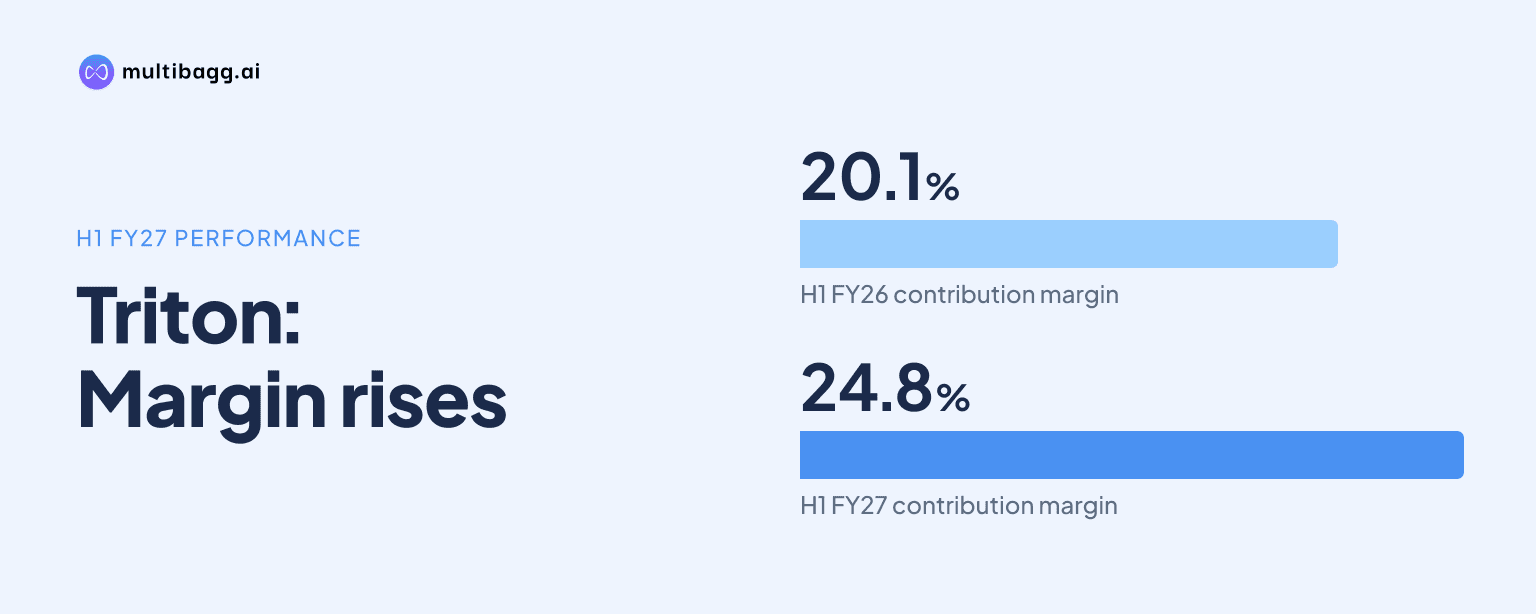
Triton Valves Limited, referred to here as Triton, raised standalone contribution margin to 24.8% in H1 FY 27 from 20.1% a year earlier, as material cost fell to 65.1% of sales from 74.3%. The change lifted contribution by Rs 12.11 crore to Rs 54.14 crore despite sales increasing only 4.4% to Rs 218.38 crore.
Know Triton Valves inside out
Results, valuation, peers and who's buying, in one view.
How did Triton’s standalone contribution margin change in H1 FY 27?
Triton’s standalone contribution margin increased by 4.7 percentage points year on year to 24.8% in H1 FY 27, from 20.1% in H1 FY 26. Contribution, which remains after material cost and tolling, job-work and labour charges, rose to Rs 54.14 crore from Rs 42.03 crore, while standalone sales increased to Rs 218.38 crore from Rs 209.27 crore.
The H1 result was also above the 20.6% contribution margin recorded for the full FY 26, when contribution was Rs 89.74 crore on sales of Rs 435.34 crore. This means the first-half margin was 4.2 percentage points higher than the prior full-year level, although H1 FY 27 sales represented about half of the FY 26 total.
The quarterly sequence points in the same direction. In Q2 FY 27, contribution was Rs 28.30 crore, or 25.6% of Rs 110.77 crore sales, compared with Rs 25.82 crore, or 24.0%, in Q1 FY 27. Q2 FY 26 contribution was Rs 22.42 crore, equivalent to 21.4% of Rs 104.97 crore sales.
What drove Triton’s H1 FY 27 margin expansion?
The disclosed driver was a sharp reduction in material-cost intensity: material cost declined to 65.1% of standalone sales in H1 FY 27 from 74.3% in H1 FY 26. In rupee terms, material cost fell by Rs 13.28 crore to Rs 142.14 crore even as sales rose by Rs 9.11 crore, creating the principal basis for the Rs 12.11 crore increase in contribution.
That benefit was partly offset by a higher share of tolling, job-work and labour. These expenses rose to Rs 22.11 crore, or 10.1% of sales, from Rs 11.82 crore, or 5.6%, a year earlier. The contribution calculation therefore reflects both the 9.2-percentage-point fall in the material-cost ratio and a 4.5-percentage-point increase in the tolling, job-work and labour ratio.
The Q2 figures show that material-cost intensity continued to decline within FY 27. Material cost was 63.2% of sales in Q2 FY 27, compared with 67.0% in Q1 FY 27 and 72.8% in Q2 FY 26. At the same time, Q2 tolling, job-work and labour was 11.2% of sales, above 9.0% in Q1 FY 27 and 5.8% a year earlier.
Did Triton convert higher contribution into operating profit?
Triton converted the higher contribution into Rs 14.45 crore of standalone operating profit in H1 FY 27, up from Rs 8.94 crore in H1 FY 26. Operating-profit margin rose to 6.6% from 4.3%, even though operating overheads increased by Rs 6.59 crore to Rs 39.68 crore over the same comparison.
Reported EBITDA, or earnings before interest, tax, depreciation and amortisation, increased to Rs 17.53 crore from Rs 11.85 crore, and its margin rose to 8.0% from 5.7%. Other income was Rs 3.08 crore in H1 FY 27 versus Rs 2.91 crore a year earlier, so most of the Rs 5.68 crore EBITDA increase came from the change in operating profit rather than other income.
Profit before tax, or PBT, reached Rs 8.01 crore, equal to 3.7% of sales, against Rs 2.81 crore and 1.3% in H1 FY 26. Interest rose to Rs 4.68 crore from Rs 4.34 crore and depreciation rose to Rs 4.83 crore from Rs 4.70 crore, but the increase in EBITDA exceeded those additional charges.
Net profit was Rs 11.18 crore, or 5.1% of sales, compared with Rs 1.42 crore, or 0.7%, in H1 FY 26. This figure includes a Rs 5.17 crore merger benefit under income tax, while normal income tax was Rs 2.00 crore; the net-profit comparison should therefore be distinguished from the pre-tax operating progression.
Got a follow-up? Ask IRIS
Which standalone segment supported Triton’s H1 FY 27 result?
Automotive provided Rs 212.00 crore of Triton’s Rs 218.38 crore standalone sales in H1 FY 27, while Climate Control supplied Rs 6.38 crore. Automotive sales increased from Rs 203.81 crore in H1 FY 26, whereas Climate Control sales rose from Rs 5.46 crore, showing that the sales base and the margin outcome were predominantly tied to Automotive.
Automotive PBT was Rs 10.67 crore, or 5.0% of its sales, compared with Rs 6.42 crore and 3.2% in the prior-year half. Climate Control’s disclosed PBT margin remained negative at 41.7% in H1 FY 27, although it improved from negative 68.5% in H1 FY 26; this segment did not contribute a positive PBT margin.
Q2 continued to show the difference in segment scale. Automotive sales were Rs 108.28 crore of the Rs 110.77 crore standalone total, while Climate Control sales were Rs 2.49 crore. Automotive PBT margin was 5.8% in Q2 FY 27, compared with 4.2% in Q1 FY 27 and 3.8% in Q2 FY 26; Climate Control’s Q2 PBT margin was negative 64.1%.
What should investors watch after H1 FY 27?
Triton’s presentation identifies product mix, increased traction in electric-vehicle components, exports and internal cost-reduction initiatives as Q2 operating developments. It also says Q2 revenue growth contained a significant commodity-rate component, so the H1 movement in sales of Rs 218.38 crore and in material cost of Rs 142.14 crore should be assessed alongside future commodity conditions.
At the group level, inventory was Rs 203.25 crore in September 2026, up from Rs 121.79 crore in March 2026. Triton attributes the increase to higher sales, commodity effects and early arrival of containers after Q1 supply-chain issues, and says anticipated higher H2 FY 27 sales for Climate Control and Metals should allow inventory availability to facilitate growth.
Conclusion
Triton’s H1 FY 27 standalone result shows a defined change in unit economics: the material-cost ratio fell by 9.2 percentage points, contribution margin rose by 4.7 percentage points, and operating-profit margin increased by 2.3 percentage points. Automotive, with Rs 212.00 crore of sales, remained the principal business behind the reported improvement, while Climate Control still had a negative PBT margin.
The next results will show whether the Q2 material-cost ratio of 63.2% and contribution margin of 25.6% can be maintained as sales develop. Management’s disclosed H2 FY 27 expectation is for higher Climate Control and Metals sales, supported by inventory that had risen to Rs 203.25 crore at September 2026.