










Triton inventory hits Rs 203.25 crore as borrowing rises
Key highlights
- Triton reported consolidated inventory of Rs 203.25 crore at Sep-26, versus Rs 121.79 crore at Mar-26.
- Triton’s short-term borrowings were Rs 152.79 crore at Sep-26, compared with Rs 119.31 crore at Mar-26.
- Triton reported Rs 33.22 crore of increased short-term bank loans in H1 FY 27.
- Triton’s inventory days rose to 101.5 at Sep-26 from 76.9 at Mar-26.
powered by IRIS
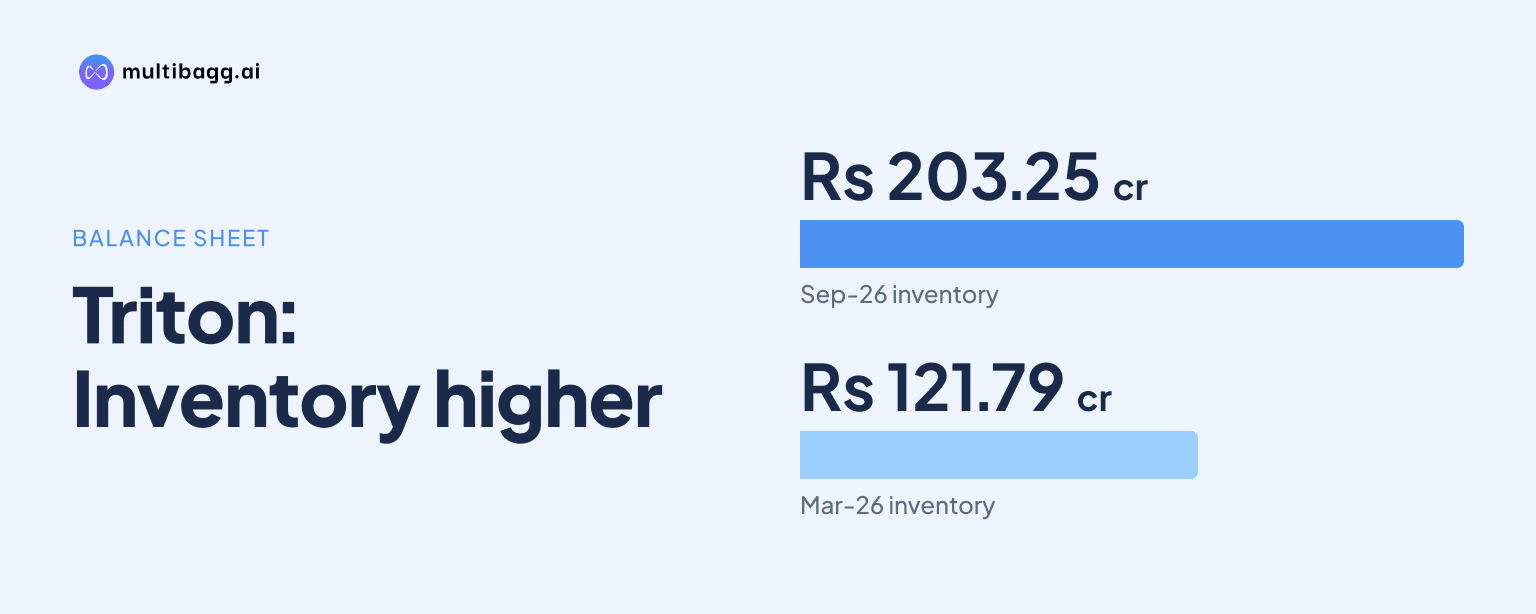
Triton Valves Limited recorded consolidated inventory of Rs 203.25 crore at Sep-26, up from Rs 121.79 crore at Mar-26, while short-term borrowings reached Rs 152.79 crore from Rs 119.31 crore; H1 FY 27 cash flow records Rs 33.22 crore of increased short-term bank loans.
Know Triton Valves inside out
Results, valuation, peers and who's buying, in one view.
Why did Triton’s inventory increase by Sep-26?
Triton said inventory increased because of higher sales, commodity effects and containers arriving early in the last days of September 2026. Consolidated inventory was Rs 203.25 crore at Sep-26, an increase of Rs 81.46 crore from Rs 121.79 crore at Mar-26. The company classified the drivers as business, economic and supply-chain factors.
The stock build coincided with a rise in consolidated sales to Rs 386.62 crore in H1 FY 27 from Rs 266.34 crore in H1 FY 26. Material cost rose to Rs 292.34 crore from Rs 194.47 crore over the same comparison. Triton said the inventory available at September-end would facilitate anticipated higher H2 FY 27 sales in the Climate Control and Metals businesses.
Which Triton segments held inventory at Sep-26?
Triton’s Automotive + Climate Control segment held Rs 126.97 crore of inventory at Sep-26, compared with Rs 77.41 crore held by Metals before consolidation eliminations. An Rs 1.13 crore elimination reduced the reported group consolidated inventory balance to Rs 203.25 crore.
Both operating segments reported higher H1 FY 27 sales than in H1 FY 26. Automotive + Climate Control sales rose to Rs 218.38 crore from Rs 163.68 crore, while Metals sales increased to Rs 168.24 crore from Rs 102.66 crore. Triton specifically linked the inventory availability to expected H2 FY 27 growth in Climate Control and Metals, without disclosing an inventory-reduction target.
How did Triton finance its H1 FY 27 cash requirements?
Triton partly financed its H1 FY 27 requirements through Rs 33.22 crore of increased short-term bank loans and Rs 17.50 crore of proceeds from an ECLGS 50 Loan. The consolidated short-term borrowing balance stood at Rs 152.79 crore at Sep-26, versus Rs 119.31 crore at Mar-26. The cash-flow statement also records Rs 4.22 crore of repayments of old term loans.
Cash from operating activities was Rs 25.57 crore in H1 FY 27, after Rs 52.76 crore of reported working-capital changes. The statement lists Rs 81.45 crore for inventory, Rs 13.65 crore for receivables, Rs 48.23 crore for payables, Rs 3.69 crore for other items net, and Rs 2.20 crore of income tax paid within those movements.
Applications of funds totalled Rs 40.07 crore, including Rs 11.97 crore for purchases of property, plant and equipment and Rs 1.44 crore invested in Power Gen. Co. Financing activities provided Rs 40.07 crore, including the loan proceeds, short-term bank borrowing increase, Rs 7.10 crore of finance cost and dividend paid, and Rs 0.67 crore of cash-balance utilisation.
Long-term loans were Rs 25.54 crore at Sep-26, compared with Rs 12.51 crore at Mar-26, while total liabilities rose to Rs 293.93 crore from Rs 196.53 crore. Net worth increased to Rs 143.12 crore from Rs 128.31 crore, and Triton reported H1 FY 27 net profit of Rs 15.84 crore, including a Rs 5.17 crore merger-related tax benefit.
Got a follow-up? Ask IRIS
What do Triton’s working-capital ratios show?
Triton’s inventory days increased to 101.5 at Sep-26 from 76.9 at Mar-26, matching the higher inventory balance. Receivable days declined to 37.5 from 40.4, while payable days increased to 43.1 from 28.9. The movement shows that the rise in stock occurred alongside fewer reported receivable days and more reported payable days.
Cash conversion days increased to 95.9 at Sep-26 from 88.4 at Mar-26. The current ratio was 1.21 at Sep-26 against 1.20 at Mar-26, while debt over equity was 1.25 compared with 1.03. Annualised debt to earnings before interest, tax, depreciation and amortisation was 3.32 at Sep-26, versus 3.16 at Mar-26.
Annualised return on capital employed was 12.70% at Sep-26, compared with 11.00% at Mar-26, and debt-service coverage was 2.36 compared with 1.88. Cash and equivalents were Rs 4.08 crore at Sep-26, up from Rs 3.54 crore at Mar-26, despite the H1 FY 27 cash-flow statement recording Rs 0.67 crore of cash-balance utilisation.
What could determine whether Triton’s inventory supports H2 FY 27 sales?
Triton said the Sep-26 stock position was intended to support anticipated H2 FY 27 growth in Climate Control and Metals. In H1 FY 27, Automotive + Climate Control profit before tax was Rs 8.01 crore, up from Rs 2.68 crore in H1 FY 26, while Metals profit before tax rose to Rs 6.03 crore from Rs 2.57 crore.
Management said the Climate Control vertical had a healthy order book in Q3 and that large tyre-pressure monitoring system valve programmes with Aumovio and Sensata would start launching from Q1 FY 27. Its outlook also cited new automotive climate-control programmes, scaling electric-vehicle platforms of Ather, River and Simple, and new Metals alloys for writing instruments, medical equipment and defence.
Management said it would continue to focus on operating-margin improvement and cost optimisation. It also disclosed plans for further capital expenditure in automotive and metals to widen product ranges and increase production capacity, but gave no amount or timetable for that additional spending.
Conclusion
Triton’s Sep-26 balance sheet shows a larger working-capital requirement alongside higher operating activity. Inventory rose by Rs 81.46 crore from Mar-26, short-term borrowings rose by Rs 33.48 crore, and consolidated H1 FY 27 sales increased by Rs 120.28 crore year on year. Receivable and payable-day movements partly offset the effect of higher inventory, but cash conversion days still increased to 95.9.
The next result should show whether management’s anticipated H2 FY 27 Climate Control and Metals growth converts the available inventory into sales. Investors can also watch the disclosed Q3 Climate Control order book, the stated Aumovio and Sensata programme launches, further automotive and metals capital-expenditure plans, and subsequent movement in inventory days and short-term borrowing.