










Khadim franchises account for 78% of its 814-store network
Key highlights
- Khadim had 814 branded retail stores in September 2026.
- Khadim reported 630 franchise stores and 184 COCO-category stores.
- Tier III cities accounted for 52% of Khadim retail stores, versus 18% in metros.
- East India represented 69% of Khadim’s retail network across 21 states and three union territories.
powered by IRIS
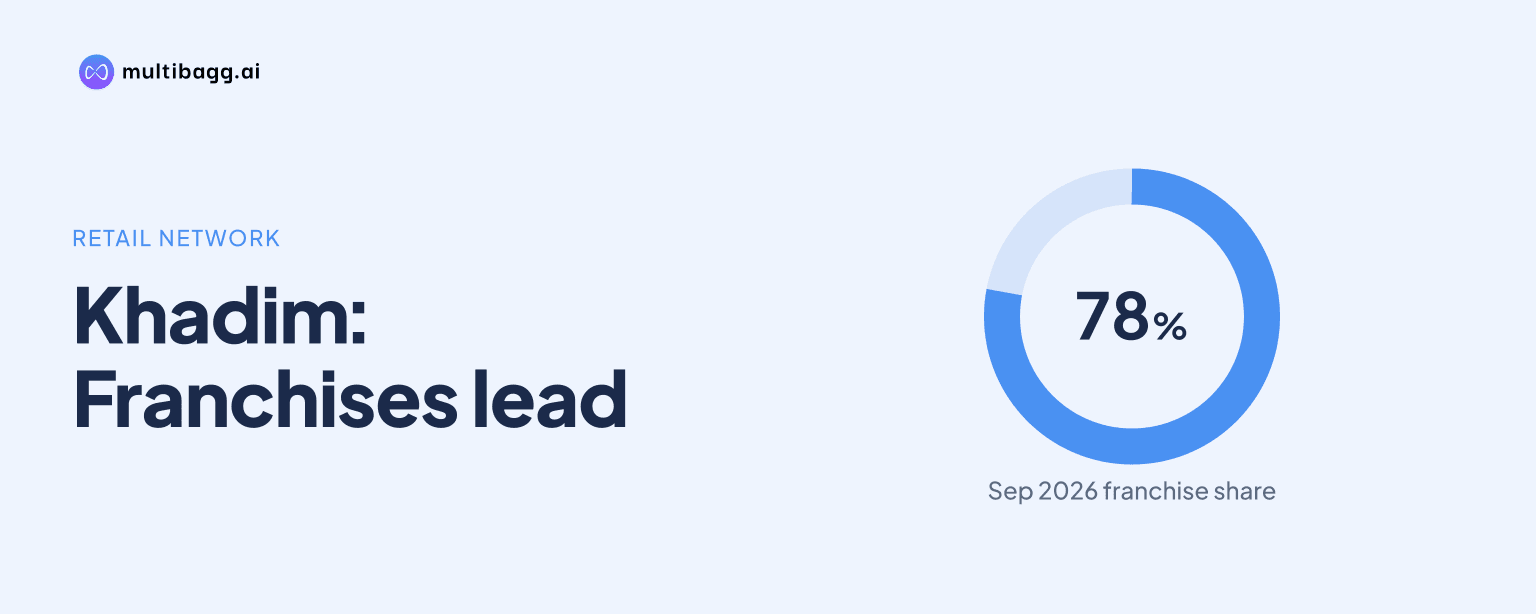
Khadim India Limited had 814 branded retail stores in September 2026, and franchises accounted for 78% of its retail presence. The network included 630 franchise stores and 184 stores classified as COCO, a category label used in the presentation, while Tier III cities accounted for 52% of outlets, compared with 18% in metros.
Know Khadim India inside out
Results, valuation, peers and who's buying, in one view.
How is Khadim's 814-store network structured?
Khadim’s 814-store network was predominantly franchise-led in September 2026, with 630 franchise outlets and 184 outlets classified as COCO in its presentation. Management describes 78% of retail presence as being through the franchise route. The stated percentage and store-count split point to the same operating mix: franchises form the larger part of the branded retail footprint rather than the COCO category.
Khadim presents this structure as part of an asset-light growth model. Alongside the 78% franchise-route share, it says that 100% of product requirements are outsourced. The presentation does not provide separate sales, profitability, investment or store-size data for the 630 franchise outlets and 184 COCO-category outlets, so the disclosed evidence establishes the network mix but does not quantify the financial contribution of either format.
Where are Khadim stores located by city tier?
Khadim’s largest city-tier exposure was in Tier III locations, which represented 52% of its retail stores as of September 2026. This was above the 18% metro share, the 17% Tier II share and the 13% Tier I share. The distribution places more than half of the 814-store branded network in the Tier III category rather than in the three higher-density categories shown by management.
The comparison also shows that metros and Tier I cities together represented 31% of the network, below the 52% Tier III share on its own. Tier II cities added 17%, bringing the combined non-metro categories to 82% of stores. Khadim does not disclose the city-by-city outlet list, revenue split or franchise-versus-COCO split within each tier, so the presentation supports a geographic-format reading of store presence rather than a conclusion about customer spending or sales productivity.
Which regions account for Khadim's store presence?
Khadim’s retail network was concentrated in East India, which accounted for 69% of stores, compared with 17% in South India and 7% each in North and West India. The company reported presence across 21 states and three union territories with 814 branded stores in September 2026. East India therefore had a larger stated share than the other three zones combined, which together represented 31%.
The zonal pattern differs from an evenly distributed national network. South India was the second-largest zone at 17%, or 10 percentage points behind the East, while both North and West stood at 7%. Khadim calls itself the largest presence in East India and a prominent brand player in South India, with those descriptions qualified in the presentation as being in terms of the number of exclusive retail stores.
The footprint covers 21 states and three union territories, but the 69% East share shows where most outlets were located at the reported date. The presentation’s map contains state and territory store labels, but it does not assign names to those individual numerical labels in the supplied material. It therefore supports the stated 69%, 17%, 7% and 7% zonal comparison without allowing a verified ranking of every state or union territory.
Got a follow-up? Ask IRIS
What supports Khadim's asset-light retail model?
Khadim supports its stated asset-light model through a 78% franchise retail presence and outsourcing of 100% of product requirements. These are separate mechanisms disclosed together in the company overview: the first concerns the route to retail presence, while the second concerns product sourcing. The presentation does not state that either mechanism guarantees a particular margin, capital requirement or rate of future store additions.
The company’s retail model has added formats over time. Khadim began retail operations in South India in 1993 with four outlets, commenced retail business through COCOs in 1999, and expanded into the shop-in-shop format in 2017. In 2025, it launched its first customer relationship management programme for retail stores and opened its first travel-retail store at Kolkata International Airport as well as its first store at Sealdah Station.
Khadim also identifies design as a retail support capability, citing domestic and global fashion-trend understanding and the development of sub-brands. Management says these capabilities have helped create and grow sub-brands, support premiumisation and target aspirational customers. The presentation names product and brand activity including O Pro, the GEN alpha range, British Walkers, bags, men’s slippers, ladies’ slippers, kids’ clogs and quick-dry footwear, but it gives no sales figures for those products or brands.
Conclusion
Khadim’s September 2026 store data describes a retail system shaped by three concentrations: 630 of 814 outlets were franchises, 52% of stores were in Tier III cities, and East India accounted for 69% of the network. Together, the figures show that Khadim’s reported store presence rests more on franchise distribution, smaller-city coverage and its eastern base than on a predominantly metro or COCO-category footprint.
The presentation provides no future store-opening target, franchise target or dated expansion timetable after September 2026. The unresolved items to watch are whether the customer relationship management programme launched in 2025 and the first travel-retail locations at Kolkata International Airport and Sealdah Station lead to further disclosed additions, and whether Khadim later reports separate operating measures for franchise and COCO-category outlets.