










Khadim targets East and South entry via company-operated stores
Key highlights
- Khadim had 814 exclusive branded outlets as of September 30, 2026.
- Khadim plans COCO-led entry into Eastern and Southern markets before franchise expansion.
- Khadim’s retail price range is Rs 49 to Rs 8,499 across footwear and accessories.
- Khadim reported H1 FY27 revenue of Rs 172.1 crore and EBITDA margin of 5.7%.
powered by IRIS
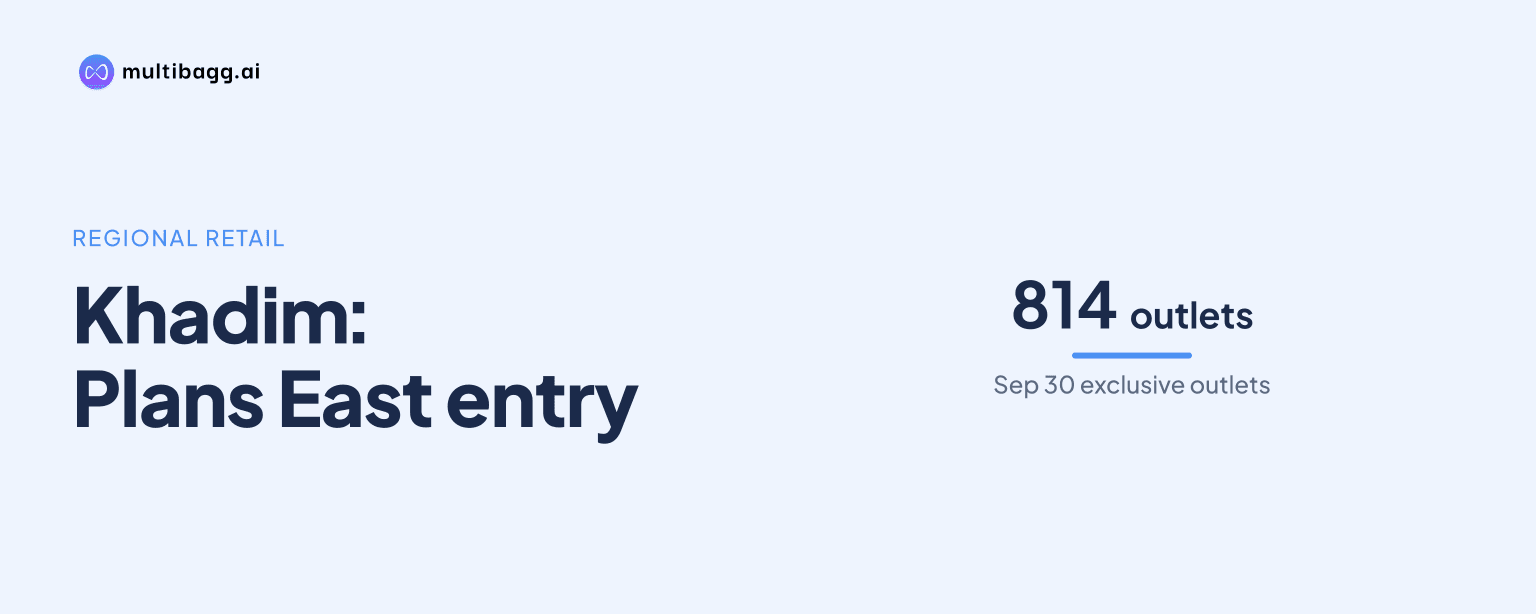
Khadim India Limited is targeting entry into new Eastern and Southern markets through company-operated stores before franchisees, starting from a retail network of 814 exclusive branded outlets as of September 30, 2026. Management links the rollout to premiumisation, an asset-light model and optimum capacity utilisation.
Know Khadim India inside out
Results, valuation, peers and who's buying, in one view.
What is Khadim’s geographic growth strategy?
Khadim’s retail strategy is to expand its store network across India, with a specific focus on Eastern and Southern India. The presentation identifies premiumisation, an asset-light model and optimum capacity utilisation as the accompanying elements of this pan-India store-network plan.
Khadim’s stated sequence is to enter a new market through company-operated stores, referred to as COCOs, and then augment its presence there through franchisees. The presentation does not name the states or cities involved, set a timetable, or disclose a target number of openings in either region.
The existing network comprised 814 exclusive branded outlets on September 30, 2026. That is a reported reach figure rather than an outlet-opening target, and Khadim does not provide the split between COCOs and franchise outlets within the 814-store network.
Why will Khadim use company-operated stores before franchisees?
Khadim will use company-operated stores first because its disclosed growth plan specifies COCO-led entry followed by franchise-led augmentation in new markets. The presentation does not provide a store-level revenue threshold, payback period or other criterion for when a market would move to franchise expansion.
Management places this sequencing alongside an asset-light model, but gives no capital-expenditure amount, franchise fee, lease structure or ownership breakdown for either format. The disclosed operational mechanism is limited to company-operated market entry and subsequent franchise additions.
Khadim targets middle-income and upper-middle-income consumers in metros, including mini metros, and in Tier I and Tier II cities. Its retail offer ranges from Rs 49 to Rs 8,499 and includes leather and non-leather sandals, slippers, boots, ballerinas, stilettos, moccasins, sports shoes and accessories.
Which products and price segments support Khadim’s expansion?
Khadim says its brands and product range can address about 85% of total Indian footwear-market potential through retail. This is management’s assessment of addressable market coverage, not a reported market-share figure, and the presentation says the company is positioned across both retail and distribution segments.
The market segmentation shown by Khadim places 54% of value in mass footwear priced at Rs 500 or below and 30% in the economy band of Rs 501 to Rs 1,000. Mid-priced footwear at Rs 1,001 to Rs 3,000 represents 10% of value, while premium footwear above Rs 3,000 represents 6%; mass and economy together account for 84%.
Khadim’s product architecture spans men’s, women’s and children’s categories. British Walkers and Power Stance offer men’s formal shoes and sandals using premium-quality leather, Lazard covers men’s semi-formal and casual footwear, and O Pro covers sports and activity sneakers with synthetic or canvas uppers.
For women and children, softouch offers closed and open shoes and sandals, Sharon and cleo offer women’s sandals, adrianna targets pre-teen and teenage girls, and bonito targets toddlers and children. Khadim describes its overall positioning as affordable fashion for the entire family, although it does not disclose revenue by brand, category or price band.
Khadim sourced 100% of its products externally in FY26 and associates this model with smaller quantities of premium, high-quality products. The presentation does not state that outsourced sourcing is designed specifically for the East and South store rollout.
Got a follow-up? Ask IRIS
How do Khadim’s financial results frame its expansion plan?
Khadim’s revenue declined to Rs 367.1 crore in FY26 from Rs 418 crore in FY25, while gross margin declined to 48.9% from 54.4%. Earnings before interest, tax, depreciation and amortisation, or EBITDA, fell to Rs 49.1 crore from Rs 65.3 crore, and EBITDA margin moved to 13.4% from 15.6%.
Profit after tax, or PAT, declined to Rs 3.1 crore in FY26 from Rs 5.1 crore in FY25, and PAT margin moved to 0.9% from 1.2%. In H1 FY27, Khadim reported revenue of Rs 172.1 crore, EBITDA of Rs 9.7 crore and PAT of Rs 3.2 crore; the half-year period is not directly comparable with the two full financial years.
H1 FY27 gross margin was 46.5%, below the FY26 level of 48.9%, while EBITDA margin was 5.7%, compared with 13.4% in FY26. PAT margin was 1.9% in H1 FY27 versus 0.9% in FY26, but Khadim provides no revenue, margin, outlet-addition or regional-contribution forecast for the expansion strategy.
Conclusion
Khadim’s disclosed model combines a controlled initial entry format with franchise-led scaling in Eastern and Southern India. Its 814 exclusive branded outlets, price range from Rs 49 to Rs 8,499, and brands across mass, economy, mid-priced and premium footwear provide the existing network and assortment behind that plan.
The next disclosures to watch are the locations selected for entry, the numbers of COCO and franchise openings, and any timetable for the pan-India rollout. Management has also identified premiumisation, an asset-light model and optimum capacity utilisation as priorities, while the presentation leaves the financial contribution of the regional strategy unresolved.