










MV Electrosystems targets 40 monthly propulsion system sets
Key highlights
- MV Electrosystems reported 557 executable 3-Phase Propulsion Equipment systems worth Rs 975.6 crore as of September 30, 2026.
- MV Electrosystems targets about 50 propulsion-set deliveries by Q3FY27 and about 40 sets a month thereafter.
- MV Electrosystems held material inventory equivalent to about 40 propulsion sets at September 30, 2026.
- MV Electrosystems manufactured, billed and dispatched seven propulsion systems in September 2026.
powered by IRIS
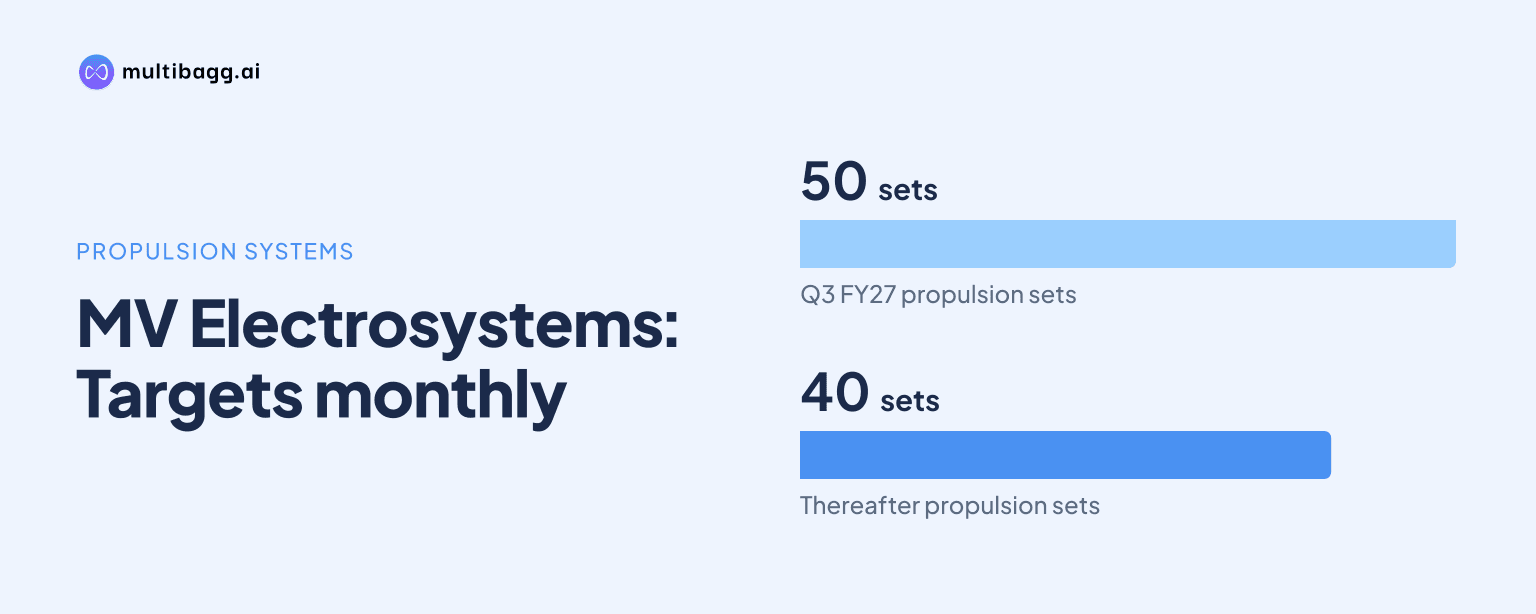
MV Electrosystems Ltd. targets about 40 3-Phase Propulsion Equipment sets a month after Q3FY27, against 557 executable systems valued at Rs 975.6 crore on September 30, 2026. It plans to deliver about 50 sets by Q3FY27 and execute the balance in FY28.
Know MV Electrosystems inside out
Results, valuation, peers and who's buying, in one view.
What is MV Electrosystems’ executable propulsion order book?
MV Electrosystems reported 557 executable 3-Phase Propulsion Equipment orders worth Rs 975.6 crore as of September 30, 2026. The total consists of Rs 907.9 crore of equipment supply value and Rs 67.7 crore of annual maintenance contract (AMC) value. The company states that this total includes a three-year AMC and excludes goods and services tax.
The executable propulsion category is substantially larger than the Rs 94.7 crore of developmental orders across eight units. Those developmental orders comprise six MEMU Propulsion Equipment units worth Rs 91.2 crore, one 3-Phase Propulsion System with Composite Converter worth Rs 2.7 crore, and one 2 × 500 kVA Hotel Load Converter worth Rs 0.8 crore. Cable management systems and control panels add other orders in hand of about Rs 20.0 crore.
The delivery plan applies specifically to the 557 executable propulsion systems rather than to the eight developmental units. The presentation separately classifies the developmental orders as new applications, while identifying the executable order book as the commercial 3-Phase Propulsion Equipment pipeline. This classification separates the Rs 975.6 crore planned execution pool from newer product applications.
How will MV Electrosystems phase propulsion deliveries?
MV Electrosystems is targeting delivery of about 50 propulsion sets by Q3FY27, followed by a planned run-rate of about 40 sets a month. Q3FY27 is the third quarter in the company’s FY27 fiscal-year labelling. Management says the remaining executable order book is targeted for execution in FY28, without disclosing a monthly delivery schedule for each FY28 quarter.
MV Electrosystems manufactured, billed and dispatched seven propulsion systems in September 2026. In the second quarter of FY27 (Q2FY27), net revenue from operations was Rs 19.0 crore, compared with Rs 12.8 crore in Q1FY27 and Rs 12.5 crore in Q2FY26. The presentation does not provide revenue by propulsion systems, cable-management products or other product lines.
The planned increase from seven systems dispatched in September 2026 to about 40 sets a month is a management target rather than a reported production result. Management said it had built manufacturing manpower during FY26 before propulsion production, but lower volumes led to under-absorption of fixed costs. Earnings before interest, tax, depreciation and amortisation were a loss of Rs 6.2 crore in Q2FY27, against a profit of Rs 3.5 crore in Q2FY26.
Got a follow-up? Ask IRIS
What inventory and sourcing support the delivery plan?
MV Electrosystems said it held material inventory equivalent to about 40 propulsion sets as of September 30, 2026. That disclosed inventory coverage matches one month of the planned 40-set monthly run-rate, although the presentation does not disclose how much is finished goods, work in progress or component inventory. Balance-sheet inventories stood at Rs 71.3 crore in September 2026, up from Rs 67.5 crore in March 2026.
MV Electrosystems has ordered long-lead items including insulated-gate bipolar transistors, gate drivers, capacitors, heat sinks, power cables and connectors. It says remaining materials are largely off the shelf or available within 30 to 45 days. The presentation does not state supplier quantities, component delivery dates or the value of inventory assigned solely to propulsion systems.
Material cost was a stated factor in H1FY27, when management said part of the inventory used had been procured during the development phase. Cost of goods sold rose to Rs 27.7 crore in H1FY27 from Rs 15.1 crore in H1FY26, while gross profit declined to Rs 4.1 crore from Rs 10.8 crore. The figures show that the early execution period carried a different cost mix from the prior-year half.
What operating capability supports MV Electrosystems’ propulsion programme?
MV Electrosystems says its indigenously developed insulated-gate bipolar transistor-based 3-Phase Propulsion Equipment completed 50,000 kilometres of field trials and was cleared by Chittaranjan Locomotive Works for commercial supply. The company says commercial delivery commenced in 2025–26, and it identifies 557 systems as the executable order book for this platform.
MV Electrosystems operates two manufacturing and assembly facilities in Palwal, Haryana, and has a 45-member in-house research and development team. Its new research and development centre was partially operational in Q2FY27. The presentation does not disclose installed monthly production capacity, capacity utilisation or output per facility against the planned 40-set monthly run-rate.
The company’s product-development plan includes expanding the propulsion platform into MEMU and EMU applications. In 2026–27, it participated for the first time in a Modern Coach Factory, Raebareli tender for EMU propulsion, according to the presentation. The Rs 91.2 crore MEMU developmental order provides a disclosed example of this move into adjacent railway traction applications.
What financial indicators accompany the planned ramp-up?
MV Electrosystems reported H1FY27 net revenue from operations of Rs 31.7 crore, compared with Rs 25.9 crore in H1FY26. Reported profit after tax was a loss of Rs 12.1 crore in H1FY27, versus a loss of Rs 2.9 crore a year earlier. Management linked the period’s operating pressures to low production absorption and higher material cost from development-phase inventory.
The balance sheet showed inventories of Rs 71.3 crore at September 2026, while current assets were Rs 338.1 crore and current liabilities were Rs 58.6 crore. At March 2026, the respective figures were Rs 67.5 crore, Rs 98.3 crore and Rs 67.0 crore. The presentation does not identify how these balance-sheet movements are allocated between propulsion execution, developmental products and the company’s other railway businesses.
Conclusion
The disclosed execution case rests on converting 557 executable 3-Phase Propulsion Equipment systems, valued at Rs 975.6 crore including Rs 67.7 crore of AMC value, into deliveries. The order book is distinct from Rs 94.7 crore of developmental orders and about Rs 20.0 crore of cable-management and control-panel orders, making propulsion execution the largest identified order category.
The next milestones are management’s target of about 50 propulsion-set deliveries by Q3FY27 and a planned run-rate of about 40 sets a month thereafter, with the balance targeted for FY28. Investors can also watch the 30-to-45-day availability of remaining materials and whether higher production volumes reduce the fixed-cost under-absorption and material-cost effects reported in H1FY27.