










Saraswati Saree Depot cash cycle falls to 53 days in Q2 FY27
Key highlights
- Saraswati Saree Depot’s cash conversion cycle declined to 53 days in Q2 FY27 from 64 days in FY26.
- Saraswati Saree Depot’s inventories increased 50.4% to Rs 181.501 crore at Sep 27.
- Saraswati Saree Depot’s trade payables rose 103.0% to Rs 188.548 crore at Sep 27.
- Saraswati Saree Depot reported Rs 0 short-term borrowings and a 1.9-times current ratio in Q2 FY27.
powered by IRIS
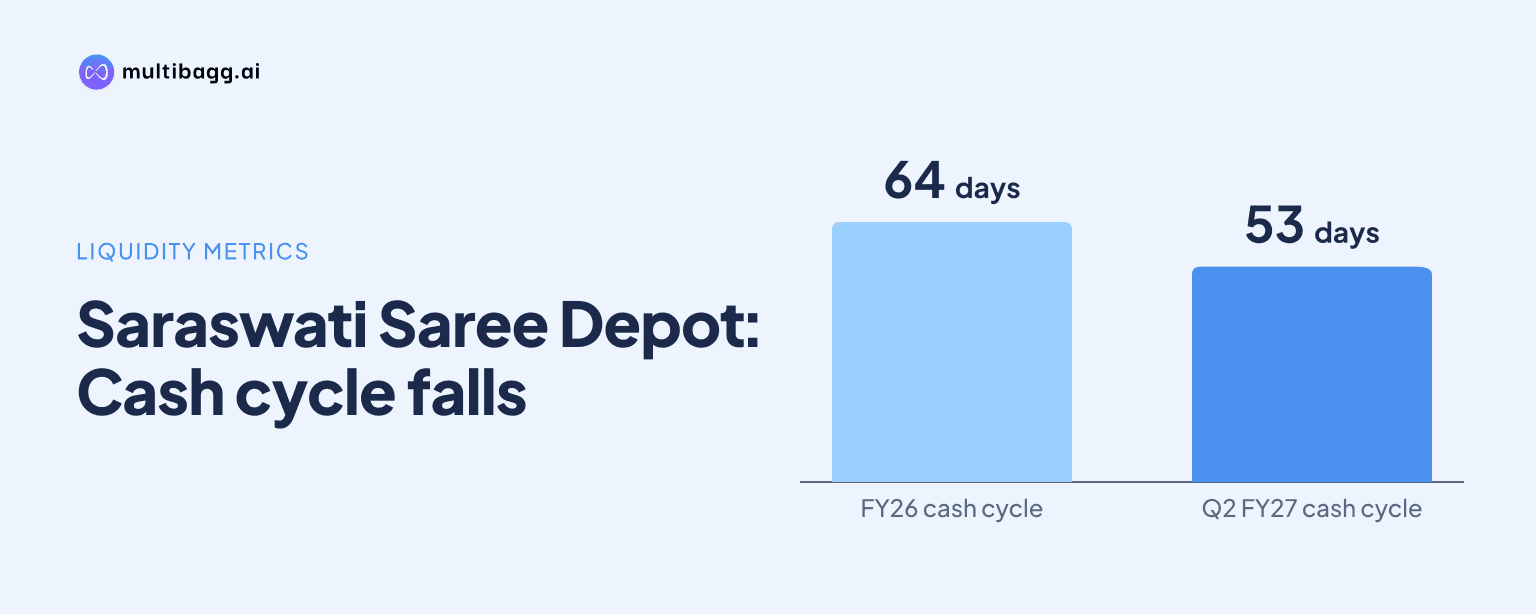
Saraswati Saree Depot Limited reduced its cash conversion cycle to 53 days in Q2 FY27 from 64 days in FY26, as payable days rose to 136 from 60 and outweighed higher inventory and receivable days. Trade payables increased to Rs 188.548 crore, compared with Rs 92.861 crore at Mar 26.
Know Saraswati Saree Depot inside out
Results, valuation, peers and who's buying, in one view.
Why did Saraswati Saree Depot’s cash cycle fall to 53 days?
Saraswati Saree Depot’s cash conversion cycle fell by 11 days because the extension in supplier-payment days was greater than the rise in inventory and receivable days. Its stated calculation, inventory days plus receivable days minus payable days, was 131 plus 58 minus 136 in Q2 FY27, compared with 78 plus 46 minus 60 in FY26.
The presentation calculates the Q2 FY27 measures using closing balances and quarterly flows annualised by multiplying them by four. This means the 53-day measure is based on an annualised quarterly run rate rather than a full-year flow period. Inventory days rose by 53 days and receivable days by 12 days, but payable days rose by 76 days.
Mechanically, Saraswati Saree Depot held stock for longer and took longer to collect customer dues, while it also took substantially longer to pay suppliers. Management described the resulting 53-day cash conversion cycle as working capital released during the period. The cited pages do not include a cash-flow statement to reconcile that description with cash movements.
How much did Saraswati Saree Depot’s inventory and receivables rise?
Saraswati Saree Depot’s inventories increased 50.4% to Rs 181.501 crore as on Sep 27 from Rs 120.691 crore at Mar 26. The Rs 60.810 crore increase coincided with inventory days rising to 131 from 78. The company defines inventory days as closing inventory divided by procurement cost, multiplied by 365.
Trade receivables increased 15.7% to Rs 91.903 crore from Rs 79.421 crore over the same balance-sheet dates. The Rs 12.482 crore increase was lower than the inventory build in both absolute and percentage terms, but receivable days still rose to 58 from 46. Saraswati Saree Depot calculates this measure as closing trade receivables divided by revenue, multiplied by 365.
The higher closing balances came as H1 FY27 revenue from operations declined 17.6% to Rs 290.977 crore from Rs 353.162 crore in H1 FY26. Total procurement cost declined 17.4% to Rs 258.354 crore from Rs 312.704 crore. Lower reported revenue and procurement costs, alongside larger closing balances, contributed to the higher inventory and receivable day counts.
Got a follow-up? Ask IRIS
How did supplier credit support Saraswati Saree Depot’s working-capital build?
Saraswati Saree Depot’s trade payables increased 103.0% to Rs 188.548 crore as on Sep 27 from Rs 92.861 crore at Mar 26. The Rs 95.687 crore increase exceeded the combined Rs 73.292 crore rise in inventories and trade receivables. In balance-sheet terms, that relationship indicates that additional supplier credit covered the disclosed build in those two working-capital balances.
Payable days increased to 136 in Q2 FY27 from 60 in FY26, a 76-day movement that exceeded the 53-day increase in inventory days and the 12-day increase in receivable days. Saraswati Saree Depot calculates payable days as closing trade payables divided by procurement cost, multiplied by 365. The longer payment period therefore directly reduces the stated cash conversion cycle.
Current liabilities rose 99.0% to Rs 204.798 crore from Rs 102.910 crore, with trade payables accounting for most of the increase. Provisions and other liabilities also increased to Rs 16.250 crore from Rs 10.050 crore. Short-term borrowings were Rs 0 at both Sep 27 and Mar 26, so the balance sheet records no increase in short-term borrowings alongside the working-capital expansion.
What happened to Saraswati Saree Depot’s liquidity and debt position?
Saraswati Saree Depot reported Rs 0 in short-term borrowings at Sep 27 and Mar 26, while H1 FY27 finance costs declined to Rs 28 lakh from Rs 54.3 lakh in H1 FY26. Management said short-term borrowings had been fully repaid during the year. The balance sheet also recorded shareholders’ funds of Rs 196.343 crore, versus Rs 194.661 crore at Mar 26.
Current assets rose 37.0% to Rs 387.620 crore from Rs 282.920 crore, but current liabilities increased faster, by 99.0% to Rs 204.798 crore. The current ratio consequently declined to 1.9 times from 2.8 times, according to the presentation. Current assets exceeded current liabilities by Rs 182.822 crore at Sep 27.
Cash and bank balances were Rs 100.550 crore at Sep 27, compared with Rs 69.950 crore at Mar 26. Separately, the financial-position slide reported cash and cash equivalents of Rs 88.655 crore, up 26.8% year on year, and said net cash was 45% of shareholders’ funds. The supplied pages present these as separate cash measures and do not reconcile the difference.
Conclusion
Saraswati Saree Depot’s 53-day Q2 FY27 cash cycle reflects a larger increase in supplier credit than in inventories and receivables, not a reduction in the underlying inventory or collection periods. Inventory days rose from 78 to 131, receivable days increased from 46 to 58, and payable days increased from 60 to 136. Trade payables rose Rs 95.687 crore, exceeding the Rs 73.292 crore combined increase in inventories and receivables.
The next point to watch is whether the 136 payable days and Rs 188.548 crore trade-payables balance persist in later reporting periods, particularly because Q2 FY27 working-capital days use annualised quarterly flows. The presentation gives no target for inventory, receivable or payable days. It does disclose Rs 0 short-term borrowings, a 1.9-times current ratio and Rs 100.550 crore in cash and bank balances at Sep 27.