










Saraswati Saree Depot gives no H1 retail revenue split in presentation
Key highlights
- Saraswati Saree Depot discloses no H1 retail revenue or 1.25% retail-revenue share in the supplied presentation.
- Saraswati Saree Depot operates two Maharashtra stores spanning more than 185,000 square feet.
- Saraswati Saree Depot says its Kolhapur flagship contributes close to 89% of combined store sales.
- Saraswati Saree Depot reported Q2 FY27 revenue of Rs 143.387 crore, down 31.2% year on year.
powered by IRIS
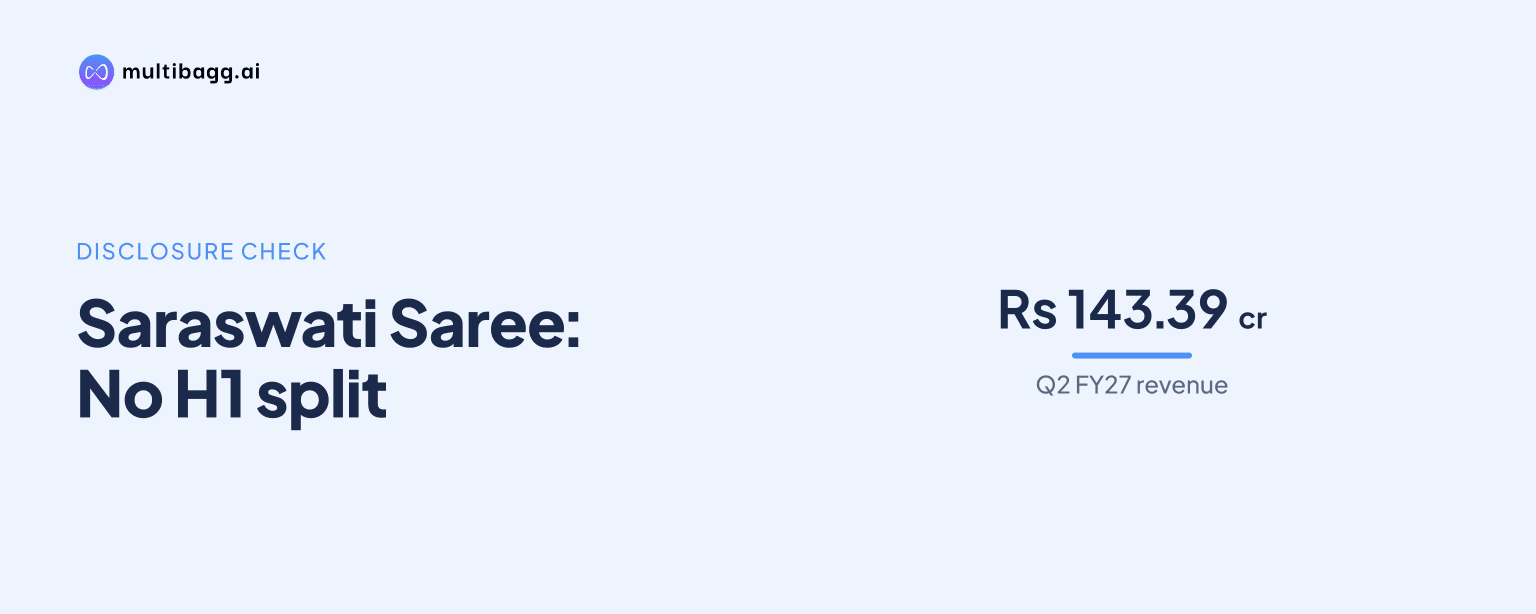
Saraswati Saree Depot Limited does not disclose H1 retail revenue or a 1.25% retail-revenue share in the supplied presentation, although it confirms that its first exclusive outlet marks entry into direct-to-consumer retail and says the Kolhapur flagship contributes close to 89% of combined sales from its two Maharashtra stores.
Know Saraswati Saree Depot inside out
Results, valuation, peers and who's buying, in one view.
Does Saraswati Saree Depot report a 1.25% H1 retail-revenue contribution?
Saraswati Saree Depot does not report H1 retail revenue, a 1.25% retail-revenue contribution, or H1 company revenue in the supplied pages. The presentation says only that the first exclusive retail outlet marks its entry into direct-to-consumer retail alongside the core wholesale business.
That means the stated 1.25% figure cannot be verified or independently calculated from this extract. The supplied financial disclosure covers Q2 FY27, the quarter ended September 30, 2026, when Saraswati Saree Depot reported revenue from operations of Rs 143.387 crore.
The Q2 FY27 result was 31.2% below Rs 208.4 crore in Q2 FY26, but the presentation gives no split between wholesale sales and direct-to-consumer sales. It also does not disclose the outlet’s location, opening date, selling area, customer traffic, profitability or inclusion within the two-store sales base.
How large is Saraswati Saree Depot’s store network?
Saraswati Saree Depot operates two stores in Maharashtra, its inaugural flagship at Uchgaon, Kolhapur, and a second store at Ulhasnagar. The two locations collectively cover more than 185,000 square feet and carry the full range of the company’s products.
The company describes its stores as destination-scale facilities with a catalogue of more than 300,000 stock-keeping units, or SKUs. The disclosed assortment includes sarees, kurtis, dress materials, blouse pieces, shirt and pant pieces, lehengas, bottoms and chunaris.
The sales concentration is high within that two-store network: the Kolhapur flagship accounts for close to 89% of total combined sales. Saraswati Saree Depot does not disclose the measurement period for that percentage, Ulhasnagar’s standalone sales, or store-level revenue that could be matched to Q2 FY27.
How does Saraswati Saree Depot’s wholesale model work?
Saraswati Saree Depot’s stated wholesale model begins with its procurement team identifying weavers and suppliers across India’s weaving hubs and ordering samples made to its specifications. The team inspects and examines samples before placing orders with selected weavers or suppliers.
Goods are packaged and dispatched from supplier units to Saraswati Saree Depot’s stores, where they are checked for quality defects on arrival. Product photoshoots are conducted on a case-to-case basis, connecting supplier selection and receipt with the catalogue of more than 300,000 SKUs.
The final steps described in the presentation are primarily business-to-business: sales activity takes place at stores, products are dispatched to customers, and those customers, identified as retailers, sell to end users. The first exclusive outlet adds a direct-to-consumer route, but the presentation does not disclose a distinct fulfilment or inventory process for that outlet.
Got a follow-up? Ask IRIS
What does Saraswati Saree Depot disclose about direct-to-consumer retail?
Saraswati Saree Depot discloses that its first exclusive retail outlet marks entry into direct-to-consumer retail alongside the core wholesale business. The statement establishes the new channel’s existence but does not quantify its sales, margins, costs or contribution to company revenue.
The presentation therefore does not establish that wholesale remains dominant by revenue during H1, even though its operating workflow explicitly describes sales to retailer customers. A wholesale-versus-direct-to-consumer comparison would require channel revenue or a stated sales mix, neither of which appears in the supplied pages.
Company-level Q2 FY27 figures cannot fill that gap. Saraswati Saree Depot reported earnings before interest, tax, depreciation and amortisation of Rs 8.662 crore, with a 6.04% margin, and profit after tax of Rs 7.387 crore, with a 5.15% margin, without assigning either measure to wholesale or retail.
What role does the Surat purchase office have?
Saraswati Saree Depot acquired approximately 25,000 square feet in Surat in October 2024 and designated it as a purchase office close to suppliers. The company identifies the site as a key lever for reducing cost of goods sold, rather than as a third sales store or exclusive retail outlet.
The Surat facility serves a different disclosed role from the more than 185,000 square feet of selling space in Kolhapur and Ulhasnagar. The Maharashtra locations carry the full product range, while the Surat site is positioned to support purchasing activity near suppliers.
Saraswati Saree Depot reported a gross margin of 11.73% in Q2 FY27, up 57 basis points from Q2 FY26, where one basis point equals one-hundredth of a percentage point. The presentation does not attribute that increase to the Surat office or quantify any reduction in cost of goods sold since the October 2024 acquisition.
The company also reported cash and equivalents of Rs 88.655 crore in Q2 FY27, up 26.8% since FY26, with no borrowings, and a cash conversion cycle of 53 days, improved by 11 days. These are company-level measures and do not identify the working-capital needs of the wholesale business, the first retail outlet or the Surat purchase office.
Conclusion
Saraswati Saree Depot’s supplied presentation confirms a first move into direct-to-consumer retail but does not support a claim that the new business contributed 1.25% of H1 revenue. The disclosed operating base remains two Maharashtra stores spanning more than 185,000 square feet, with Kolhapur contributing close to 89% of their combined sales and the stated customer route centred on retailers selling to end users.
The next disclosure to watch is whether Saraswati Saree Depot provides channel-level sales, outlet economics or a direct-to-consumer share of revenue. Management has also identified the approximately 25,000-square-foot Surat purchase office, acquired in October 2024, as a lever to reduce cost of goods sold, but the presentation leaves unresolved whether it has delivered a measurable sourcing-cost or margin benefit.