










National Aluminium Company Limited advances Anugola smelter plan
Key highlights
- NALCO plans to add 0.5 MTPA of smelting capacity at Anugola, taking total capacity from 0.46 MTPA to about 1 MTPA.
- The reported ₹30,000 crore investment includes about ₹18,000 crore for the smelter and ₹12,000 crore for the proposed power plant.
- NALCO and NLC India plan a 50:50 joint venture for a 1,080 MW captive thermal power plant with four 270 MW units.
- NALCO has targeted commissioning of the Anugola expansion during 2030-31.
powered by IRIS
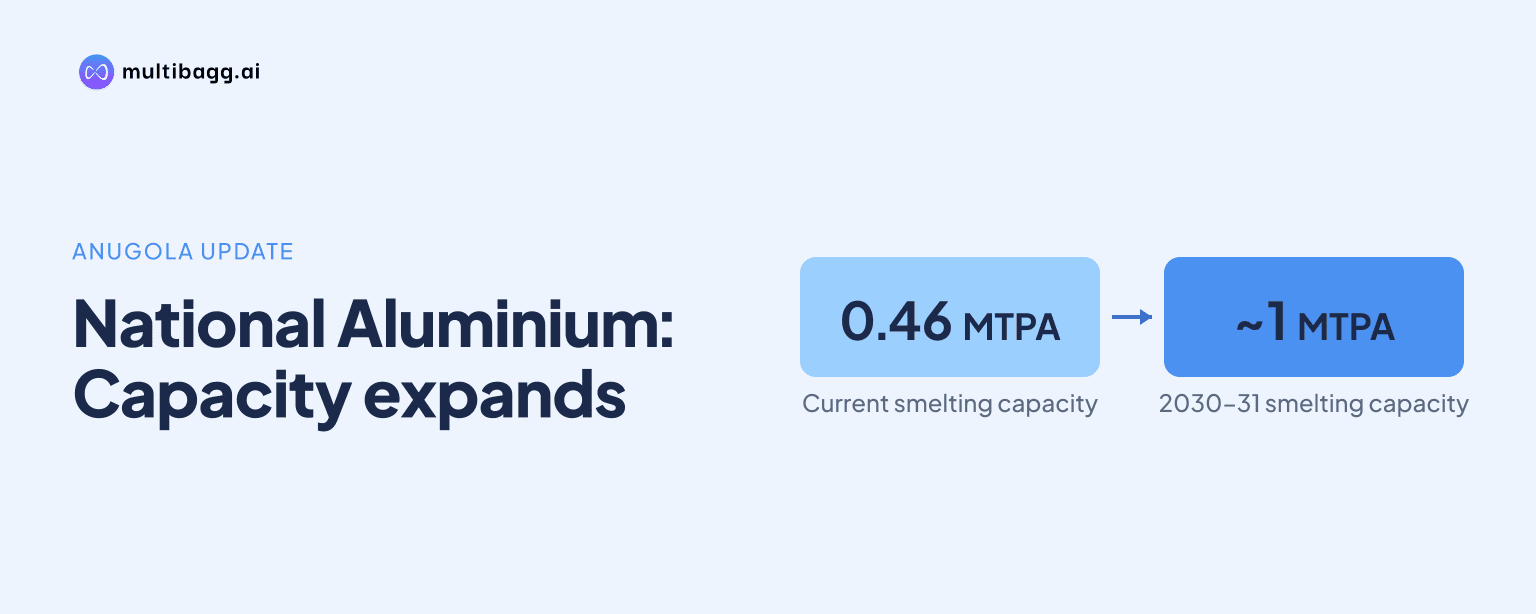
National Aluminium Company Limited is advancing a ₹30,000 crore brownfield smelter expansion at Anugola, Odisha, that would add 0.5 MTPA and lift its aluminium smelting capacity from 0.46 MTPA to about 1 MTPA, with commissioning targeted for 2030-31.
Know National Aluminium Company inside out
Results, valuation, peers and who's buying, in one view.
What is NALCO building at Anugola?
NALCO is developing a proposed 0.5 million tonnes per annum brownfield aluminium smelter expansion at Anugola in Odisha. The project is intended to nearly double the company’s existing smelting capacity of 0.46 MTPA, taking total capacity to approximately 1 MTPA once the additional line is operational.
The company has placed the investment for the broader smelter expansion project at around ₹30,000 crore. In an August statement to reporters, Chairman and Managing Director Brijendra Pratap Singh said NALCO planned total investments of ₹30,000 crore in a new smelter and coal power plant over five years, with roughly ₹18,000 crore budgeted for the proposed smelter and ₹12,000 crore for the power plant.
The project is a brownfield expansion, meaning it is planned alongside NALCO’s existing operations rather than at an entirely new industrial location. This approach connects the new capacity with an established aluminium production base, but land acquisition and rehabilitation requirements remain important parts of the project’s preparation.
How is the Anugola project progressing?
NALCO has received key statutory approvals and has started work on the project’s enabling requirements, including land-related processes. A meeting of the Rehabilitation and Peripheral Development Advisory Committee was recently held to address land acquisition, compensation and rehabilitation matters connected with the proposed expansion.
The committee process matters because the project cannot move through construction planning without progress on land availability and the associated rehabilitation framework. NALCO has said it is holding discussions with the Odisha state government, while its chairman has indicated that land was not yet visible at the time of those discussions.
The company has also described groundwork for the proposed smelter as progressing steadily. Separately, NALCO said its fifth-stream alumina refinery expansion was at an advanced stage of commissioning, placing the smelter proposal alongside a broader effort to strengthen its presence across the aluminium value chain.
Got a follow-up? Ask IRIS
How will NALCO meet the new smelter’s power needs?
NALCO plans to support the new smelter with a 1,080 MW captive thermal power plant in a 50:50 joint venture with NLC India Limited. The proposed plant would have four units of 270 MW each and is designed to address most of the additional 1,100 MW power requirement cited for the expansion.
Aluminium smelting is energy-intensive, so captive generation is central to the economics and operating reliability of a new smelter. The proposed power plant is therefore part of the project structure, rather than a separate supporting investment with no direct link to metal production.
NALCO also plans to integrate 200 MW to 250 MW of renewable energy into the project’s power ecosystem. The available information does not specify the renewable technology, project locations or commissioning schedule, but the planned renewable capacity would sit alongside conventional captive generation.
What does the EGA technology agreement mean for NALCO?
NALCO has licensed Emirates Global Aluminium’s DX+ Ultra aluminium-smelting technology for the proposed Anugola expansion. The agreement was signed in Dubai on 7 September 2026 and covers licence rights, know-how, designs, technical information and support for implementation.
EGA was selected through a bidding process to provide the technology for reduction cells covering 0.5 MTPA of capacity. EGA will also provide experts to support project development and train NALCO employees to operate the EGA-designed reduction cells.
The technology agreement gives the project an identified process technology provider before the proposed commissioning period of 2030-31. NALCO has said the arrangement is intended to support energy-efficient production and optimise capital and operating costs, although the company has not disclosed financial terms of the licence or project-level operating-cost estimates.
For investors and the wider aluminium industry, the expansion outlines a significant addition to domestic primary aluminium capacity. Its execution will depend on the stated land, rehabilitation, power-plant and construction milestones being completed ahead of the targeted start-up period.
Conclusion
NALCO’s Anugola proposal combines a 0.5 MTPA brownfield smelter, a planned 1,080 MW captive thermal plant and up to 250 MW of renewable integration. The EGA technology partnership and statutory progress provide defined building blocks for the project, while land acquisition and rehabilitation remain active implementation matters.
The next developments to watch are progress in land availability, the formation and execution plan of the NLC India joint venture, and updates on the target commissioning window of 2030-31. NALCO has also linked the expansion strategy with the advanced commissioning stage of its fifth-stream alumina refinery project.