










NALCO Q2 profit rises 28% with domestic sales growth
Key highlights
- NALCO’s Q2 / 26-27 profit after tax rose 28.1% year on year to Rs 1,835 crore.
- Revenue from operations increased 26.3% year on year to Rs 5,419 crore in Q2 / 26-27.
- Domestic metal sales rose 6.3% year on year to 119 thousand tonnes.
- Coal production increased 16.37% year on year to 1,095 thousand tonnes.
powered by IRIS
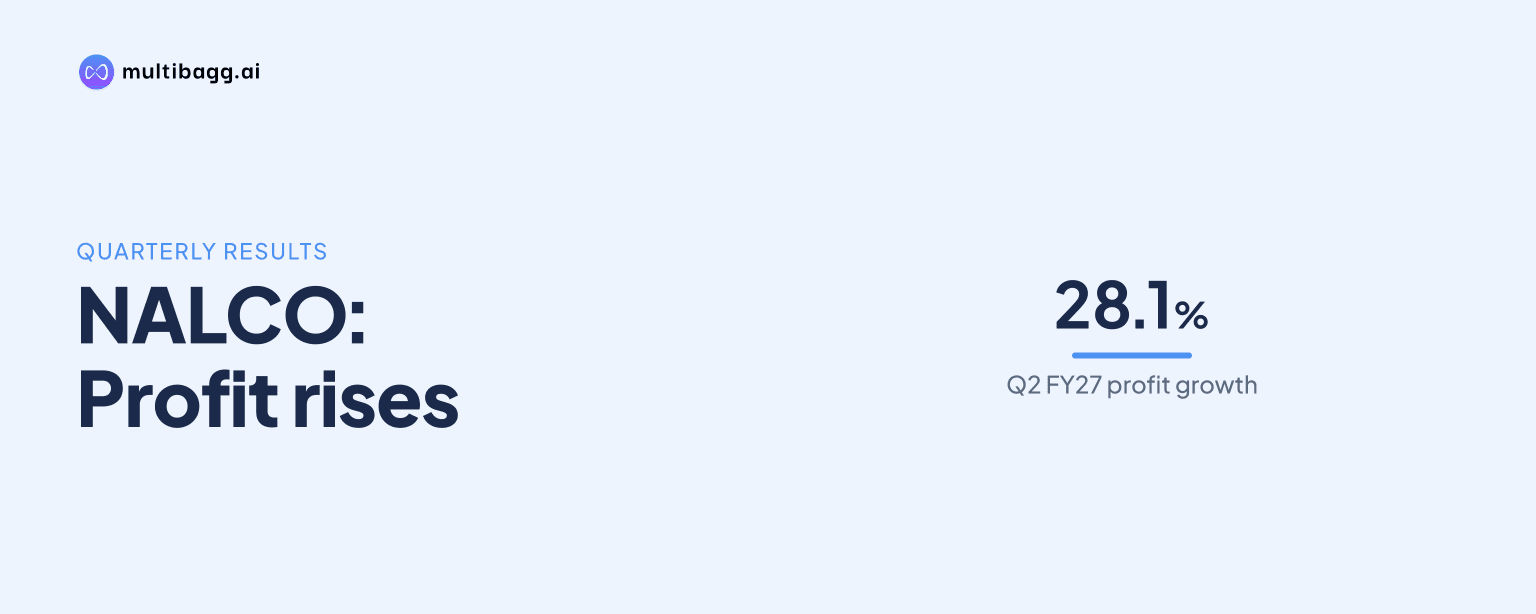
NALCO reported profit after tax of Rs 1,835 crore in Q2 / 26-27, up 28.1% from Rs 1,433 crore in Q2 / 25-26, while revenue from operations increased 26.3% and domestic metal sales rose 6.3%. Coal production also grew 16.37%, although bauxite, alumina hydrate and thermal-power output declined year on year.
Know National Aluminium Company inside out
Results, valuation, peers and who's buying, in one view.
How much did NALCO’s Q2 profit increase?
NALCO’s profit after tax increased 28.1% year on year to Rs 1,835 crore in Q2 / 26-27 from Rs 1,433 crore in Q2 / 25-26. Profit before tax rose 30.4% to Rs 2,471 crore from Rs 1,895 crore, while depreciation increased 2.3% to Rs 178 crore and finance cost rose 25% to Rs 10 crore.
Revenue from operations was Rs 5,419 crore, compared with Rs 4,292 crore a year earlier and Rs 5,302 crore in Q1 / 26-27. Net sales accounted for Rs 5,380 crore in Q2 / 26-27, up from Rs 4,262 crore in Q2 / 25-26, while other operating income was Rs 39 crore versus Rs 30 crore.
What changed between NALCO’s Q2 and Q1 financial results?
NALCO’s Q2 / 26-27 revenue from operations rose Rs 117 crore from Rs 5,302 crore in Q1 / 26-27, but profit after tax declined Rs 167 crore from Rs 2,002 crore. Total income increased Rs 192 crore sequentially to Rs 5,667 crore, including other non-operating income of Rs 248 crore, compared with Rs 173 crore in Q1 / 26-27.
Operating expenses rose to Rs 3,008 crore in Q2 / 26-27 from Rs 2,594 crore in Q1 / 26-27, an increase of Rs 414 crore. As a result, EBIDTA, the presentation’s earnings measure excluding exceptional income, declined to Rs 2,659 crore from Rs 2,881 crore sequentially, although it remained 28.0% above Rs 2,077 crore in Q2 / 25-26.
Did NALCO sell more aluminium and alumina domestically?
NALCO sold 119 thousand tonnes of metal domestically in Q2 / 26-27, up 6.3% from 112 thousand tonnes in Q2 / 25-26 and also above 112 thousand tonnes in Q1 / 26-27. Metal exports were 2 thousand tonnes, compared with 1 thousand tonnes in the preceding quarter; the Q2 / 25-26 comparison is shown as nil in the presentation.
Domestic alumina sales rose 12.9% year on year to 35 thousand tonnes from 31 thousand tonnes, but declined from 43 thousand tonnes in Q1 / 26-27. Alumina export sales were unchanged sequentially at 305 thousand tonnes but fell 16.4% from 365 thousand tonnes a year earlier, a reduction of 60 thousand tonnes that exceeded the 4 thousand-tonne increase in domestic alumina sales.
Got a follow-up? Ask IRIS
Which NALCO production lines increased and declined?
NALCO produced 120 thousand tonnes of metal in Q2 / 26-27, 0.8% above 119 thousand tonnes in Q2 / 25-26 and 4 thousand tonnes above Q1 / 26-27. Coal output rose 16.37% to 1,095 thousand tonnes from 941 thousand tonnes a year earlier, and was also higher than 1,009 thousand tonnes in the prior quarter.
Bauxite production declined 8.9% year on year to 1,622 thousand tonnes from 1,780 thousand tonnes, and alumina hydrate output fell 3.5% to 556 thousand tonnes from 576 thousand tonnes. Thermal-power generation was 1,634 million units, down 6.3% from 1,743 million units; bauxite, alumina hydrate and power output were each also below Q1 / 26-27 levels of 1,829 thousand tonnes, 578 thousand tonnes and 1,725 million units, respectively.
What market conditions does NALCO identify for the next quarter?
NALCO expects London Metal Exchange aluminium prices to average US$2,950 to US$3,150 per tonne in Q4 2026. The monthly price was US$3,670 in May 2026 and US$3,061 in October 2026, while the company identifies global inventories of 0.23 million tonnes, near-term physical tightness and constraints on Russian-origin inventory as supportive factors.
NALCO lists stronger Chinese production and rising semi-fabricated and alloy exports from China and Indonesia among factors that could cap prices. Its listed downside risks include faster Gulf restarts and stronger-than-expected United States Federal Reserve tightening, while upside risks include renewed Hormuz disruption, Chinese capacity enforcement and a weaker United States dollar.
Conclusion
NALCO’s Q2 / 26-27 result combined a 28.1% increase in profit after tax to Rs 1,835 crore with 26.3% growth in revenue from operations to Rs 5,419 crore. Domestic metal sales reached 119 thousand tonnes and coal output reached 1,095 thousand tonnes, but bauxite output fell 158 thousand tonnes year on year and thermal-power generation fell 109 million units.
The next disclosed marker is NALCO’s Q4 2026 London Metal Exchange aluminium-price outlook of US$2,950 to US$3,150 per tonne. The company identifies inventories of 0.23 million tonnes, Middle East disruption, Chinese and Indonesian exports, Gulf capacity restarts and United States monetary conditions as matters to watch next.