










NALCO sees $2,950-$3,150 Q4 aluminium average on low stocks
Key highlights
- NALCO expects LME aluminium to average $2,950-$3,150 a tonne in Q4 2026.
- NALCO reports historically low global aluminium inventories of 0.23 million tonnes.
- Global aluminium consumption of 19.22 exceeded production of 18.64 in Q2 / 26-27 in NALCO's cited CRU data.
- NALCO's domestic metal sales increased 6.3% year on year to 119,000 tonnes in Q2 / 26-27.
powered by IRIS
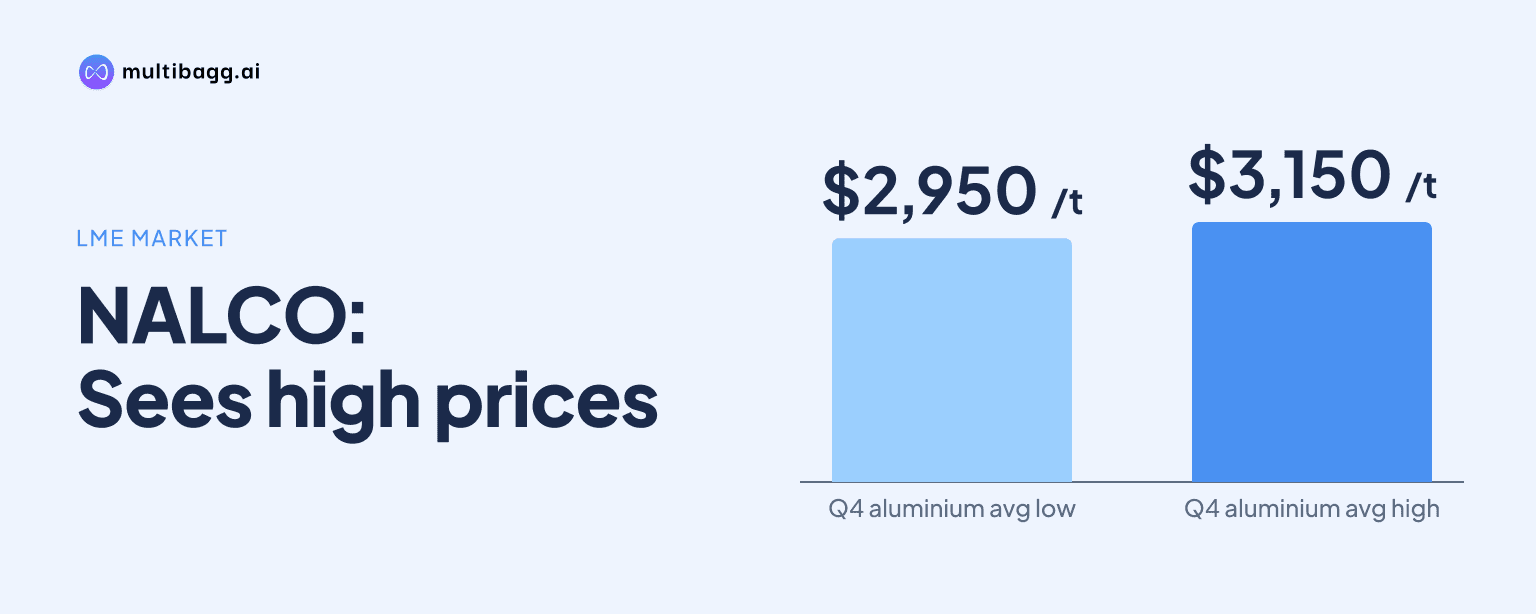
NALCO expects London Metal Exchange (LME) aluminium to average $2,950-$3,150 a tonne in Q4 2026, supported by global inventories at a historically low 0.23 million tonnes and an expected market deficit during the quarter. The view follows an LME monthly price of $3,061 a tonne in October 2026, down from $3,670 in May 2026.
Know National Aluminium Company inside out
Results, valuation, peers and who's buying, in one view.
What is NALCO's Q4 2026 aluminium price outlook?
NALCO expects LME aluminium to average between $2,950 and $3,150 a tonne in Q4 2026. The company bases this outlook on its expectation that the global aluminium market will remain in deficit during Q4 2026 before gradually moving towards a more balanced position in 2027. The stated range spans $200 a tonne and is an outlook rather than a disclosed selling-price target.
The forecast follows sizeable movement in monthly LME prices during 2026. The price rose from $3,148 a tonne in January to $3,670 in May, then fell to $3,061 in October, a decline of $609 a tonne from May. October's level was $111 a tonne above the lower bound of NALCO's Q4 range and $89 a tonne below its upper bound.
Why does NALCO expect aluminium inventories to support prices?
NALCO identifies global inventories of 0.23 million tonnes as historically low and says steady LME stock drawdowns have supported prices throughout the period. It also points to near-term physical tightness and constraints around Russian-origin inventory. These factors underpin the company's Q4 2026 view because limited available metal can increase the effect of supply or logistics disruptions.
NALCO also cites resurfaced geopolitical tensions and possible disruption to Middle East aluminium production and logistics. It says disruption and recovery dynamics were initially supportive before easing. The company's upside-risk cases are renewed Hormuz disruption, Chinese capacity enforcement and a weaker United States dollar, each of which NALCO considers potentially supportive for aluminium prices.
What could push aluminium prices below NALCO's range?
NALCO says strong Chinese production and rising semi-fabricated and alloy exports from China and Indonesia could cap prices or create downside. That supply risk contrasts with the 0.23 million-tonne inventory position: low inventories can support prompt availability, while higher output and exports can add supply to the broader market. NALCO specifically lists faster Gulf restarts and a China-Indonesia export surge as downside risks.
NALCO also identifies macroeconomic conditions as a bearish influence. Its presentation cites a firmer United States dollar, elevated United States Treasury yields and a hawkish Federal Reserve stance, with further rate increases priced for December 2026. The company therefore attributes price direction to both physical aluminium conditions and broader risk sentiment and macro flows.
Got a follow-up? Ask IRIS
What do global aluminium and alumina balances show?
NALCO's cited CRU data show global aluminium consumption exceeded production in Q2 / 26-27 and is forecast to do so again in Q3' 2026-27 (F). In Q2 / 26-27, production was 18.64 and consumption was 19.22, compared with 18.74 and 18.84 respectively in Q2 / 25-26. The difference widened to 0.58 in Q2 / 26-27 from 0.10 a year earlier, consistent with NALCO's stated deficit-market expectation.
For Q3' 2026-27 (F), CRU forecasts production of 19.00 and consumption of 19.12, a difference of 0.12. That is narrower than the Q2 / 26-27 difference of 0.58 and aligns with NALCO's view of a gradual move towards balance in 2027. The global alumina figures point the other way: 2026 production is listed at 145.20 against consumption of 143.30, after 2025 production of 144.10 and consumption of 143.00.
How does Indian demand relate to NALCO's market outlook?
India's aluminium consumption was 3.05 against primary aluminium production of 2.19 in 2026-27 up to Sept'26, according to the industry data presented by NALCO. In FY 2025-26, consumption was 6.12 and production was 4.29, compared with 5.50 and 4.24 in FY 2024-25. The presentation specifies that consumption includes imports and scrap, while production covers primary aluminium.
Electrical applications account for 48% of Indian aluminium consumption in NALCO's sector breakdown, followed by transportation and automobiles at 15% and building and construction at 13%. NITI Aayog, as cited by NALCO, projects domestic aluminium demand growth of around 6-8% compound annual growth rate through 2030. The source attributes recent demand growth to power, transportation, packaging and consumer-durables sectors.
NALCO's domestic metal sales rose 6.3% year on year to 119,000 tonnes in Q2 / 26-27 from 112,000 tonnes in Q2 / 25-26, while export metal sales were 2,000 tonnes. Metal production was 120,000 tonnes, compared with 119,000 tonnes a year earlier. Revenue from operations increased 26.3% to Rs 5,419 crore in Q2 / 26-27, while profit after tax rose 28.1% to Rs 1,835 crore; NALCO does not isolate the contribution of aluminium prices to those changes.
Conclusion
NALCO's outlook combines a Q4 2026 LME aluminium range of $2,950-$3,150 a tonne with historically low global inventories of 0.23 million tonnes and an expected market deficit. Consumption exceeded production in the cited Q2 / 26-27 global aluminium data, while India's 3.05 consumption figure exceeded its 2.19 primary-production figure through Sept'26. Supply additions, exports and macro conditions remain the counterweights to these supportive factors.
The next indicators to watch are whether the Q3' 2026-27 (F) gap of 19.12 consumption against 19.00 production narrows further, and whether the stated Hormuz, Gulf restart, Chinese capacity and export risks materialise. NALCO also discloses pre-commissioning from June'26 at its 1 MTPA fifth-stream alumina refinery and pre-project work on the 0.5 MTPA Angul smelter expansion.