










Namo eWaste sets Q4 FY27 hydrometallurgy pilot target
Key highlights
- Namo eWaste discloses 32,000 MTPA of lithium-ion battery recycling and refurbishment capacity at Nashik.
- Namo eWaste targets Q4 FY27 operation of a 1-TPD Nashik hydrometallurgy pilot.
- The Nashik pilot is intended to process lithium, nickel, cobalt and manganese from battery black mass.
- Namo eWaste reports that about 80% of its e-waste is sourced directly from OEMs.
powered by IRIS
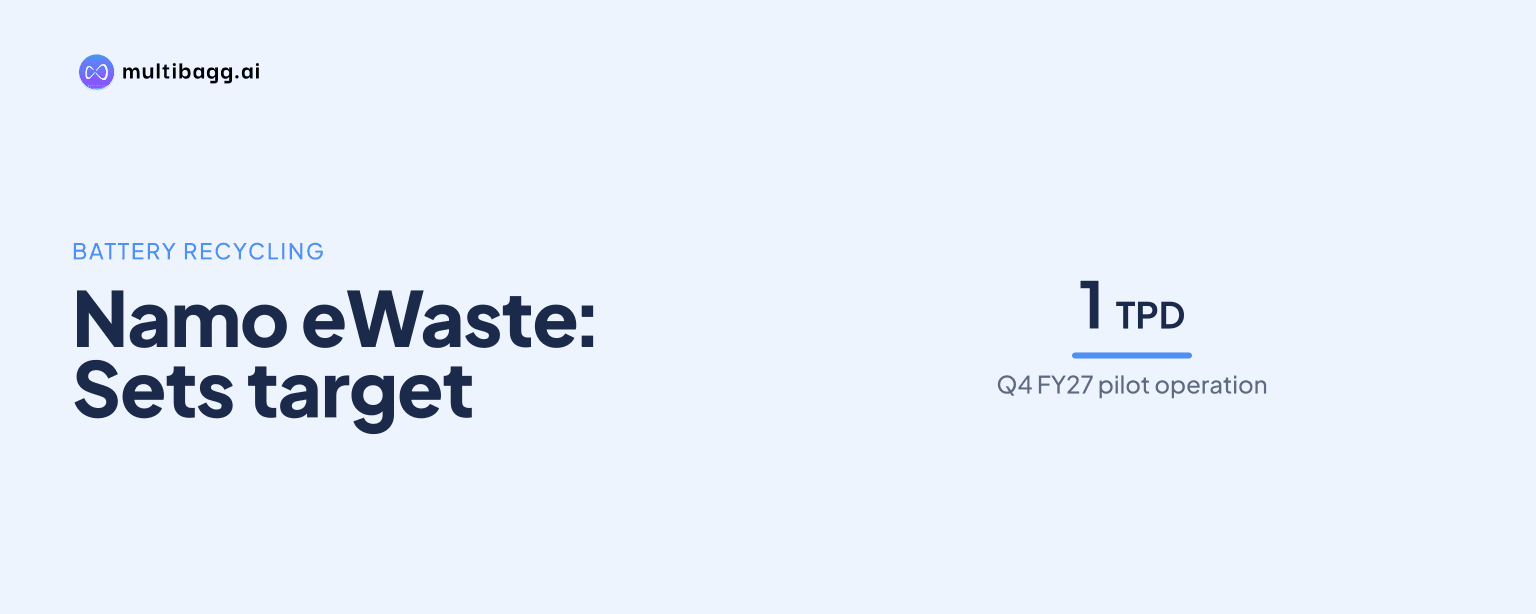
Namo eWaste Management Ltd. is targeting Q4 FY27 operation of a 1-tonne-per-day (TPD) hydrometallurgy pilot at Nashik, extending its 32,000-metric-tonnes-per-annum (MTPA) battery recycling facility into black-mass refining for lithium, nickel, cobalt and manganese. The presentation describes a pilot, not a commercial-scale refining capacity or recovery yield.
Know Namo eWaste Management inside out
Results, valuation, peers and who's buying, in one view.
What is Namo eWaste's battery recycling capacity?
Namo eWaste discloses 32,000 MTPA of battery-waste refurbishment and recycling capacity at its Nashik, Maharashtra facility. The site occupies 22,000 square feet and is described as a manufacturing unit for refurbishment, recycling and critical-metal recovery from lithium-ion battery waste.
The 32,000-MTPA battery figure is separate from the company's e-waste recycling facilities. Namo eWaste does not disclose current throughput, utilisation, black-mass output or recovered-metal volumes for the Nashik battery unit, so its operating scale cannot be measured from the presentation.
The battery process begins with safe collection and transportation of spent lithium-ion batteries, followed by manual dismantling. Namo eWaste separates reusable cells from dead cells: reusable cells are tested and refurbished for second-life applications, while dead cells move to discharge and controlled shredding.
How will hydrometallurgy change Namo eWaste's battery process?
Namo eWaste plans a 1-TPD hydrometallurgy pilot at Nashik to refine black mass and recover lithium, nickel, cobalt and manganese by Q4 FY27. The pilot adds a disclosed refining stage after the mechanical processing of battery material, rather than ending the process with black-mass extraction.
For dead cells, Namo eWaste describes discharge using saline solution before shredding in a controlled environment intended to avoid fire. It then separates copper, iron and aluminium from black mass, which is sent for further refining through hydrometallurgy and salt extraction.
The proposed refining outputs differ from the metals separated earlier in the process. Copper, iron and aluminium are identified at the black-mass extraction stage, while lithium, cobalt, nickel and manganese are the materials Namo eWaste identifies for hydrometallurgical processing.
The 1-TPD pilot is much smaller in stated scale than the 32,000-MTPA battery facility, and the presentation does not equate the two measures. Namo eWaste says the pilot is intended to enhance value addition and recovery efficiencies, but it does not provide recovery percentages, capital expenditure, feedstock volumes or a commercial hydrometallurgy capacity.
How does Namo eWaste's battery unit fit its facility network?
Namo eWaste's Nashik battery facility sits alongside three e-waste facilities in Palwal, Nashik and Hyderabad. The battery plant and the hydrometallurgy pilot are both located in Nashik, while the e-waste network is intended to provide regional processing across the National Capital Region, western India and Hyderabad.
Palwal has the largest disclosed e-waste site area at 172,330 square feet, compared with 87,187 square feet for the Nashik e-waste facility. Hyderabad is reported as a 2.5-acre site, and Namo eWaste says its old Faridabad facility will shift to Palwal.
Namo eWaste says capacity is not a constraint because higher utilisation and double-shift operations could expand processing at its facilities. However, it provides no utilisation percentage for Palwal, Nashik or Hyderabad, and therefore does not quantify available capacity headroom.
Got a follow-up? Ask IRIS
How does Namo eWaste secure recycling feedstock?
Namo eWaste reports that about 80% of its e-waste is sourced directly from original equipment manufacturers (OEMs), supported by 50 to 70 active OEM relationships and more than 26 collection centres. The company describes these arrangements as supporting material quality, traceability and planning for its e-waste operations.
The disclosed OEM contracts run for one to five years, with recycler selection occurring through tenders, auctions, requests for offer or service-based selection. Namo eWaste states that its processing locations in the National Capital Region, Nashik and Hyderabad support multi-location handling and lower logistics costs.
These procurement disclosures apply specifically to e-waste, not necessarily to lithium-ion batteries. Namo eWaste does not disclose what proportion of battery feedstock comes from OEMs, collection centres or other channels, so the supply position for the 32,000-MTPA battery facility cannot be quantified.
The e-waste process includes scheduled pickup, on-site data wiping or physical destruction, GPS-tracked transportation, dismantling, shredding and segregation. Battery recycling adds safe spent-battery collection, saline-solution discharge and black-mass processing, creating a distinct feedstock and process chain for the planned hydrometallurgy stage.
What should readers watch before Q4 FY27?
The principal disclosed milestone is whether the Nashik 1-TPD hydrometallurgy pilot becomes operational by Q4 FY27. Its start would place refining of lithium, nickel, cobalt and manganese within Namo eWaste's stated battery-recycling sequence after dismantling, discharge, shredding and black-mass extraction.
A separate operational development is Hyderabad's e-waste facility, which commenced partial commercial operations in late Q2FY27 and has 25,000 MTPA of stated capacity. This facility is distinct from the Nashik battery operation, but both projects represent additions to the company's decentralised processing network during FY27.
The presentation also identifies Palwal as upcoming with a commercial hydrometallurgy plant. Namo eWaste does not disclose a commissioning date, processing capacity, recovery yield or capital cost for that Palwal project, leaving its scale and timetable unresolved.
Conclusion
Namo eWaste is combining a 32,000-MTPA Nashik battery recycling facility with a planned 1-TPD hydrometallurgy pilot to move beyond mechanical black-mass extraction. Its disclosed process separates reusable cells for second-life applications and routes dead cells through discharge, shredding, metal separation and planned refining for lithium, nickel, cobalt and manganese.
The next event to watch is the Q4 FY27 operating target for the Nashik pilot. Readers should also monitor the ramp-up of Hyderabad after its late-Q2FY27 partial start and any later disclosure on the proposed Palwal commercial hydrometallurgy plant, particularly its capacity, schedule and recovery performance.