










Namo eWaste says formal recyclers handle only 20% of waste
Key highlights
- Namo eWaste says formal recyclers handle about 20% of India’s e-waste, while informal operators handle roughly 80%.
- Namo eWaste projects India’s e-waste recycling market will rise from Rs 13,300 crore in 2024 to Rs 25,400 crore by 2034.
- Namo eWaste says India’s e-waste collection rate is about 10% to 11%.
- Namo eWaste’s Nashik facility has 32,000 metric tonnes per annum of battery-recycling capacity, and its pilot hydrometallurgy plant is planned by Q4 FY27.
powered by IRIS
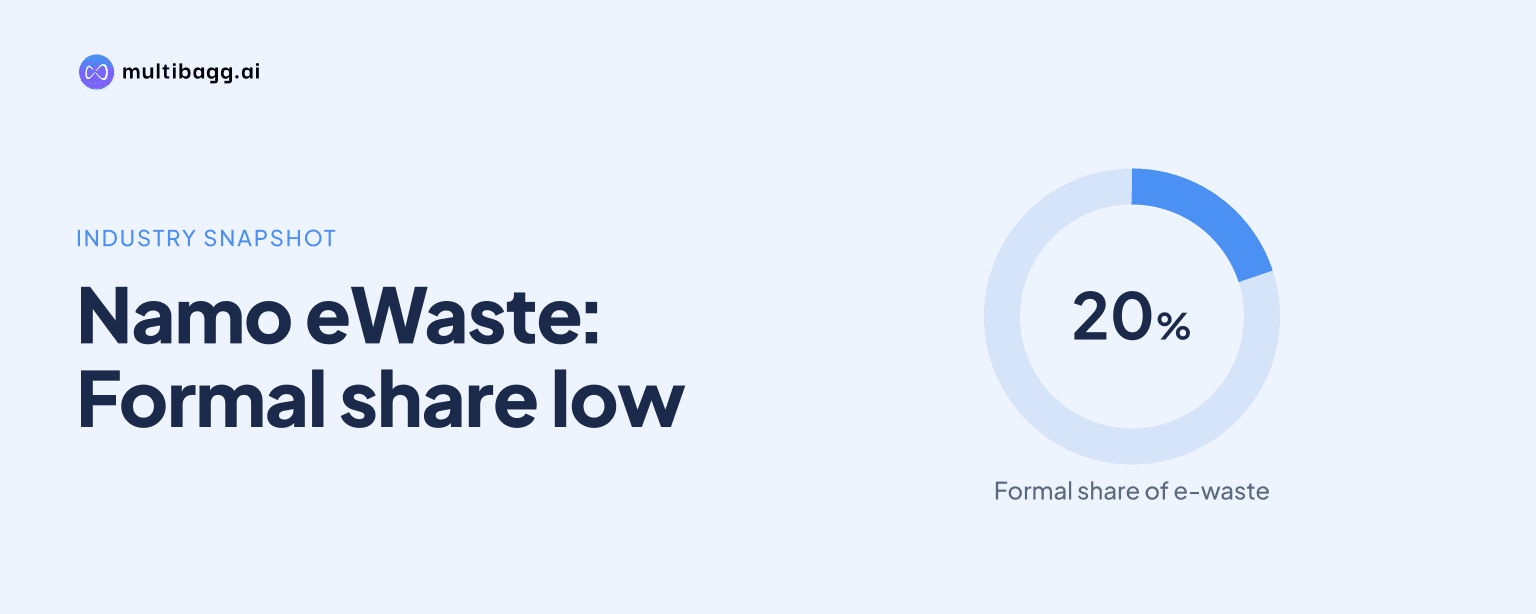
Namo eWaste says formal recyclers handle about 20% of India’s e-waste, while informal operators handle roughly 80%, and it projects the domestic recycling market will reach Rs 25,400 crore by 2034 from Rs 13,300 crore in 2024. The presentation identifies low collection rates and recovery technologies as opportunity mechanisms.
Know Namo eWaste Management inside out
Results, valuation, peers and who's buying, in one view.
Why does Namo eWaste see a formal recycling gap in India?
Namo eWaste sees the main gap in the split between formal and informal processing: formal recyclers contribute about 20% of e-waste handling, while informal operators handle roughly 80%. The presentation says formal recycling achieves recovery rates above 95%, while lower recovery in informal processing is associated with more than Rs 20,000 crore of annual metal loss.
India’s e-waste generation increased from about 3 million tonnes in 2020 to about 6.2 million tonnes in 2024, according to the presentation. Namo eWaste also describes India as the world’s fourth-largest e-waste generator and says the collection rate is only about 10% to 11%, with limited formal collection centres.
In Namo eWaste’s framing, the difference between the 20% formal share and the 10% to 11% collection rate makes collection infrastructure important alongside processing capacity. Its plan to expand a pan-India collection and reverse-logistics network is intended to improve raw-material sourcing for recycling operations.
How large is India’s e-waste recycling market?
Namo eWaste projects India’s e-waste recycling market will rise to Rs 25,400 crore by 2034 from Rs 13,300 crore in 2024, implying a compound annual growth rate, or CAGR, of about 6% to 7%. The Rs 12,100 crore increase is a market forecast in the presentation, not a company revenue forecast.
Namo eWaste identifies three routes through which recyclers can generate revenue: refurbishment and second-life use of products, material recovery from electrical and electronic equipment, and sale of Extended Producer Responsibility, or EPR, credits and compliance services to producers. The presentation says EPR-led formalisation is expected to accelerate sector growth.
The company’s way-forward plan includes expanding original equipment manufacturer, or OEM, and EPR partnerships to participate in this formalisation trend. It does not disclose a target market share, collection volume or revenue contribution from EPR credits in the supplied presentation.
What materials make e-waste recovery relevant?
Namo eWaste says electronic waste contains more than 60 valuable elements and comprises 37% glass, 33% metal and 30% plastic. Its stated metal mix is led by iron at 52%, followed by copper at 18% and aluminium at 12%, while zinc and lead each account for 3%.
The presentation cites recoverable precious-metal yields from specific waste streams. One tonne of mobile phones can yield 300 grams to 400 grams of gold and 3 kilograms to 4 kilograms of silver, while one tonne of printed circuit boards can yield 200 grams to 300 grams of gold and 1 kilogram to 2 kilograms of silver.
Namo eWaste also identifies lithium, cobalt and rare earth elements as materials available in e-waste. The mix of 30% plastic, 37% glass and 33% metal means equipment must be separated into several material streams, rather than treated as a single-metal input.
Got a follow-up? Ask IRIS
Why is battery recycling part of Namo eWaste’s opportunity?
Namo eWaste identifies lithium-ion battery recycling as a further recycling opportunity, with a projected Indian market size of Rs 31,150 crore by 2030. It says domestic lithium-ion demand is expected to exceed 260 gigawatt-hours, or GWh, by 2030, led by electric vehicles and energy-storage growth.
The presentation lists electric-vehicle powertrains, battery energy storage systems, telecom towers and consumer electronics as lithium-ion battery applications. It also cites Rs 1,500 crore of National Critical Mineral Mission incentives as support for battery-recycling infrastructure.
Namo eWaste says hydrometallurgy can enable 90%-95%+ recovery efficiencies for critical battery metals. It identifies lithium, nickel, cobalt, manganese, copper and graphite as materials associated with black mass, the intermediate material produced during battery processing.
Battery chemistry affects the mix available for recovery. Cathode material accounts for 65% of lithium cobalt oxide batteries, 41% of lithium ferro phosphate batteries and 52% of lithium nickel cobalt manganese batteries in the presentation, while copper sheets account for 6%, 9% and 8%, respectively.
How does Namo eWaste plan to address the opportunity?
Namo eWaste plans to commission a Hyderabad facility, expand collection and reverse logistics, ramp up lithium-ion battery recycling, and establish pilot and commercial hydrometallurgy capabilities. Management states a target to raise battery-recycling utilisation to 80% to 90%, with the intended effect of increasing operating leverage and revenue contribution.
At Nashik, Maharashtra, Namo eWaste has a 22,000-square-foot battery-waste refurbishing and recycling unit with 32,000 metric tonnes per annum of capacity. It is establishing a one-tonne-per-day pilot hydrometallurgy plant to refine black mass and recover lithium, nickel, cobalt and manganese, with operations planned by the fourth quarter of financial year 2027, or Q4 FY27.
Management also states a 30% to 40% revenue CAGR objective. The presentation links that target to commissioning Hyderabad, increasing battery-recycling utilisation, expanding the collection network, deploying hydrometallurgy and adding OEM and EPR partnerships.
Conclusion
Namo eWaste’s industry case combines a formal-sector share of about 20%, an estimated informal share of roughly 80%, and an e-waste recycling market projected to grow from Rs 13,300 crore in 2024 to Rs 25,400 crore by 2034. The company presents low collection rates, recoverable metals and EPR compliance as the mechanisms that could shift more waste into organised recycling channels.
The next disclosed items to watch are the Hyderabad commissioning, collection-network expansion, progress toward 80% to 90% battery-recycling utilisation and operation of the one-tonne-per-day Nashik hydrometallurgy pilot by Q4 FY27. Management’s stated 30% to 40% revenue CAGR target and planned OEM and EPR partnership expansion are further measures of execution against that plan.