










NAMO eWaste says OEMs supply about 80% of its feedstock
Key highlights
- NAMO eWaste says about 80% of its e-waste feedstock is sourced directly from OEMs.
- NAMO eWaste reports 50–70 active OEM relationships with contracts lasting one to five years.
- NAMO eWaste has more than 26 collection centers and e-waste capacity of 32,000 metric tonnes per annum at Palwal.
- NAMO eWaste says its one-tonne-per-day Nashik hydrometallurgy pilot plant is planned to be operational by Q4 FY27.
powered by IRIS
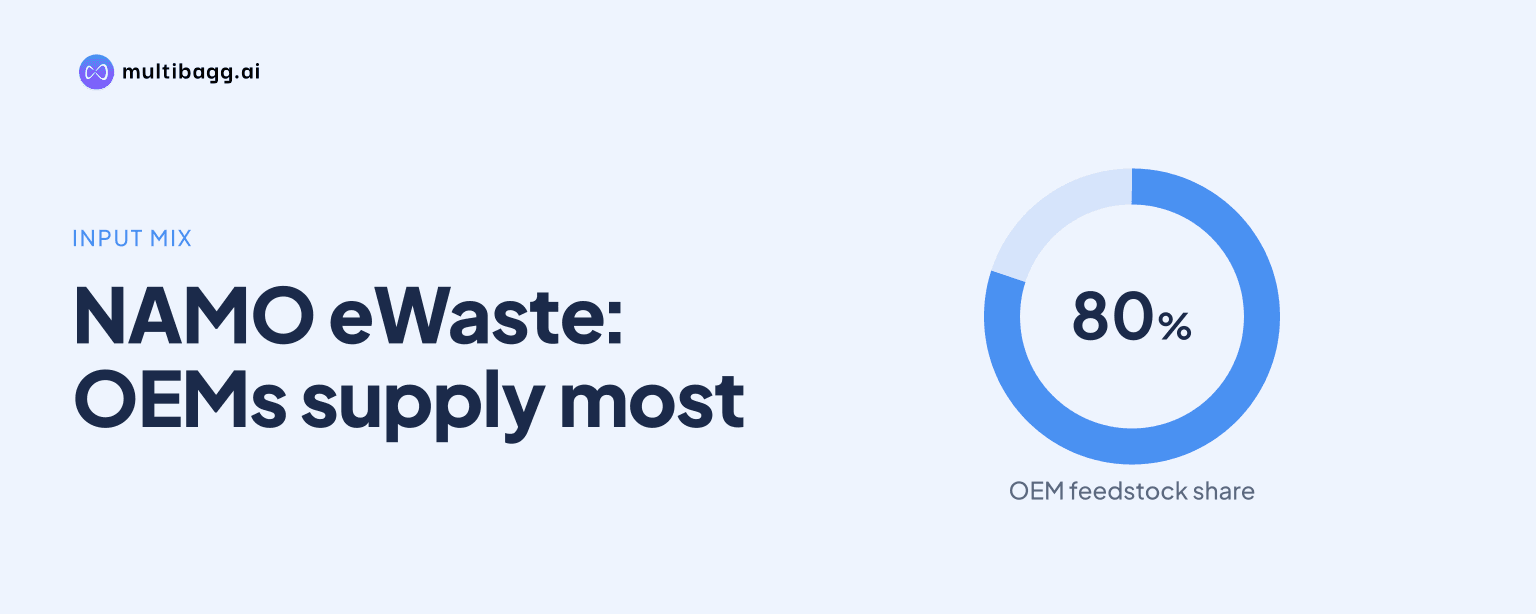
NAMO eWaste says about 80% of its e-waste feedstock is sourced directly from original equipment manufacturers (OEMs), supported by 50–70 active OEM relationships and contracts lasting one to five years. In its H1FY27 presentation, NAMO eWaste says this sourcing structure, alongside more than 26 collection centers, provides recurring and traceable material flows.
Know Namo eWaste Management inside out
Results, valuation, peers and who's buying, in one view.
How does NAMO eWaste secure e-waste feedstock?
NAMO eWaste secures about 80% of e-waste feedstock directly from OEMs, according to its H1FY27 presentation. The company says direct sourcing is intended to ensure material quality and traceability, while its pan-India collection network supports access to discarded electronic items before they reach recycling facilities.
NAMO eWaste reports 50–70 active OEM relationships but does not provide an exact counterparty count, volumes supplied by each OEM, or feedstock tonnage from the direct channel. The company says recurring and traceable material flows support planning and higher utilisation, although the presentation gives no utilisation rate or comparison of direct OEM feedstock with other sourcing channels.
NAMO eWaste's collection process covers scheduled pickup, onsite data destruction, secure transportation with global positioning system tracking, dismantling, shredding and segregation. This sequence links sourcing to handling and processing, rather than treating collection as separate from the recycling operation.
Why do NAMO eWaste OEM contracts run for up to five years?
NAMO eWaste says its OEM contracts run for one to five years and provide stability in feedstock volumes. The disclosed range means individual arrangements can vary from one-year contracts to five-year contracts, but the presentation does not state minimum volume commitments, pricing terms, renewal rates or the share of direct material under each tenure.
NAMO eWaste says OEMs select recyclers through tenders, auctions, requests for offers or service-based selection. It identifies compliance, reliability, service quality and environmental standards as selection criteria, indicating that the 50–70 active relationships depend on operating and service capabilities as well as recycling capacity.
The company describes procurement as its “moat” and says long-tenure contracts provide higher feedstock visibility. That is a management characterisation of the supply-chain model; the H1FY27 presentation does not quantify a financial outcome, such as revenue, margin or utilisation, attributable to contracts of one to five years.
Got a follow-up? Ask IRIS
How do NAMO eWaste collection centers and plants support sourcing?
NAMO eWaste says more than 26 collection centers support pan-India collection and segregation, while facilities in Palwal, Nashik and Hyderabad provide multi-location processing. The company lists lower logistics costs, better sourcing and regional extended producer responsibility, or EPR, as advantages of its decentralised e-waste facilities.
The Palwal facility has disclosed capacity of 32,000 metric tonnes per annum, compared with 9,300 metric tonnes per annum at Nashik and 25,000 metric tonnes per annum at Hyderabad. Palwal's capacity is 22,700 metric tonnes per annum above Nashik's, while Hyderabad commenced partial commercial operations in late Q2FY27.
NAMO eWaste discloses 1,72,330 square feet at Palwal, 87,187 square feet at Nashik and 2.5 acres at Hyderabad. It also says the old Faridabad facility will shift to Palwal, and management says higher utilisation and double-shift operations offer capacity headroom, without providing a timetable for shifts or current plant utilisation.
What customer relationships and battery plans does NAMO eWaste disclose?
NAMO eWaste says it partners with more than 300 global and Indian brands across multiple industries, compared with its more specific disclosure of 50–70 active OEM relationships. Its presentation lists brands including Havells, Philips, Schneider Electric, Adobe, BMW, Samsung, Flipkart, GE Healthcare, Fortis, Maruti Suzuki and Amazon, but does not identify which listed brands are active OEM feedstock suppliers.
The distinction between the two figures is material: the 300-plus count refers to global and Indian brands and long-term partnerships, while 50–70 refers specifically to active OEM relationships. NAMO eWaste does not disclose the overlap between these groups, the contract status of each named brand or the services provided to each customer.
NAMO eWaste is establishing a one-tonne-per-day pilot hydrometallurgy plant at Nashik to further refine battery black mass and recover lithium, nickel, cobalt and manganese. The Nashik battery recycling and refurbishment unit has capacity of 32,000 metric tonnes per annum across 22,000 square feet, and the company says the pilot plant is planned to be operational by Q4 FY27.
Conclusion
NAMO eWaste's disclosed feedstock strategy relies on direct procurement from OEMs, which the company says accounts for about 80% of e-waste supply. The 50–70 active OEM relationships, contracts spanning one to five years and more than 26 collection centers are presented as mechanisms for traceable material flows before processing at Palwal, Nashik and Hyderabad.
The next disclosed points to watch are the planned Q4 FY27 operation of the Nashik one-tonne-per-day hydrometallurgy pilot plant and the proposed shift of the old Faridabad facility to Palwal. NAMO eWaste has not disclosed timing for that relocation, current utilisation at its e-waste plants, or contract renewal and volume details for its OEM relationships.